Home › Garden pests › Slugs and snails
Garden pests
Slugs and snails
Cornu aspersum (brown garden snail) and many other species · Mollusc
Also called brown garden snail (USA).
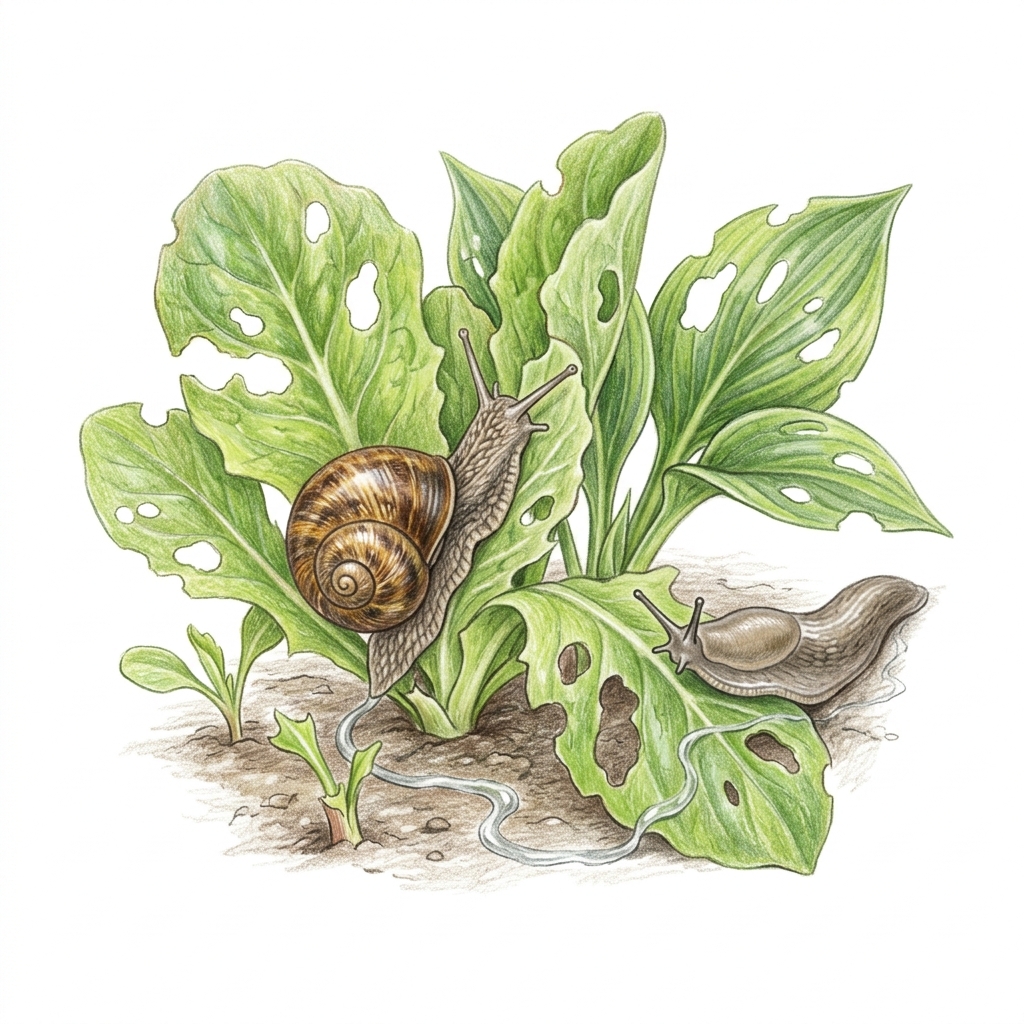
Illustration
Slugs and snails chew ragged holes in leaves, flowers and seedlings at night and leave shiny slime trails. Pick them off by torchlight, trap them, water in the morning, and welcome the birds, frogs and beetles that eat them.
How to spot it
- Irregular, ragged holes in leaves and flowers, and seedlings eaten down overnight.
- Shiny slime trails on and around the plants.
- The slugs and snails themselves after dark or on damp, cloudy days; by day they hide under boards, stones and dense plants.
- Holes tunnelled into potatoes and other tubers by slugs that live mostly underground.
Easily confused with
Earwigs
Similar ragged holes, but no slime trails.
Caterpillars, such as cabbage whites
They leave droppings (frass) and sometimes webbing, not slime.
Cutworms
Seedlings severed at soil level, with a grey-brown caterpillar curled in a C in the soil beneath.
Where it's a problem
- Worldwide: Garden pests in many countries, most active on mild, damp nights. Most kinds are harmless: in the UK, only a few of over 44 slug and 90 snail species eat live plants.
- United Kingdom: Outdoor use of metaldehyde slug pellets has been banned in Great Britain since 31 March 2022, to protect birds and mammals. The RHS says pellets of any kind, even organic ones, harm garden wildlife.
- Australia: The giant African snail isn't in Australia. Its shell is usually 5–10 cm long and can reach 30 cm. If you think you've found one, don't handle it bare-handed, and report it to the Exotic Plant Pest Hotline on 1800 084 881 (in Queensland, also Biosecurity Queensland on 13 25 23).
What to do
- Go out with a torch on mild, damp evenings and pick them off by hand.
- Set traps, such as boards raised slightly off the ground or beer traps, and empty them every day or two.
- Water in the morning rather than the evening, so the ground is drier at night.
- Grow plants they tend to leave alone, such as those with thick or waxy leaves (geraniums, sedums, fuchsias).
- Encourage birds, frogs, hedgehogs and ground beetles. For slugs (not snails), a biological control nematode watered into the soil affects only molluscs.
- Barriers are disputed: UC IPM finds copper bands work, but an RHS garden trial found copper tape, bark mulch, eggshells, grit and wool pellets made no difference.
If you use slug pellets or bait, choose one labelled for slugs and snails and follow the label and local rules. Sources warn that pellets, even organic ones, harm garden wildlife, and some baits are poisonous to dogs and cats.
Take care: Slugs and snails can carry rat lungworm, an extremely rare cause of meningitis. Never eat them raw, wash your hands after gardening or handling them, wash lettuce and other leafy vegetables well, and supervise small children where snails are about.
Free account, no card needed. You sign up or sign in first, then the scanner opens.
Sources
- RHS: Slugs and snails
- University of California IPM: Snails and slugs
- GOV.UK (Defra): Outdoor use of metaldehyde to be banned to protect wildlife
- Business Queensland: Giant African snail
- NSW Health: Rat lung worm disease fact sheet
- University of California IPM: Earwigs
- RHS: Cutworms
Facts checked Sunday 27 September 2026. General guidance only: follow your local council, agency and product label.