Home › Vegetables › Sweet corn
Vegetables
Growing sweet corn
Zea mays. A tall warm-season crop grown for its sweet cobs, sown where it grows or raised in deep pots. The wind pollinates it, so it is grown in a block rather than a single row. It wants sun, warmth and steady water, and frost kills it. These steps work anywhere: they go by soil and weather, not by month. Also called corn (US and Canada), sweetcorn (UK and Ireland), maize (the crop as a whole, though it usually means field corn grown for grain).
How sweet corn grows
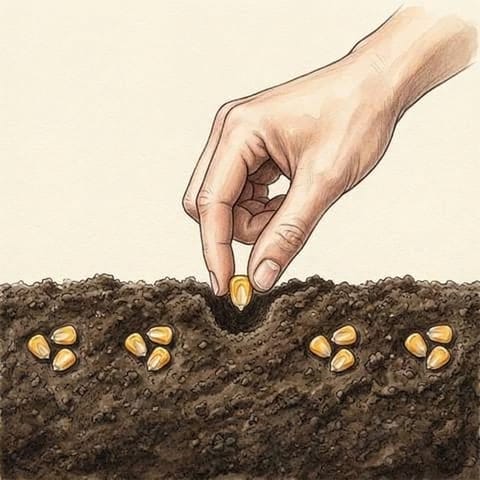 SowTwo or three seeds a spot, in a blockUp in 1–2 weeks
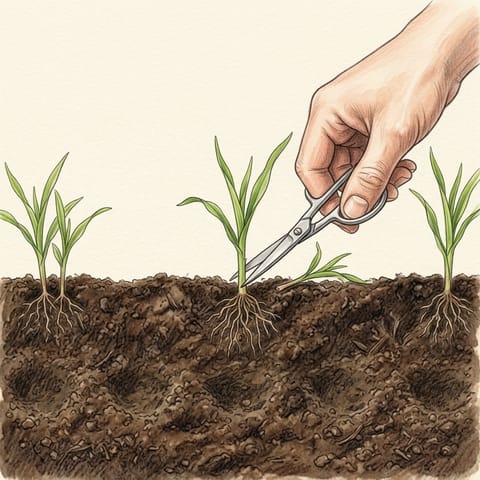 ThinKeep the strongest in each spotAbout 2 weeks
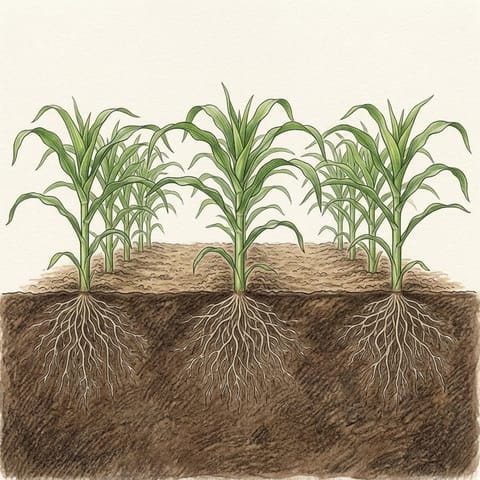 GrowFast, leafy growth to knee height3–5 weeks
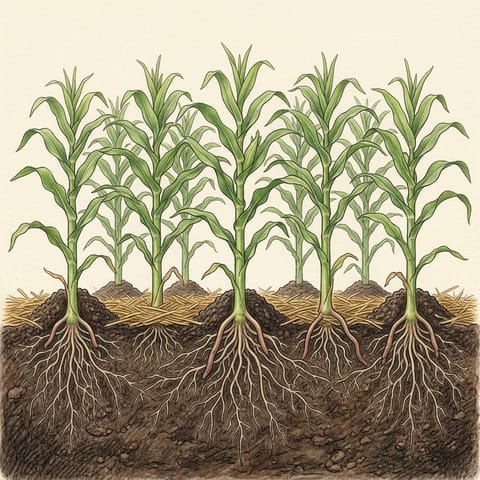 Earth upSoil drawn up, mulch goes downAbout 6 weeks
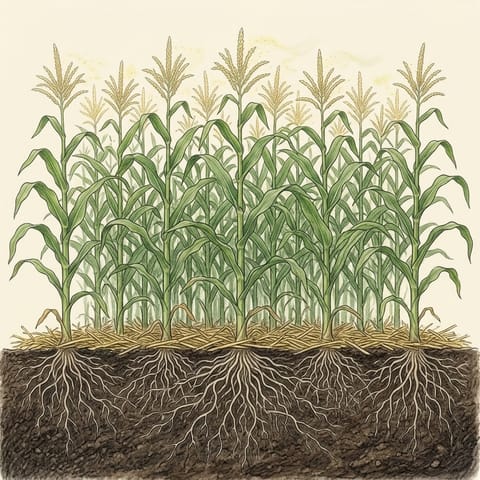 TasselsPollen tassels open at the top7–10 weeks
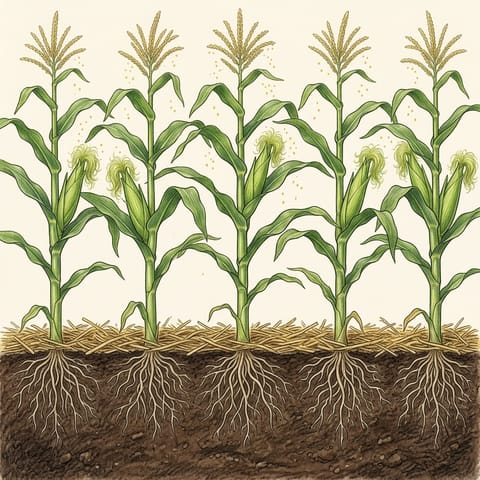 SilksSilks catch pollen on the windA few days later
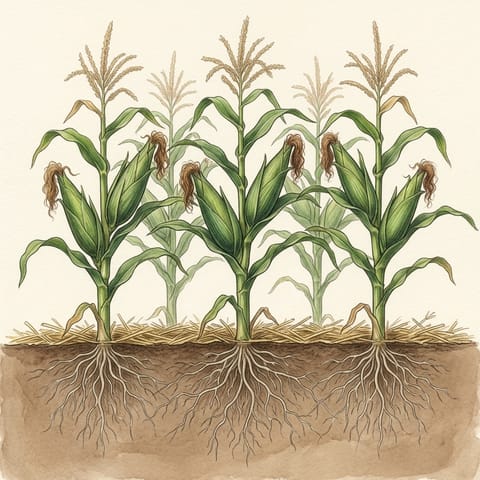 Cobs fillSilks turn brown, kernels swell1–3 weeks after the silks
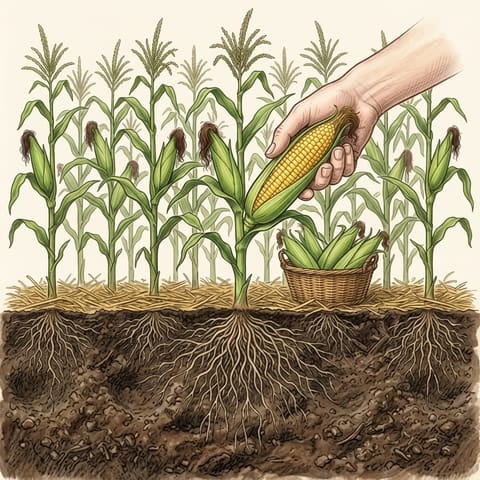 PickMilky juice, then twist offAbout 3 weeks after the silks
Times run from sowing in the bed and vary with the variety and the weather: early kinds are quicker, and hot weather speeds the cobs up. Seedlings raised in pots go out at about three weeks old.
Growing it, step by step
Is it right for you?
- Sweet corn needs a warm, frost-free spell of about three months, a little less for early kinds, with days around 21–30°C (70–86°F).
- Frost kills it, and cold, wet soil rots the seed. Hot, dry, windy weather over about 35°C (95°F) while the silks are out spoils pollination and leaves gaps in the cobs.
- It needs room for a block, not a single row. The wind carries pollen from the tassels at the top of each plant to the silks on the cobs below. In a block of at least four short rows, every plant has neighbours on all sides, so pollen reaches the silks whichever way the wind blows. A single long row gives cobs with gaps.
- Plants grow up to about 2 m (6½ ft) tall and give one or two cobs each. Put the block where its shade won't fall on shorter crops.
When to plant
Sow where it is to grow once the soil is at least 13°C (55°F), or 16–18°C (60–65°F) for supersweet kinds, and the last frost has passed. For an earlier start, sow in deep pots indoors, kept warm at 18–21°C (65–70°F), and plant out after the last frost. For cobs over a longer time, sow a new block every two to three weeks.
Short, cool summers: raise seedlings in deep pots indoors, warm the soil under a cover and plant out quick, early kinds after the last frost. Mild climates: sow from late spring, a new block every few weeks while there is time for the cobs to ripen before it cools. Hot or subtropical places: sow from early spring through summer, timed so the plants don't flower in hot, dry, windy spells. Tropics: the drier months: heavy rain while the silks are out gives poorly filled cobs.Prepare the bed
- A warm, sunny spot sheltered from strong wind. Dig in plenty of compost or well-rotted manure before sowing: corn is a hungry crop.
- Slightly acid soil suits it best, pH 6.0–6.5, but most well-drained garden soils grow it well. See soil pH.
- In cool places, warm the soil first under a cloche or cover for a week or two before sowing.
Sow and plant
- Sow 2.5 cm (1 in) deep, two or three seeds to a spot. Space the spots 30 cm (12 in) apart, in rows 75 cm (30 in) apart, and make at least four short rows side by side so the plants stand in a block.
- Or sow one seed 2.5 cm (1 in) deep in each deep pot or module, and keep it warm. Harden seedlings off for a week, then plant them out at about three weeks old, when they are 8–15 cm (3–6 in) tall, at the same depth as in the pot and in a block.
- Use fresh seed: corn seed keeps only a year or two.
- Keep supersweet kinds well away from other sweet corn, popcorn and maize, or time the sowings so they flower at different times. If they cross, the kernels turn starchy.
Get it started
- Water well after sowing, then only when the surface dries until the shoots are up. Seed rots in cold, wet soil, supersweet kinds most of all.
- Water seedlings you plant out every day for the first week, until they settle.
- When the seedlings are about 15 cm (6 in) tall, keep the strongest in each spot and snip the others off at soil level.
- Protect seedlings from birds, mice, slugs and snails, and cover them with fleece if a cold night is forecast.
Keep it growing
- Weed: hoe shallowly while the plants are small, taking care of the roots near the surface. Once the plants are tall they shade most weeds out.
- Earth up: about six weeks after sowing (three weeks after planting out), draw soil up around the base of each stem. Extra roots grow into it and steady the plants in wind. In windy spots, also run string around the outside of the block.
- Mulch: once the stems are earthed up and the soil is warm, a thick layer of straw about 5 cm (2 in) deep holds moisture and keeps weeds down.
- Water: a deep soak at the base about twice a week in dry weather, wetting the soil about 15 cm (6 in) down. Never let it dry out from when the tassels appear until the cobs are full: dry soil then gives small, poorly filled cobs.
- Feed: compost-rich soil is often enough. On poor or sandy soil, scatter a nitrogen-rich fertiliser beside the plants at knee height and again when the tassels appear, and water it in. Too much makes soft, tall stalks that blow over.
- Side shoots: leave the shoots that grow from the base of the stem. Removing them doesn't help and can lower the crop.
- Pollination: each silk that catches pollen becomes one kernel. Once the tassels open, tap the stems in the morning to shake pollen down onto the silks.
Watch for problems
The common ones, with a Garden help page each where there is one:
Corn earwormFall armywormEuropean corn borerAphidsCutwormsWirewormsJapanese beetleSlugs and snailsBirdsCorn smutRustDamping-offPoorly filled cobsHarvest
- Cobs are usually ready about three weeks after the silks appear, when the silks have turned brown and dry and the cob feels full and firm.
- To check, peel back a little of the husk and press a kernel with your thumbnail. Milky juice: ready. Clear and watery: give it a few more days. Thick and pasty: past its best.
- Hold the stalk and twist the cob downward to snap it off. Pick in the cool of the morning.
- In hot weather a cob stays at its best for only a day or two, so check the block often.
After harvest
- Eat or chill the cobs straight away: once picked, their sugar turns to starch, fastest in warmth. Keep them in their husks in the fridge and use them within a few days. Supersweet kinds stay sweet for about a week.
- Pull out or cut down the finished stalks and chop them up for the compost. Bin any with smut galls rather than composting them.
- Seed saved from hybrid kinds won't grow true, so buy fresh seed for the next crop.
- Next in that bed: peas, beans or leafy greens. Grow corn in a different bed next time.
Sources
- RHS: How to grow sweetcorn
- Iowa State University Extension: Growing sweet corn in the home garden
- Clemson Cooperative Extension: Sweet corn
- Utah State University Extension: How to grow sweet corn in your garden
- Gardening Australia: Sweet corn
Facts checked Wednesday 21 October 2026. General guidance only: local advice comes first.