Home › Garden pests › Earwigs
Garden pests
Earwigs
Forficula auricularia and related species · Insect
Also called common earwig (UK), European earwig (Australia and North America).
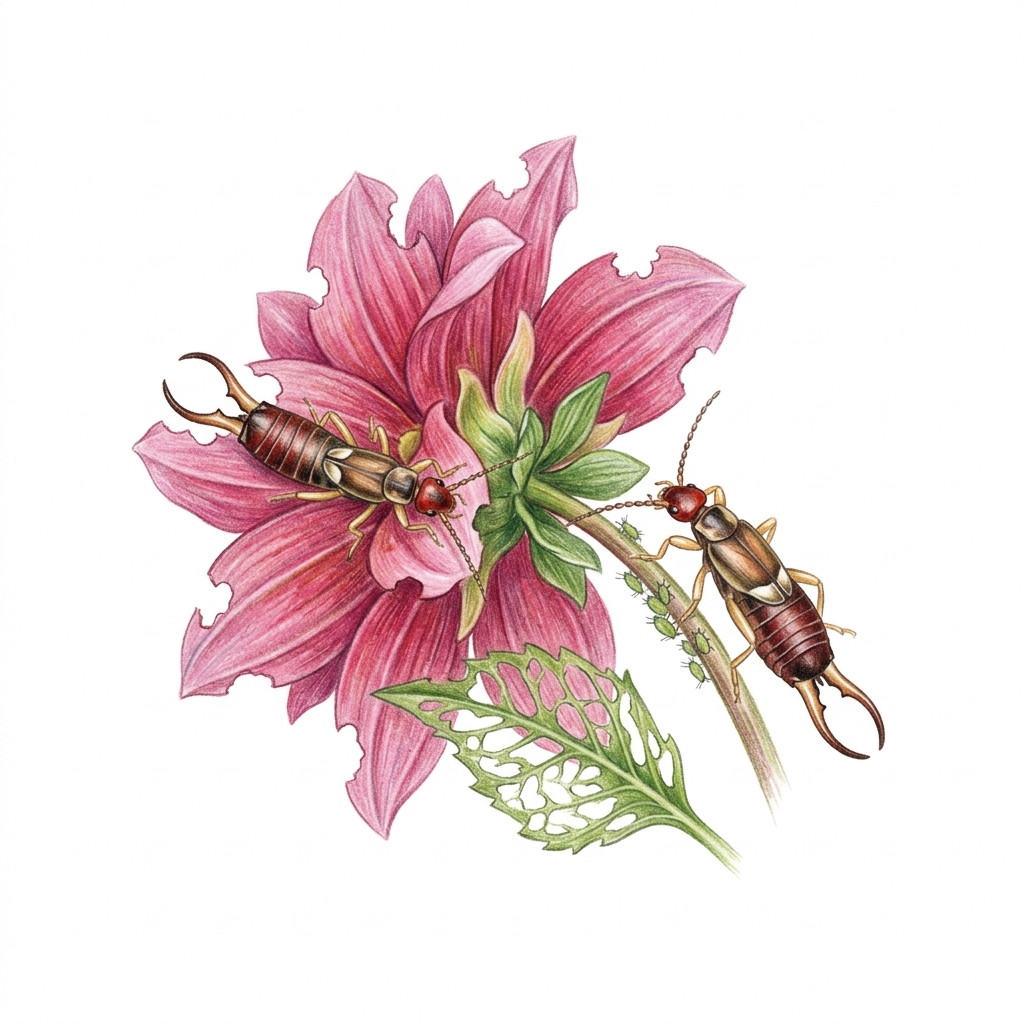
Illustration
Brown insects with pincers on the tail that chew ragged holes in flowers, seedlings and soft fruit at night. They also eat aphids and insect eggs, so on fruit trees they're often more help than harm. Trap them where they're doing damage.
How to spot it
- A slim, shiny brown insect about 13–16 mm long with pincers at the tail: curved in males, straight in females.
- Ragged holes in petals and young leaves; older leaves are sometimes left as a tattered net of veins.
- Seedlings chewed down, shallow gouges in soft fruit such as strawberries and apricots, and chewed sweet corn silks.
- Nothing to see by day: go out with a torch after dark to catch them feeding.
- By day, earwigs packed into dark, damp places: under boards and clods of soil, in dense growth, or inside fruit already damaged by other pests.
Easily confused with
Slugs and snails
Leave silvery slime trails on and around the damage.
Caterpillars
Leave webbing, droppings (frass) or pupae near the damage.
Where it's a problem
- Worldwide: The European earwig comes from Europe. It was carried to North America in the early 1900s and is now common in Australian gardens too.
- Australia: The introduced European earwig is a serious pest of gardens and vegetable crops and common around suburban homes. Australia also has about 85 described native earwigs; one, Labidura truncata, has been seen attacking codling moth larvae.
- United Kingdom: The RHS advises tolerating earwigs as part of the natural balance: they damage dahlias, chrysanthemums and clematis, but on fruit trees they control aphids without harming the fruit. US sources disagree on fruit, saying earwigs can seriously damage ripening soft fruit.
What to do
- Check with a torch after dark to be sure earwigs are the cause.
- Trap them: upturned pots loosely stuffed with straw on canes, rolled-up newspaper or cardboard, or a low tin with a little oil in the bottom, set near the plants at dusk.
- Empty the traps every morning into a bucket of soapy water, and keep going until you stop catching them.
- Remove daytime hiding places near vulnerable plants, such as boards, loose clods and dense ground cover.
- Put a sticky barrier band around tree trunks to stop them climbing up.
- Leave them be on fruit trees and around aphid-prone plants, where they eat aphids and insect eggs.
If you use an insecticide, choose one labelled for earwigs and follow the label and local rules. Sources say earwig baits often aren't very effective, and that with trapping and fewer hiding places, insecticides shouldn't be needed.
Free account, no card needed. You sign up or sign in first, then the scanner opens.
Sources
- RHS: Earwigs
- University of California IPM: Earwigs
- Penn State Extension: European earwigs
- Utah State University Extension: European earwig
- Australian Museum: Earwigs
Facts checked Sunday 27 September 2026. General guidance only: follow your local council, agency and product label.