Home › Vegetables › Swedes
Vegetables
Growing swedes
Brassica napus (Napobrassica Group). A slow, cool-season root crop of the cabbage family, grown for its big yellow-fleshed root. It is sown where it is to grow so the roots swell in cool weather: light frost sweetens them, and heat makes them small and bitter. It wants fertile soil, steady water and netting against pests. These steps work anywhere: they go by soil and weather, not by month. Also called rutabaga (US and Canada), neeps (Scotland), turnip (Scotland, Ireland, parts of England and Canada), yellow turnip or Swedish turnip (US).
How a swede grows
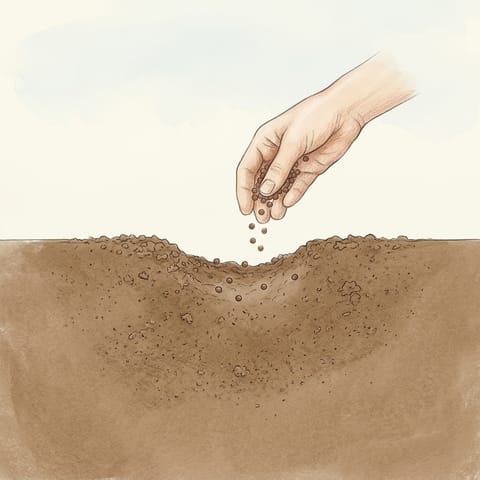 SowSeeds thinly in a shallow drillDay 0
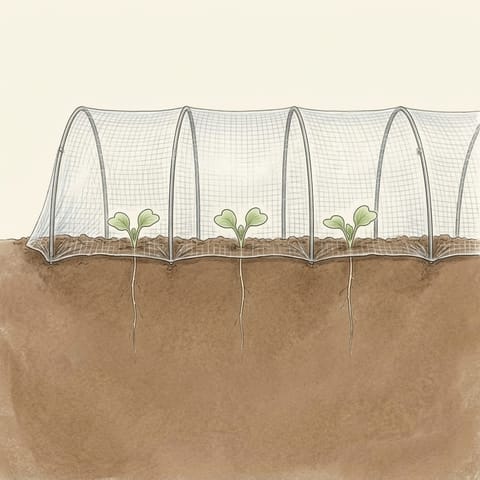 NetSeedlings up under fine meshUp in 1–2 weeks
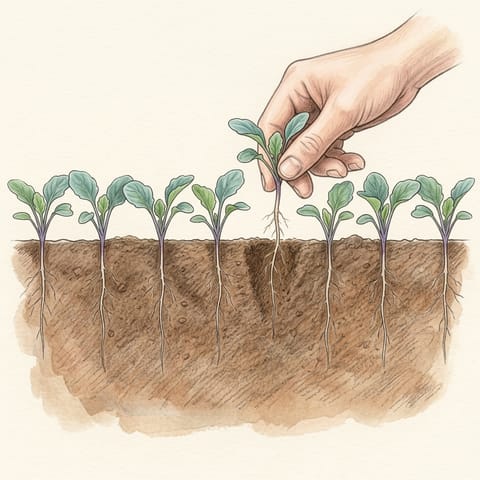 ThinThinned to 10 cm (4 in) apartAbout 4 weeks
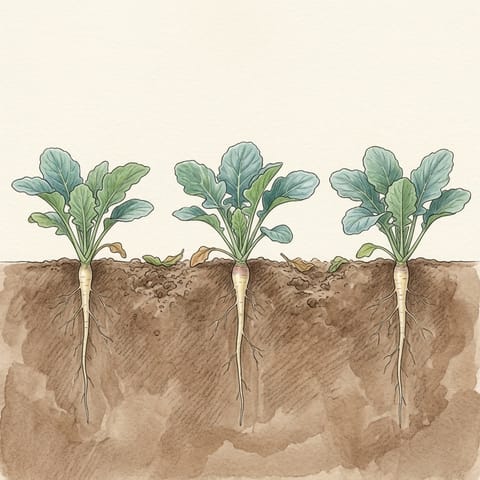 Thin againFinal spacing, 20–25 cm (8–10 in)About 7 weeks
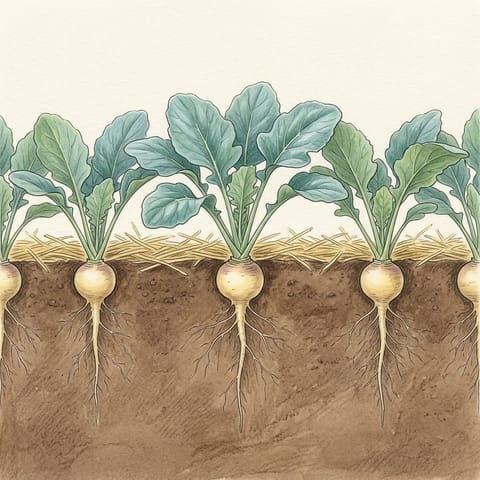 MulchStraw spread between the plantsAbout 8 weeks
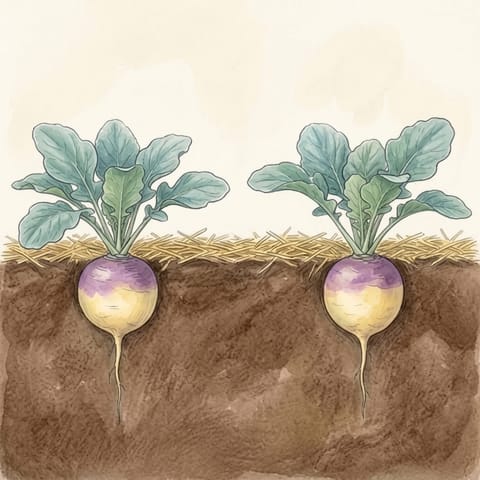 SwellRoots fatten, purple at the top10–14 weeks
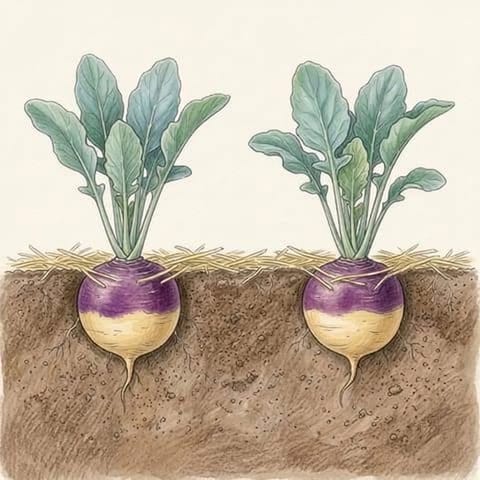 ReadyRoots 10–15 cm (4–6 in) across14–20 weeks
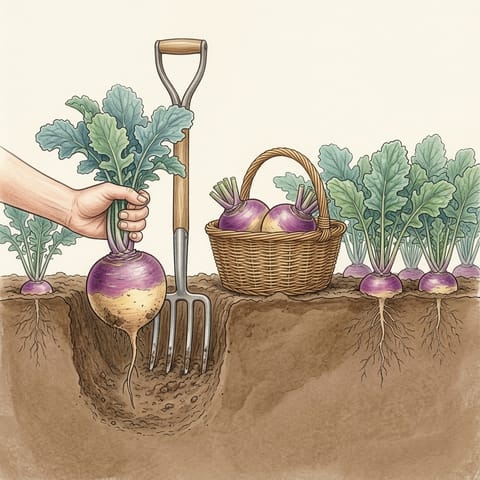 LiftLoosen with a fork, lift as neededOver 2 months or more
Times run from sowing and vary with the variety and the weather. Swedes are slow: where summers are cool, some take up to six months.
Growing it, step by step
Is it right for you?
- Swedes like cool weather, with days around 10–18°C (50–65°F), and the roots grow best below about 24°C (75°F). Hot weather gives small, bitter roots.
- They are hardy. Light frost sweetens the roots, and where the ground doesn't freeze hard they can stay in the soil into winter.
- They are slow, three months or more from sowing, so they hold a bed for a long time. Each plant needs 20–25 cm (8–10 in) of row. Baby swedes grow in a pot at least 40 cm (16 in) across.
When to plant
Sow once the soil is at least 7°C (45°F), and time it so the roots swell in cool weather, not the hottest weeks. Where autumns bring frost, that means sowing about three months before the first hard frost. In cold soil the seedlings take two weeks or more to come up; in warm soil, about a week.
Cold winters: sow from late spring to early summer, for roots in autumn and early winter. Mild climates: sow from late spring to midsummer, and lift from autumn through winter. Hot or subtropical places: sow in late summer and autumn, so the roots form in the cool months. Tropics: hard to grow well; try the cool, dry season in the highlands.Prepare the bed
- An open, sunny spot with fertile soil that drains well but holds moisture. Dig in compost or well-rotted manure well before sowing, and remove stones. On heavy clay, dig in extra compost or use a raised bed.
- Firm the soil after digging, then rake the surface fine.
- Slightly acid to neutral soil suits it, about pH 6.2–6.8. Club root is worse in acid soil: if yours is below 6, lime it a few months before sowing. See soil pH.
- Swedes need a little boron. Without enough, the roots look fine outside but the flesh inside turns brown or rots. Real shortages are rare, but roots take it up poorly in alkaline soil, above pH 7, so don't lime soil that is already neutral or alkaline. A soil test shows whether it is lacking; follow local advice before adding any.
- Avoid beds that grew any of the cabbage family in the last four years: swedes, turnips, cabbage, broccoli, cauliflower, kale, Brussels sprouts or radishes. They share club root and other soil-borne problems.
Sow and plant
- Sow straight into the bed, thinly, 1–2 cm (½–¾ in) deep, in rows 40 cm (16 in) apart.
- Cover with fine soil, firm it gently and water along the row.
- Or, for a head start, sow two seeds to each module and pull out the weaker seedling. Harden them off for a week, then plant them out young, at the same depth and 20–25 cm (8–10 in) apart, without disturbing the roots.
Get it started
- Keep the surface moist every day for the first two weeks after sowing, until the seedlings are up and growing. A dry crust on the surface holds them back. Water new transplants every day for their first ten days or so.
- On the day you sow or plant, cover the row with fine insect mesh on hoops, tucked in at the edges. It keeps flea beetles off the seedlings, cabbage white caterpillars off the leaves and, in cool climates, cabbage root fly maggots out of the roots. Keep it on all season; lift it only to thin and weed.
- Guard seedlings against slugs and snails, and weed carefully by hand while they are small. Swedes can't compete with weeds, and hoeing close to the plants damages the roots.
Keep it growing
- Thin: when the seedlings have three or four true leaves, about four weeks after sowing, thin them to 10 cm (4 in) apart. About three weeks later, thin again to a final 20–25 cm (8–10 in). Crowded swedes make big tops and thin roots.
- Water: keep the soil evenly moist. In dry weather, a deep soak once or twice a week, more often on sandy soil; in cool or showery weather they need much less. Dry soil makes the roots bitter and woody, and a big soak after a dry spell splits them. Steady water matters most as the roots near full size.
- Mulch: after the final thinning, about eight weeks after sowing, spread straw about 5 cm (2 in) deep between the plants. It keeps the soil cool and evenly moist, so the roots swell without splitting, and smothers weeds.
- Feed: good soil needs none. Too much nitrogen grows big leafy tops and spoils the roots. Only if growth is pale and slow, give one light nitrogen-rich feed about six weeks after the seedlings come up.
- Check: every week, look under the leaves for caterpillars and yellow eggs, even under the net, and for the tiny round holes flea beetles leave.
Watch for problems
The common ones, with a Garden help page each where there is one:
Flea beetlesCabbage root flyCabbage white caterpillarsAphidsSlugs and snailsBirdsWirewormsRoot-knot nematodesClub rootPowdery mildewWhite blisterBrown heartSplit rootsHarvest
- Most swedes are ready 14–20 weeks after sowing. Lift them once the roots are about 10 cm (4 in) across; 10–15 cm (4–6 in) is best. Baby swedes can be pulled earlier, at about 5 cm (2 in).
- The flavour is best after a few light frosts, which sweeten the roots.
- Loosen the soil beside the row with a fork, then lift them by the leaves as you need them, over two months or more.
- Where the soil doesn't freeze hard or stay wet, leave them in the ground into winter. Before hard frosts, cover the row with straw or fleece.
- The young leaves can be cooked as greens. Take only a few from each plant, or the root suffers.
After harvest
- Cut the leaves off about 2.5 cm (1 in) above the root and brush off the soil.
- Keep them cold and moist, close to 0°C (32°F): in a bag in the fridge for a few weeks, or packed in damp sand in a cool, frost-free shed for two to four months.
- Where winters are cold or the soil stays wet, lift the last of them before the ground freezes and store them the same way.
- Dig out the old roots and leaves once you finish: left in, they carry cabbage-family diseases on. Bin any with knobbly, distorted lumps on the roots rather than composting them: that is club root.
- Next in that bed: anything outside the cabbage family, such as potatoes, onions, carrots, beans or peas. Keep swedes, turnips, cabbage, broccoli, cauliflower, kale, Brussels sprouts and radishes out for four years.
Sources
- RHS: How to grow swede
- Iowa State University Extension: Growing turnips and rutabagas in the home garden
- Utah State University Extension: How to grow rutabagas and turnips in your garden
- University of Georgia Extension: Growing rutabagas in the home garden
- RHS: Nutrient deficiencies (boron and swedes)
Facts checked Friday 23 October 2026. General guidance only: local advice comes first.