Home › Vegetables › Turnips
Vegetables
Growing turnips
Brassica rapa subsp. rapa. A quick, cool-season root crop of the cabbage family, grown for its round roots and its leafy tops. It wants cool weather, steady moisture and a net against pests, and heat or dry soil turns the roots woody and hot. These steps work anywhere: they go by soil and weather, not by month.
How a turnip grows
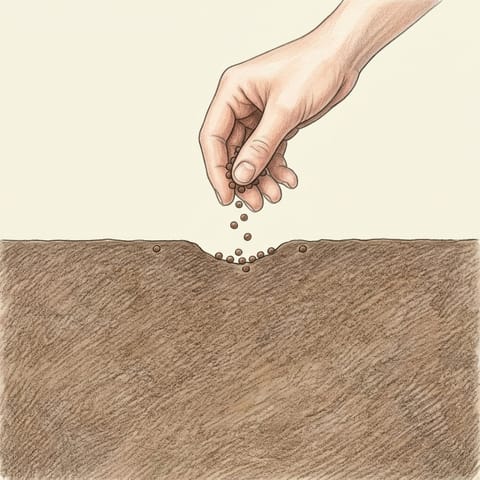 SowSmall seeds in a shallow drillDay 0
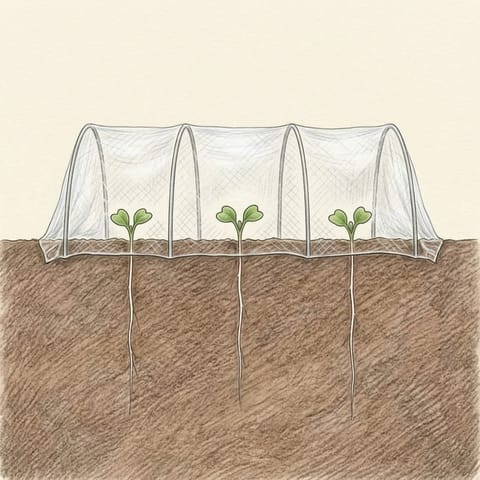 NetSeedlings up under fine meshUp in about a week
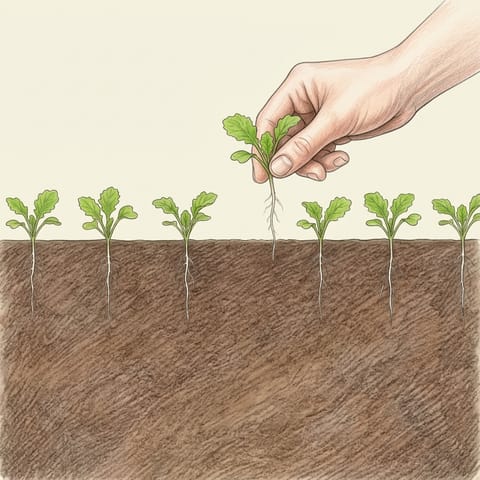 ThinSpares pulled, the rest spaced outAbout 3 weeks
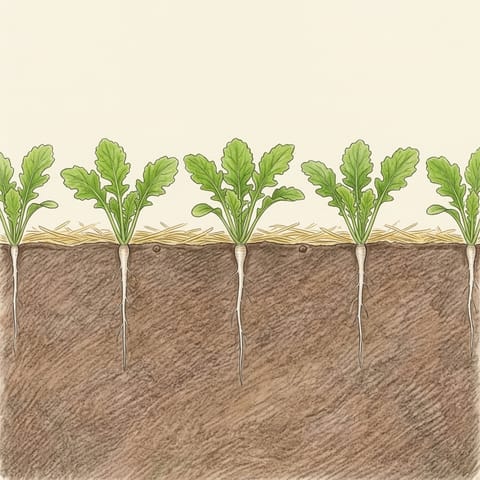 MulchStraw spread between the plantsAbout 4 weeks
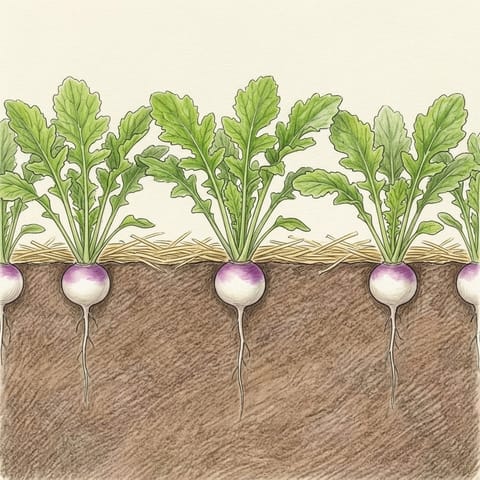 SwellThe root rounds out at the surface4–6 weeks
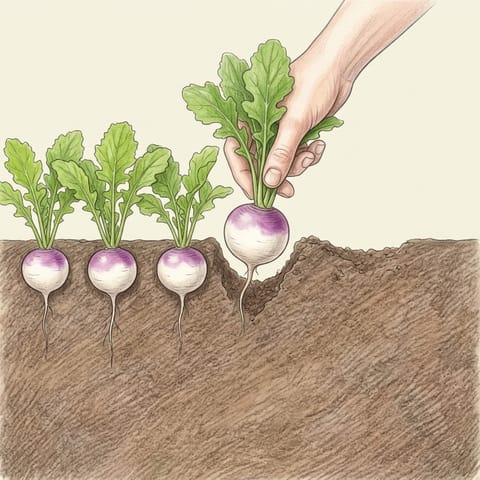 Baby turnipEvery second root pulled smallAbout 6 weeks
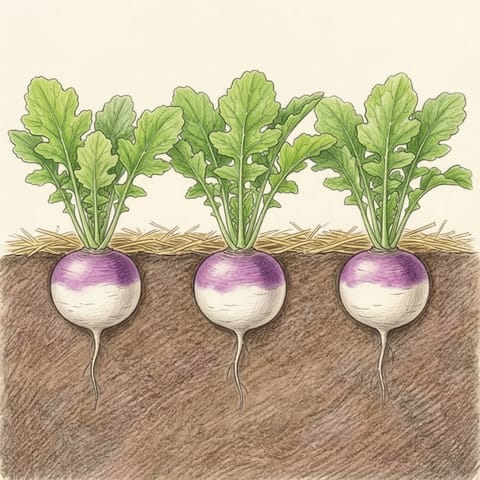 ReadyRound roots, 5–8 cm (2–3 in) across6–10 weeks
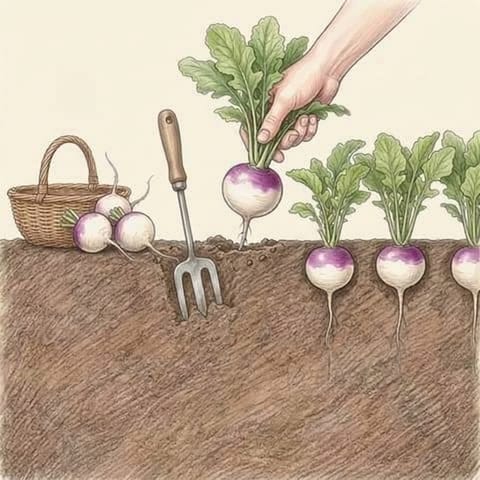 PullLoosen with a fork, lift by the topsOver 4–5 weeks
Times run from sowing and vary with the variety and the weather. Early kinds and baby turnips come first; main crops take the longest.
Growing it, step by step
Is it right for you?
- Turnips like cool weather and grow fast: early kinds are ready about six weeks after sowing, main crops about ten. Cool weather sweetens the roots; in hot weather they turn pithy and strong-tasting.
- They take light frost. Dry soil gives small, woody roots and can make them bolt: they send up a flower stalk instead of swelling a root.
- They take little room: 10–23 cm (4–9 in) a plant once thinned. They also grow well in pots at least 40 cm (16 in) across.
When to plant
Sow once the soil is at least 7°C (45°F). At 10°C (50°F) the seedlings are up in about five days, and faster in warmer soil. Turnips take light frost, so the first sowings can go in two to three weeks before the last frost. Sow a short row every three to four weeks while the weather is cool, so the roots grow before the hottest weeks: seed comes up poorly in hot, dry weather.
Cold winters: sow from early spring, and again in late summer for roots that take the autumn frosts. Mild climates: sow from late winter to late summer, a short row every few weeks, skipping the hottest weeks. Hot or subtropical places: sow from autumn to late winter, so the roots grow in the cooler months. Tropics: the cool, dry season or the highlands. Pick them small and young.Prepare the bed
- A sunny, open spot with fertile soil that drains well but holds moisture. Dig in compost, ideally the season before, then rake the surface fine and remove stones and clods.
- Hard soil holds the roots back. On heavy clay, dig in extra compost or use a raised bed.
- Slightly acid soil suits them, about pH 6.0–6.5. Club root is worse in acid soil: if yours is below 6, lime it a few months before sowing. See soil pH.
- Avoid beds that grew any of the cabbage family in the last four years: cabbage, broccoli, cauliflower, kale, Brussels sprouts, swedes or radishes. They share club root and other soil-borne problems.
Sow and plant
- Sow straight into the bed where they are to grow: turnips don't like being moved. Sow thinly, 1 cm (½ in) deep, in rows 30 cm (12 in) apart.
- Cover with fine soil, firm it gently and water along the row. If the soil is dry, water the drill before you sow.
- Or sow two seeds to each module and plant them out young, at the same depth, without disturbing the roots. Harden them off for a week first, and set them 15–23 cm (6–9 in) apart.
- For a steady supply, sow a short row every three to four weeks rather than all at once.
Get it started
- Keep the surface moist every day for the first ten days or so, until the seedlings are up. A dry crust on the surface holds them back.
- On sowing day, cover the row with fine insect mesh on hoops, tucked in at the edges. It keeps flea beetles off the seedlings, cabbage white caterpillars off the leaves and, in cool climates, cabbage root fly maggots out of the roots. Leave it on until you lift them; lift it only to thin and weed.
- Guard seedlings against slugs and snails. Weed by hand close to the plants: turnips can't compete with weeds, and hoeing close damages the roots.
Keep it growing
- Thin: at three or four true leaves, about three weeks after sowing: 10 cm (4 in) apart for baby turnips, 15 cm (6 in) for early kinds and 23 cm (9 in) for main crops. Crowded turnips make leaves, not roots. The thinnings are good in salads.
- Water: keep the soil evenly moist. In dry weather, a deep soak about twice a week, more often in hot weather or sandy soil. Dry soil gives small, woody roots and makes them bolt, a soaking after a dry spell splits them, and uneven watering makes them pithy and bitter.
- Mulch: after thinning, about four weeks after sowing, spread straw about 5 cm (2 in) deep between the plants. It keeps the soil cool and evenly moist.
- Feed: soil improved with compost the season before needs none. Too much nitrogen grows leaves at the expense of the roots. Only a main crop that looks pale needs one light nitrogen-rich feed, about six weeks after the seedlings come up.
Watch for problems
The common ones, with a Garden help page each where there is one:
Flea beetlesCabbage root flyCabbage white caterpillarsAphidsSlugs and snailsBirdsClub rootAlternaria leaf spotPowdery mildewWhite blisterDamping-offSplit rootsBoltingWoody rootsHarvest
- Pull them at golf-ball size, about 5 cm (2 in) across, to eat raw: early kinds reach it about six weeks after sowing. Pull every second plant first and leave the rest to grow on.
- For cooking, let them reach tennis-ball size, about 7–8 cm (3 in) across; main crops take about ten weeks. Don't leave them much bigger: large roots turn woody and bitter.
- Loosen the soil beside the row with a hand fork, then lift them by the leaves.
- The thinnings and young leaves are good to eat. For greens, sow a row thickly and cut the young leaves: they grow back. Leave the leaves on turnips grown for roots, or take only the odd one: cutting them holds the roots back.
After harvest
- Twist or cut off the leaves about 2.5 cm (1 in) above the root, and brush off the soil.
- Small turnips keep a week or two in a bag in the fridge. Main-crop roots keep much longer cold and damp, just above freezing, 0–2°C (32–35°F): packed in boxes of damp sand or coir somewhere cool and frost-free.
- Lift main crops before hard freezes. Where winters are mild, leave them in the ground under straw or fleece and lift them as you need them.
- Pull out the old roots once you finish. Bin any with knobbly swellings on the roots rather than composting them: that is club root.
- Next in that bed: anything outside the cabbage family, such as potatoes, onions, carrots, beans or peas. Keep turnips, cabbage, broccoli, cauliflower, kale, Brussels sprouts, swedes and radishes out for four years.
Sources
- RHS: How to grow turnips
- Utah State University Extension: How to grow rutabagas and turnips in your garden
- Clemson Cooperative Extension: Turnips and rutabagas
- Iowa State University Extension: Growing turnips and rutabagas in the home garden
- Oregon State University Extension: Soil temperature conditions for vegetable seed germination
Facts checked Friday 23 October 2026. General guidance only: local advice comes first.