Home › Garden pests › Birds
Garden pests
Birds
Many species, such as the woodpigeon (Columba palumbus) · Bird
Illustration
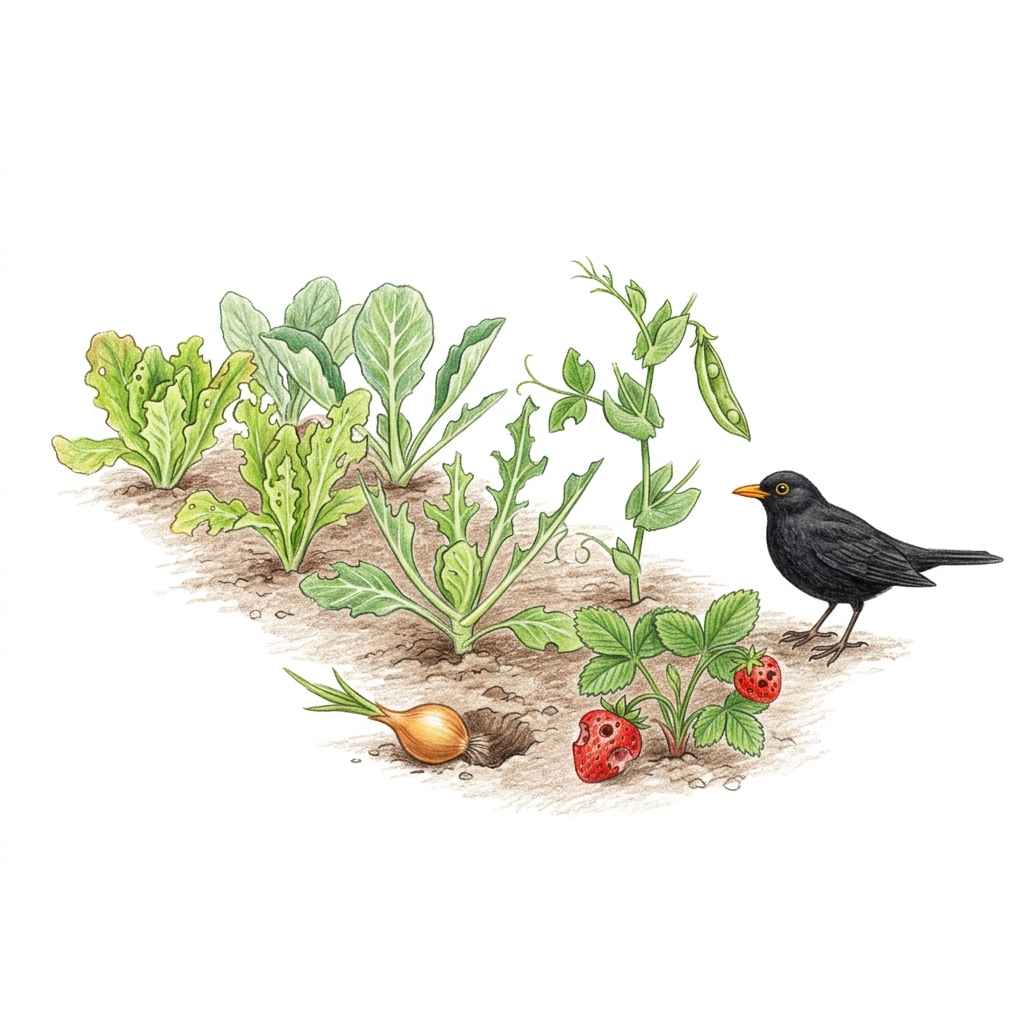
Pigeons, sparrows, finches and other birds peck seedlings, young leaves, peas and ripening fruit, and pull up newly planted onion sets. Birds are protected in many places, so protect the crop instead: cover it with taut, fine netting or fleece while it is most at risk.
How to spot it
- Seedlings, young lettuce, peas and brassicas pecked and torn, sometimes down to the stalks and larger veins.
- Newly planted onion sets pecked out of the ground.
- Ripening cherries, currants and other fruit pecked or eaten, and buds stripped from fruit bushes.
- Damage done early in the day, often without the birds being seen.
Easily confused with
Slugs and snails
Ragged holes made at night, with silvery slime trails; birds leave none.
Cutworms
Seedlings cut through at soil level overnight, with a grey-brown caterpillar curled up in the soil beneath.
Caterpillars
Holes chewed into the leaves, with small dark droppings and often the caterpillars themselves under the leaves.
Where it's a problem
- Worldwide: Wild birds are protected by law in many countries, so check your local wildlife rules before doing anything more than covering crops or scaring birds off.
- United Kingdom: All wild birds, their nests and eggs are protected by law. Woodpigeons are a common garden pest, above all on brassicas and peas; in winter, flocks of up to 50 can descend on allotments when snow or frost covers other food.
- United States: Most native birds are protected under federal law and can only be harmed with a permit from the US Fish and Wildlife Service. House finches, sparrows, robins, jays, crows and starlings are common fruit raiders.
- Australia: Native wildlife is protected by law: in Victoria, for example, under the Wildlife Act 1975. There, netting over household fruit trees and vegetable gardens must by law have holes no bigger than 5 mm x 5 mm (3/16 in) at full stretch: if you can poke a finger through, it's too big.
What to do
- Cover seedbeds, young seedlings and newly planted onion sets with fleece or taut netting until they are growing strongly (sets until they have rooted).
- Grow brassicas and peas under netting or in a fruit cage: it's the only sure protection.
- Net fruit before it ripens, over a frame of canes or wood so birds can't reach through, and take the net off after harvest: netting left lying about can trap wildlife.
- Use fine netting, keep it taut and fastened down, and check it every day for holes and trapped animals. If a bird or other animal is caught, don't try to free it yourself: call a wildlife rescue group.
- Scarers such as flashing tape and noisemakers help only for a while, as birds soon learn to ignore them. If you use them, change or move them at least once a week.
- Accept a little damage on established plants, which usually recover.
Never use poison, sticky products or traps on birds: most wild birds are protected by law, and harming them can be an offence. Protect the crop with covers instead, and ask your local wildlife agency if you need more help.
Vegetables it affects
Take care: Netting can trap flying foxes as well as birds, so never handle an animal caught in it. In Australia, if a flying fox bites or scratches you, see a doctor immediately: flying foxes can carry lyssavirus, which can be fatal.
Free account, no card needed. You sign up or sign in first, then the scanner opens.
Sources
- RHS: Pigeons
- RHS: How to grow lettuces
- RHS: How to grow onions
- University of California IPM: Birds on tree fruits and vines
- GOV.UK: Wild birds: protection, surveys and licences
- Agriculture Victoria: Use of fruit netting, harvest without harm
Facts checked Wednesday 21 October 2026. General guidance only: follow your local council, agency and product label.