Home › Plant diseases › Powdery mildew
Plant diseases
Powdery mildew
Podosphaera and related fungi · Fungus
Illustration
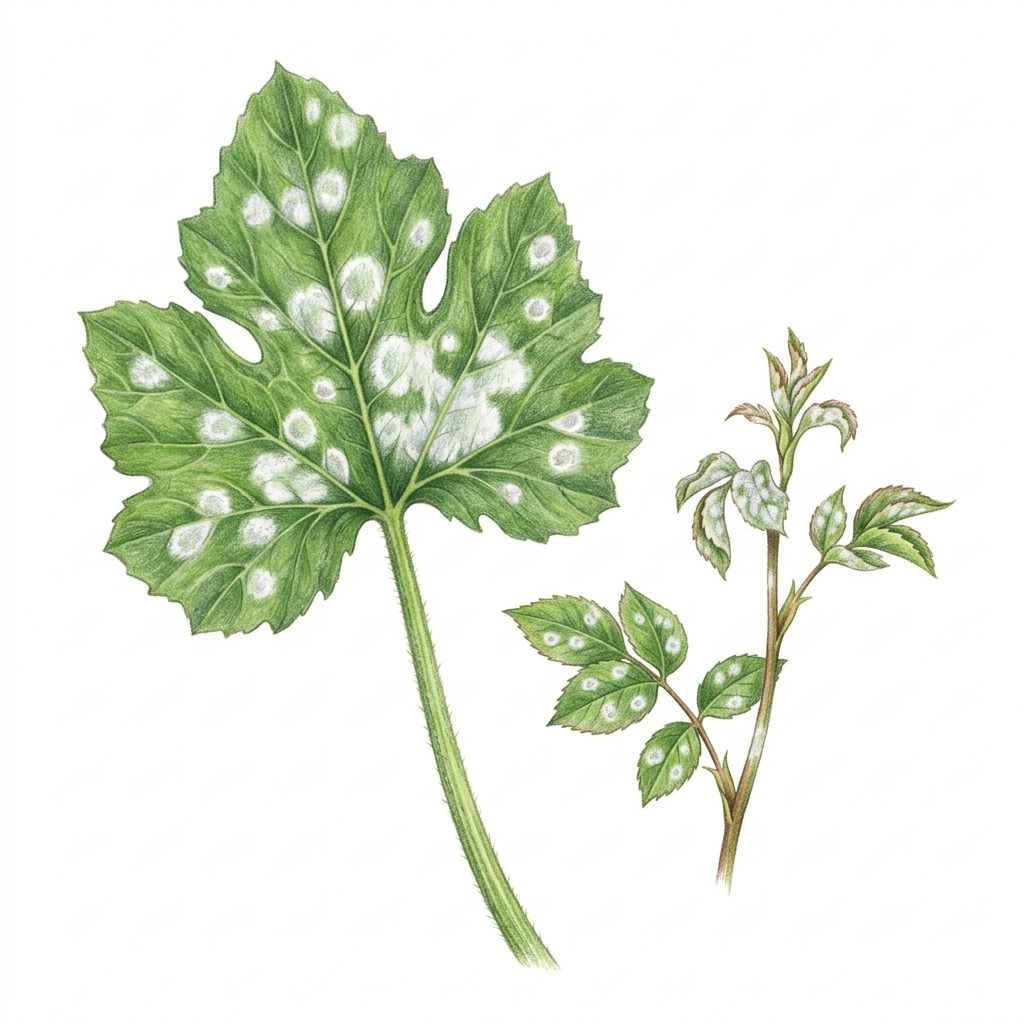
The white, flour-like dusting on the leaves of roses, courgettes and many other plants. Unlike most leaf diseases it doesn't need wet leaves, and it's worst on stressed, crowded plants in still, humid air.
How to spot it
- White, roughly round powdery spots that spread, on either side of the leaf, like a dusting of flour.
- Young leaves curling and distorting, sometimes with yellow or purple patches.
- On roses, a thick white coat around the thorns, and buds that fail to open.
- Later in the season, tiny dots that turn from white to brown to black.
Easily confused with
Downy mildew
Yellow patches held in by the veins on top, with grey or purple fuzz only underneath.
Natural silver markings on squash leaves
Smooth, with no powder that rubs off.
Grey mould
Fuzzy grey-brown growth on soft, rotting tissue.
Where it's a problem
- Worldwide: Wherever its host plants grow. It eases off in the hottest weather, as strong sun and heat above about 32 °C kill the spores. Not notifiable anywhere.
What to do
- Choose resistant varieties.
- Grow in full sun, space plants well and prune for airflow.
- Water the roots in dry spells and mulch: dry roots make plants more susceptible.
- Don't overfeed with nitrogen.
- Cut off infected shoots promptly, and clear fallen leaves in autumn.
If you use a fungicide, choose one labelled for powdery mildew and follow the label and local rules. Fungicides only protect, and the RHS recommends against them in gardens. Of home remedies, milk, vinegar and garlic aren't supported by the evidence, and baking soda with oil is still considered experimental.
Follow your local council's guidance for disposing of diseased plant material.
Free account, no card needed. You sign up or sign in first, then the scanner opens.
Sources
- RHS: Powdery mildews
- University of California IPM: Powdery mildew pest notes
- Colorado State University Extension: Powdery mildews
- Clemson University HGIC: Powdery mildew
- University of Wisconsin–Madison Extension: Powdery mildew home remedies
- University of Florida IFAS: Powdery vs downy mildew
- Business Queensland: Powdery mildew
Facts checked Sunday 27 September 2026. General guidance only: follow your local council, agency and product label.