Home › Garden pests › Whitefly
Garden pests
Whitefly
Trialeurodes vaporariorum, Bemisia tabaci and related species · Insect
Also called glasshouse whitefly (UK), greenhouse whitefly (Australia, USA), silverleaf whitefly (Australia), sweetpotato whitefly (USA).
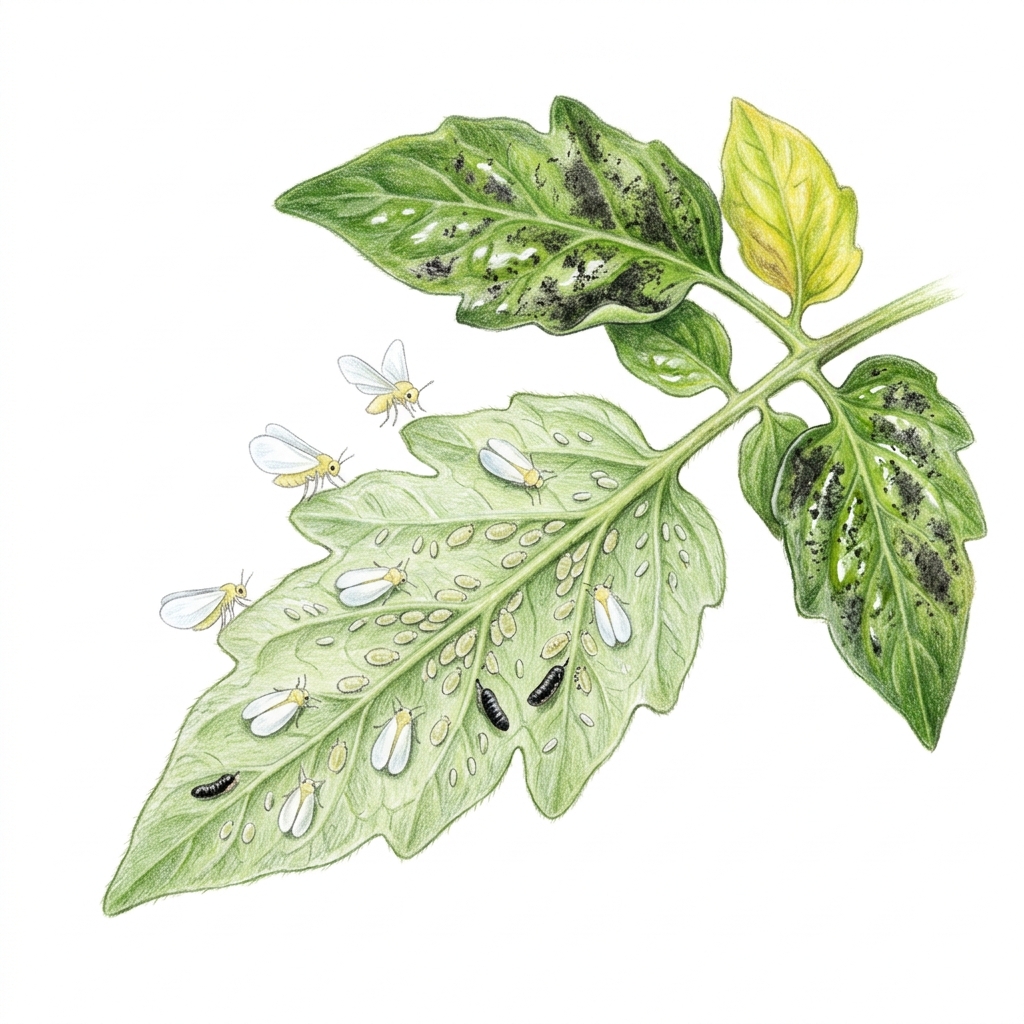
Illustration
Tiny white-winged insects that fly up in a cloud when you brush the plant, with flat, scale-like young under the leaves. They leave sticky honeydew and sooty mould. Sticky traps, hygiene and natural enemies keep them down.
How to spot it
- Tiny insects about 1.5 mm long with white wings, on leaf undersides, that fly up in a cloud when disturbed.
- Flat, oval, creamy scale-like young stuck to the undersides of leaves.
- Sticky honeydew and black sooty mould on leaves and fruit.
- Yellowing, silvering or drying leaves; pumpkin and zucchini leaves can turn silvery.
Easily confused with
Aphids
Aphids stay put when the plant is disturbed; whiteflies fly up.
Mealybugs
Fluffy white wax clusters in leaf joints; the females can't fly.
Scale insects
Shell-like bumps on stems and along leaf veins, with no white adults flying up.
Where it's a problem
- Worldwide: Greenhouse whitefly and silverleaf (sweetpotato) whitefly are widespread pests of vegetables and ornamentals, and some whiteflies spread plant viruses.
- Australia: Silverleaf whitefly, first recorded in 1994, feeds on more than 500 kinds of plant, is established in several states and spreads tomato leaf curl viruses. Capsicum whitefly has been found only on Boigu Island in the Torres Strait: if you think you've found it, report it to Biosecurity Queensland on 13 25 23 or the Exotic Plant Pest Hotline on 1800 084 881.
- United Kingdom: Glasshouse whitefly rarely survives winter outdoors, so it is mainly a greenhouse and houseplant pest. Cabbage whitefly lives outdoors on brassicas all year and can usually be tolerated.
What to do
- Check the undersides of leaves, and keep new plants apart until you're sure they're clean.
- Hang yellow sticky traps to catch adults and track numbers; they catch helpful insects too.
- Remove badly infested leaves, and hose adults off with water.
- Keep ants away and protect ladybirds, lacewings and parasitic wasps; low numbers rarely do much harm.
- In a greenhouse, ventilate well, consider the parasitic wasp Encarsia formosa as a biological control, and clean out in winter.
- Pull out finished crops promptly, and keep weeds such as sow thistle down.
If you use an insecticide, choose one labelled for whitefly and follow the label and local rules. Sources say sprays only control the whiteflies they reach, whiteflies quickly become resistant, and broad-spectrum products can set off outbreaks by killing their natural enemies.
Free account, no card needed. You sign up or sign in first, then the scanner opens.
Sources
- RHS: Glasshouse whitefly
- RHS: Cabbage whitefly
- RHS: Mealybug
- RHS: Scale insects
- University of California IPM: Whiteflies
- Business Queensland: Silverleaf whitefly
- Business Queensland: Capsicum whitefly
Facts checked Sunday 27 September 2026. General guidance only: follow your local council, agency and product label.