Home › Garden pests › Scale insects
Garden pests
Scale insects
Armoured scales (Diaspididae), soft scales (Coccidae) and related families · Insect
Also called scale (worldwide), coccids (Australia, for soft scales).
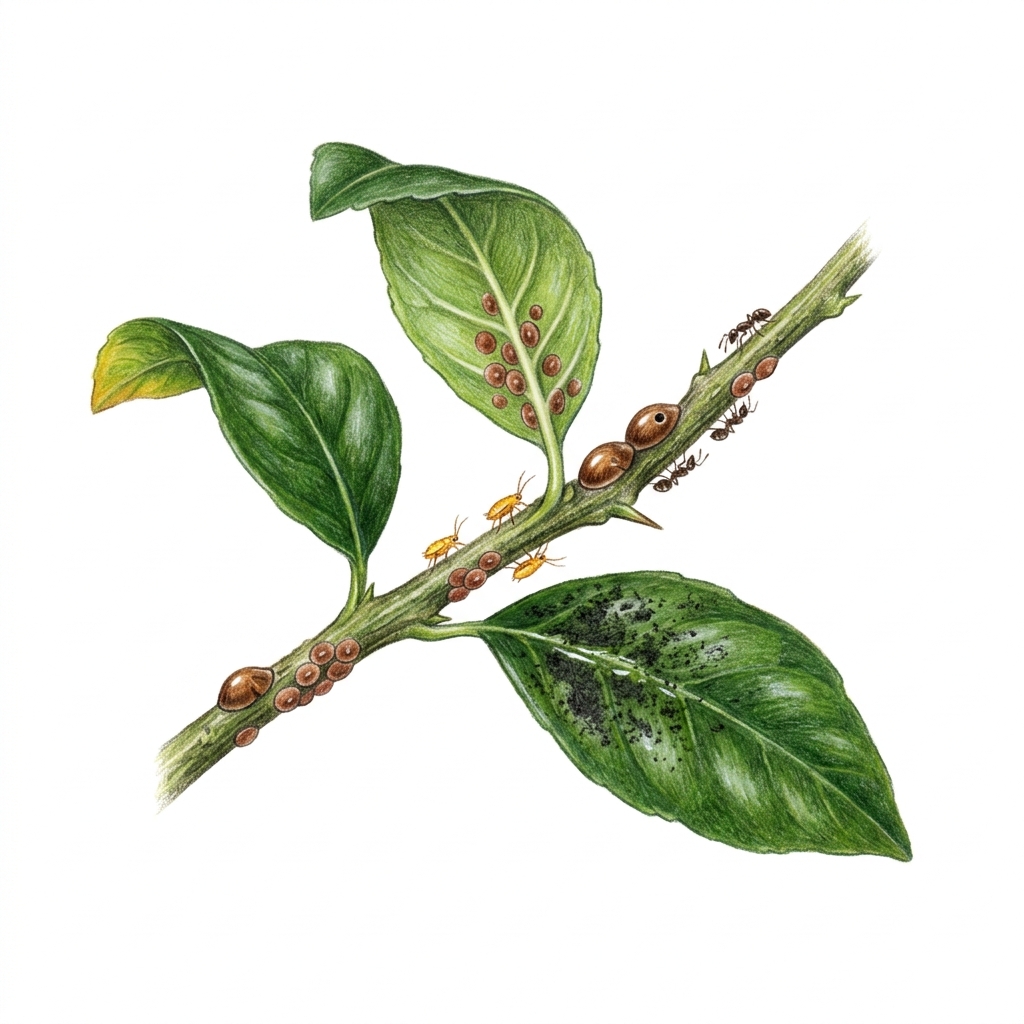
Illustration
Small sap-sucking insects that sit still under a waxy or shell-like cover on stems and leaves. Soft scales leave sticky honeydew and black sooty mould. Light attacks on healthy plants often need no action, as ladybirds and tiny wasps keep them in check.
How to spot it
- Small, still bumps on stems, twigs and leaves, from under 1 mm to over 1 cm across: flat or domed, brown, grey or white, under a waxy, shell-like cover.
- Sticky honeydew on leaves, with black sooty mould growing on it, and often ants.
- Yellowing leaves that drop early, and twigs that die back where scales are crowded.
- Tiny yellow-orange crawlers wandering over the plant when the eggs hatch.
- On some kinds, white waxy egg masses that look like mealybugs.
Easily confused with
Mealybugs
Soft oval bodies dusted with white waxy powder, with waxy threads around the edge, usually clustered in leaf joints and under loose bark.
Whitefly nymphs
Flat, oval, creamy-white scale-like young under the leaves, with clouds of tiny white-winged adults that fly up when the plant is disturbed.
Dead scales
Old scales can stay stuck on after they die. Squash one: a live scale oozes fluid, a dead one is dry, and a small round hole means a parasitic wasp got it.
Where it's a problem
- Worldwide: Found on a wide range of plants. Indoors and under glass they can breed all year; most outdoor kinds have one generation a year.
- Australia: Armoured scales such as red scale (on citrus, passionfruit and roses) and soft scales such as soft brown scale are common. Tiny parasitic wasps often keep red scale under control where little spraying is done.
- Queensland: Pyriform scale has been found in Western Australia but not in Queensland, where it is prohibited. Report a suspected find to Biosecurity Queensland on 13 25 23 or the Exotic Plant Pest Hotline on 1800 084 881.
- United Kingdom: More than 25 kinds live in British gardens, each with its own host plants and life cycle.
What to do
- Check stems, twigs and the undersides of leaves, and follow any honeydew, sooty mould or ants back to the scales.
- Leave light infestations on healthy plants: ladybirds and tiny parasitic wasps often control them.
- Scrape or wipe scales off small plants, and prune out badly infested twigs.
- Keep ants away with a sticky band around the trunk, and trim branches that bridge to buildings or the ground, because ants protect scales from their enemies.
- Water plants well and rinse off dust, which gets in the way of natural enemies.
- Wrap double-sided sticky tape around an infested twig to see when the tiny crawlers are out.
If you use an insecticide, choose one labelled for scale insects and follow the label and local rules. Sources say sprays work best just after the crawlers hatch, and that broad-spectrum sprays kill the wasps and ladybirds that keep scale in check.
Free account, no card needed. You sign up or sign in first, then the scanner opens.
Sources
- RHS: Scale insects
- University of California IPM: Scales
- Business Queensland: Red scale
- Business Queensland: Soft brown scale
- Business Queensland: Pyriform scale
- RHS: Mealybug (glasshouse)
- RHS: Glasshouse whitefly
Facts checked Sunday 27 September 2026. General guidance only: follow your local council, agency and product label.