Home › Garden pests › Mealybugs
Garden pests
Mealybugs
Planococcus citri, Pseudococcus and related species · Insect
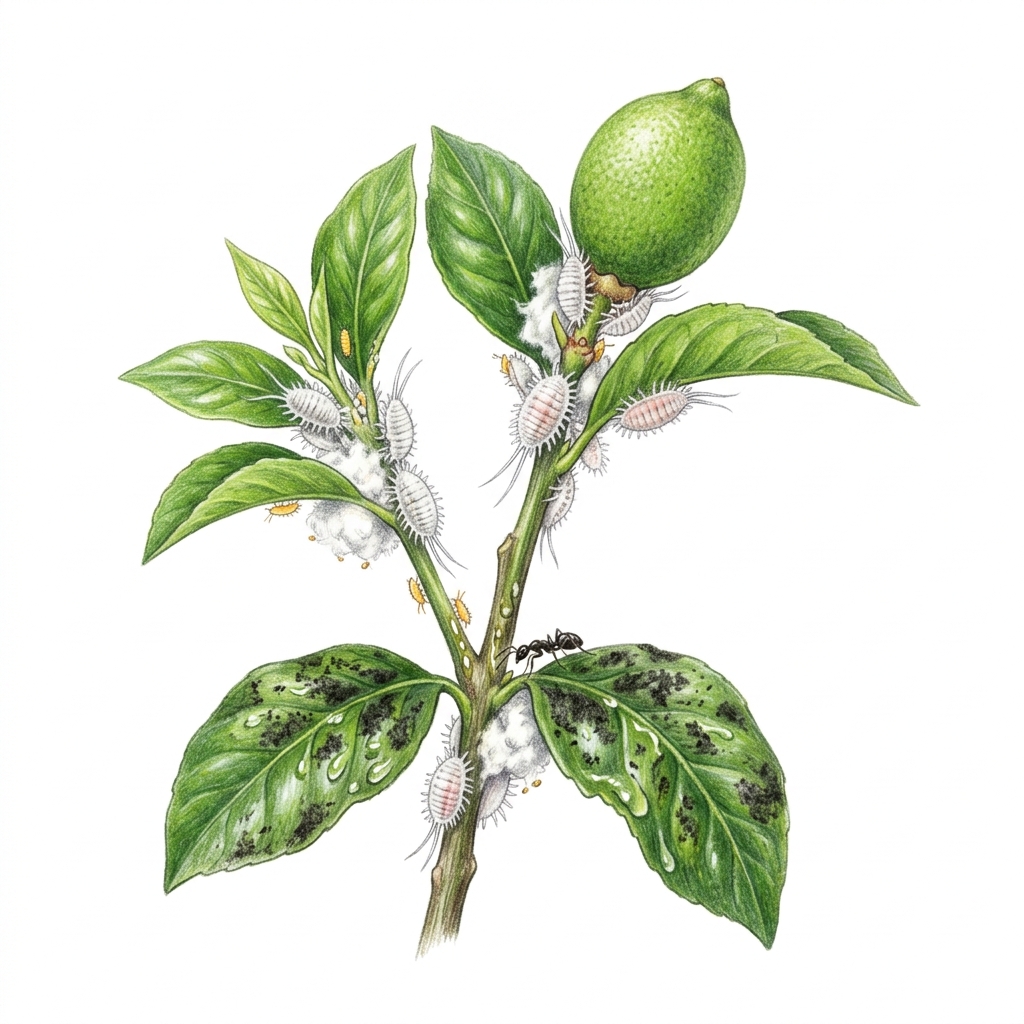
Illustration
Small sap-sucking insects coated in white, mealy wax that cluster in leaf joints, leaving sticky honeydew and sooty mould. Common on houseplants and in greenhouses; check new plants, pick them off and keep ants away.
How to spot it
- Soft, oval, segmented insects up to 4 mm, dusted in white wax, often with a fringe of waxy threads.
- Fluffy white wax in leaf joints and other sheltered spots, hiding the eggs.
- Sticky honeydew, black sooty mould, and ants.
- Stunted growth and early leaf drop in heavy infestations.
- Root mealybugs feed out of sight; you find them only when you lift or repot the plant.
Easily confused with
Scale insects
Adults are shell-like bumps that stay put; some lay white waxy egg masses that look like mealybugs.
Whitefly
Tiny white adults fly up when the plant is disturbed; female mealybugs can't fly.
Mealybug destroyer larvae
A ladybird larva up to 12 mm, more than twice a mealybug's size, faster moving and with clear legs. It eats mealybugs, so leave it.
Where it's a problem
- Worldwide: A pest of warm climates, greenhouses and houseplants, where it can breed all year.
- United Kingdom: Glasshouse mealybugs live mainly in greenhouses, conservatories and homes, and are rarely found on outdoor plants.
- Australia: Citrus mealybug occurs throughout Australia, most commonly in coastal districts and north of Sydney. Papaya mealybug, first found near Darwin in 2023, is known only around Darwin, Townsville and South East Queensland; Queensland asks for suspected sightings elsewhere to be reported to Biosecurity Queensland on 13 25 23.
What to do
- Inspect new plants closely, and keep them apart for a while before they join the others.
- Pick off small colonies, and prune out badly infested stems.
- Hose sturdy plants with a strong spray of water.
- Keep ants away, as they protect mealybugs from their natural enemies.
- Go easy on nitrogen fertiliser, which boosts egg laying.
- Throw out old, heavily infested plants. In a warm greenhouse, the mealybug ladybird or parasitic wasps can be released as a biological control (May to September in the UK).
If you use an insecticide, choose one labelled for mealybugs and follow the label and local rules. Sources say their waxy coat makes sprays unreliable, and broad-spectrum products kill the ladybirds and wasps that control them.
Free account, no card needed. You sign up or sign in first, then the scanner opens.
Sources
- RHS: Mealybug
- RHS: Scale insects
- RHS: Glasshouse whitefly
- University of California IPM: Mealybugs
- University of California IPM: Mealybug destroyer
- Business Queensland: Citrus mealybug
- Business Queensland: Papaya mealybug
Facts checked Sunday 27 September 2026. General guidance only: follow your local council, agency and product label.