Home › Garden pests › Spider mites
Garden pests
Spider mites
Tetranychus urticae and related species · Mite
Also called red spider mite (UK), glasshouse red spider mite (UK), two-spotted mite (Australia), twospotted spider mite (USA).
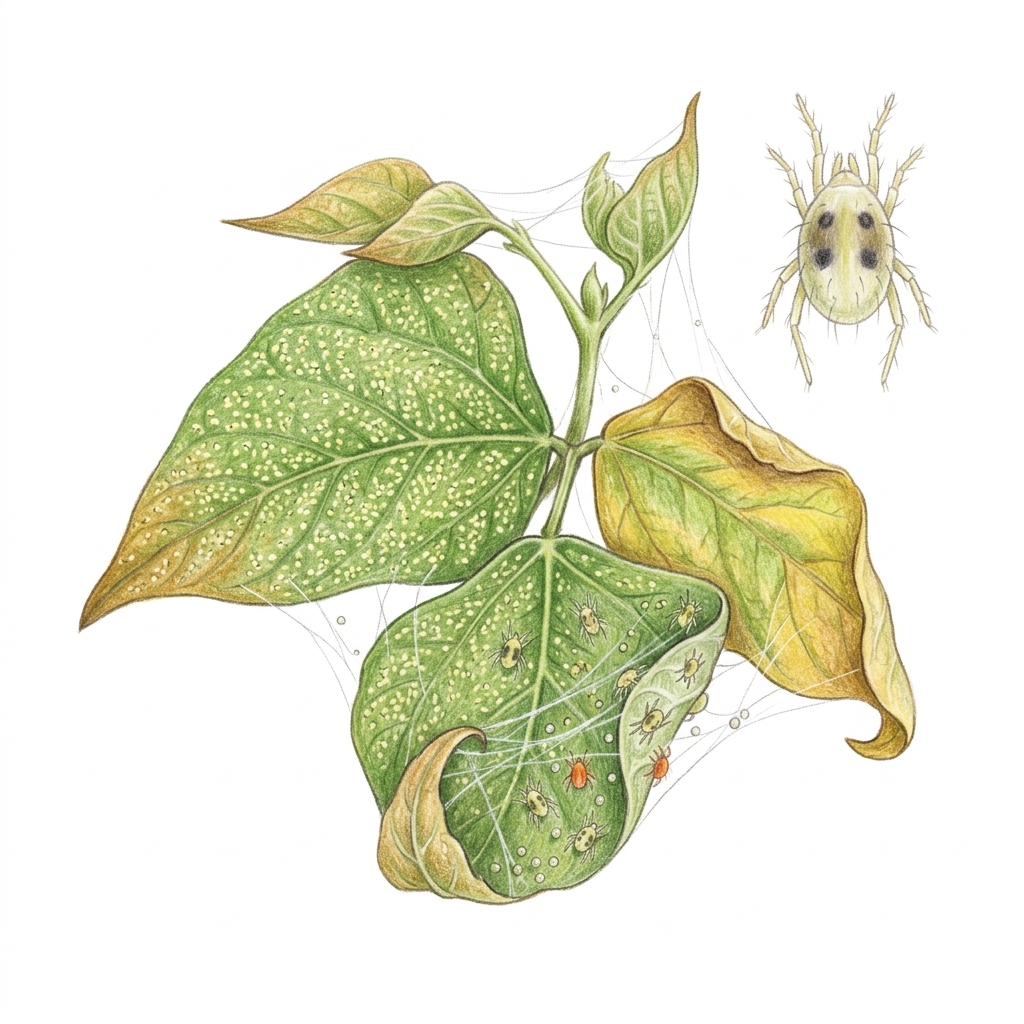
Illustration
Tiny eight-legged mites that feed under leaves, leaving fine pale speckling, bronzed leaves and silk webbing. They thrive in hot, dry, dusty weather; water plants well, hose the leaves and protect their predators.
How to spot it
- Fine pale speckling on the upper side of leaves.
- Leaves that turn dull, bronze or yellow, then drop.
- Fine silk webbing over leaves and shoot tips in bad cases.
- Tiny oval mites under 0.5 mm on leaf undersides: yellowish-green with two dark spots, or orange-red in autumn and winter.
Easily confused with
Thrips
Silvery patches dotted with tiny black specks of excrement, and no webbing.
Leafhoppers
Coarser pale spots, insects that jump when disturbed, and white cast skins stuck under the leaves.
Where it's a problem
- Australia: Two-spotted mite is found throughout Queensland on fruit, vegetables and ornamentals. Numbers climb fast in hot, dry weather, and the predatory mites that keep it down are scarce in the tropical north.
- United Kingdom: Mainly a greenhouse and houseplant pest from March to October, but it can also cause problems outdoors in hot, dry summers.
- North America: In California it is worst from June to September in hot, dusty conditions, and often after sprays for other pests have killed its predators.
What to do
- Tap a speckled leaf over white paper and look for tiny moving specks; a hand lens helps.
- Water plants well, as mites build up fastest on dry, stressed plants.
- Hose leaves, especially the undersides, with a strong spray of water, and damp down dust.
- In a greenhouse, mist plants to keep the air humid, and consider predatory mites as a biological control.
- Clear out badly infested plants at the end of summer so the mites don't overwinter.
- Avoid broad-spectrum sprays for other pests; they kill the mites' predators and can set off outbreaks.
Spider mites aren't insects, and insecticides rarely work on them; the wrong spray can make an outbreak worse by killing their predators. If you use a miticide, choose one labelled for spider mites and follow the label and local rules, and remember that mites can become resistant.
Free account, no card needed. You sign up or sign in first, then the scanner opens.
Sources
- RHS: Glasshouse red spider mite
- RHS: Thrips
- RHS: Sage and Ligurian leafhoppers
- University of California IPM: Spider mites
- University of Maryland Extension: Mites in home gardens
- Utah State University Extension: Web spinning spider mites
- Business Queensland: Two-spotted mite
Facts checked Sunday 27 September 2026. General guidance only: follow your local council, agency and product label.