Home › Garden pests › Leafhoppers
Garden pests
Leafhoppers
Cicadellidae (many species), including Eupteryx melissae, Eupteryx decemnotata, Edwardsiana rosae and Macrosteles fascifrons · Insect
Also called jassids (Australia), sage leafhopper and Ligurian leafhopper (UK, on sage, mint and other herbs), rose leafhopper (UK, on roses), potato leafhopper (USA, on potatoes and beans).
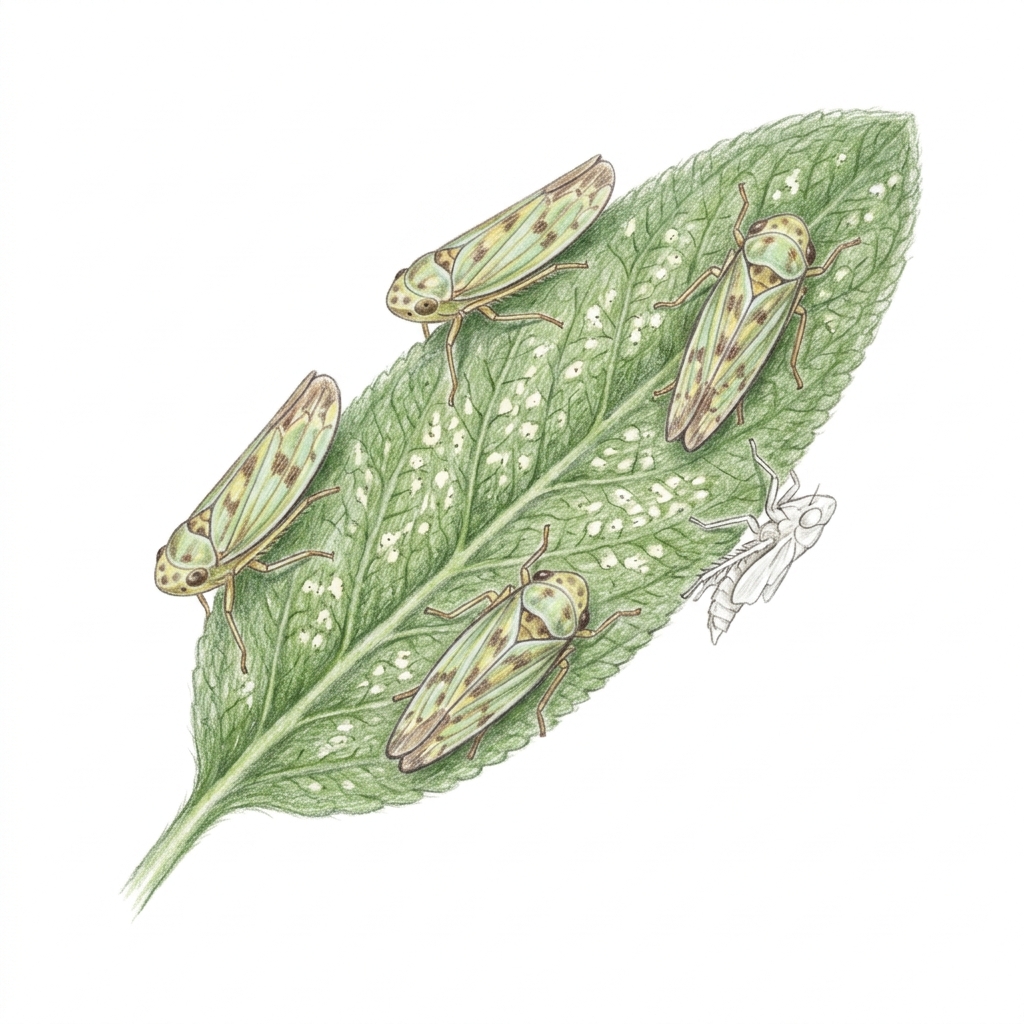
Illustration
Small, wedge-shaped sap-sucking insects that jump when disturbed and leave pale, coarse speckling on herbs such as sage, mint and rosemary, and on roses, potatoes and beans. On herbs and roses the damage is usually only cosmetic, so tolerate it; keep plants watered and weeds down, and cover young vegetables where leafhoppers or the diseases some of them carry are a problem.
How to spot it
- Coarse, pale speckling or mottling on the upper side of leaves, which can spread until the leaf looks bleached.
- Small, wedge-shaped insects about 3–4 mm (⅛ in) long under the leaves: pale green, yellow, or dappled with brown and black. They jump, fly a short way or scuttle sideways when disturbed.
- Pale, wingless young (nymphs) under the leaves, and their white cast skins left stuck there.
- On potatoes and beans, leaves that curl, turn yellow from the tips, then brown, and may drop (hopperburn).
Easily confused with
Spider mites
Finer speckling, often with silk webbing; the mites are tiny dots under the leaves and don't jump.
Thrips
Silvery patches dotted with tiny black specks of excrement, and no white cast skins under the leaves.
Aster yellows
A disease, not feeding damage: yellow, twisted, bunched new growth rather than pale speckles. Some leafhoppers carry it, so the two can turn up together.
Where it's a problem
- Worldwide: A very large family of insects. Britain alone has more than 180 species and California more than 380, and in gardens most are a nuisance rather than a threat. A few kinds spread plant diseases.
- Australia: Often called jassids, and widespread and common. The vegetable leafhopper feeds on vegetables, pulses and lucerne, and brown and spotted leafhoppers have been linked with spreading plant viruses and phytoplasmas. The glassy-winged sharpshooter, a large leafhopper 12–14 mm (½ in) long that spreads Xylella, a bacterium behind serious plant diseases overseas, is not found in Australia, and Queensland lists it as prohibited matter. Report a suspect to the Exotic Plant Pest Hotline, 1800 084 881.
- United Kingdom: Sage and Ligurian leafhoppers are widespread on sage, mint, rosemary, thyme, oregano, lavender and basil, and the rose leafhopper on roses, mostly from spring to early autumn. The RHS advises tolerating them: plants usually grow on unharmed, and mottled herbs are safe to eat.
- United States: Potato leafhopper can scorch potatoes and beans with hopperburn. The aster leafhopper, which mostly flies north from the southern states in late spring, spreads aster yellows to carrots and lettuce. In California, the beet leafhopper spreads curly top virus to beans, melons, peppers, potatoes and tomatoes.
What to do
- Turn speckled leaves over and look for the insects and their white cast skins. Leafhoppers jump or scuttle sideways when disturbed.
- Tolerate light mottling where you can: on herbs and roses it rarely affects growth or flowering, and mottled herbs are still safe to eat.
- Keep plants well watered and growing strongly, as stressed plants suffer more damage.
- Pull weeds around vegetable beds, where leafhoppers and the diseases some of them carry can shelter.
- Where leafhoppers or the diseases they spread are a problem, cover young potatoes, beans, carrots and lettuce with fine insect netting or floating row cover.
- Pull out plants with aster yellows as soon as you see them, so leafhoppers can't carry it on. In Australia and New Zealand, where it isn't found, report it instead (see Aster yellows).
- Encourage birds, ladybirds, lacewings, spiders and parasitic wasps, which all eat leafhoppers or their eggs.
If you use an insecticide, choose one labelled for leafhoppers and follow the label and local rules. Sources say sprays rarely stop leafhoppers spreading disease, because they can pass it on before they die, and broad-spectrum sprays also kill helpful insects and can set off outbreaks of other pests, such as mites.
Vegetables it affects
Free account, no card needed. You sign up or sign in first, then the scanner opens.
Sources (6, from RHS, University of California IPM, University of Illinois Extension and others)
- RHS: Sage and Ligurian leafhoppers · Rose leafhopper
- University of California IPM: Leafhoppers
- University of Illinois Extension: Leafhoppers
- Business Queensland: Leafhoppers · Glassy-winged sharpshooter
Facts checked Friday 30 October 2026. General guidance only: follow your local council, agency and product label.