Home › Garden pests › Flea beetles
Garden pests
Flea beetles
Phyllotreta, Psylliodes, Epitrix, Chaetocnema and related species · Insect
Also called crucifer, striped, potato, eggplant and spinach flea beetles (USA and Canada), brown, striped and black flea beetles (Australia).
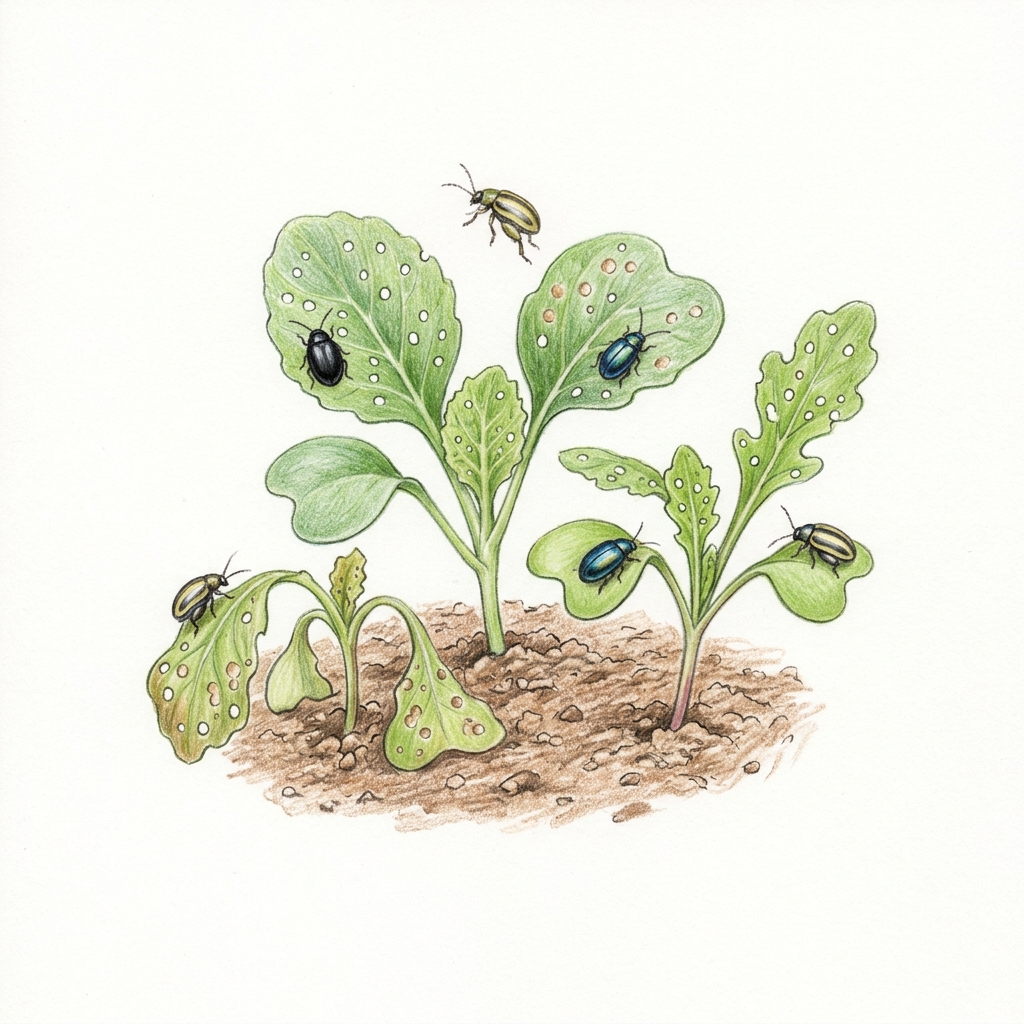
Illustration
Tiny, shiny beetles that jump like fleas and pepper the leaves of brassicas, radishes, rocket, eggplant and beet crops with small round holes, worst on seedlings. Cover young plants with fine insect mesh and keep them growing fast: once past the seedling stage, most plants shrug the damage off.
How to spot it
- Lots of small, round holes and pits in the leaves, as if peppered with shot, worst on seedlings.
- Pits scalloped out of the upper surface that often don't go right through; they dry and turn pale brown, or heal with a silvery look.
- Tiny, shiny beetles, mostly 2–3 mm (about ⅛ in) long and a few up to 6 mm (¼ in): black, bronze or metallic blue-green, some with a yellow or pale stripe down each wing case.
- Beetles that jump off the leaf when disturbed, on their enlarged back legs; they are busiest on calm, warm, sunny days.
- Seedlings that stall or die soon after coming up, most of all in hot, dry weather.
Easily confused with
Slugs and snails
Bigger, ragged holes anywhere on the leaf, made at night, with silvery slime trails.
Cabbage white caterpillars
Larger, irregular holes, with green caterpillars and their droppings on and under the leaves.
Leaf spot diseases
Some leaf spots dry and drop out, leaving holes much like flea beetle damage. Look for spots at every stage around the holes, and no tiny beetles jumping off.
Where it's a problem
- Worldwide: Many kinds, each with its favourite crops. Britain alone has more than 100 species, though only a few attack brassicas.
- Australia: Brown, striped and black flea beetles chew small holes in leaves, mainly on Asian leafy brassicas and on beans.
- United Kingdom: Most active in spring and summer. Adults come out of leaf litter in mid-spring, and in late summer more fly into gardens from oilseed rape fields and can damage mature plants.
- North America: Crucifer, striped, potato, eggplant and spinach flea beetles are all common in gardens. Adults become active once it reaches about 10°C (50°F), and damage is worst on early plantings, after warm winters and in hot, dry weather.
What to do
- Cover seedbeds and new transplants with fine insect mesh, 0.8 mm or finer, from sowing or planting day, with the edges buried at least 5 cm (2 in). Standard 1.3 mm mesh doesn't keep flea beetles out.
- Keep seedlings growing fast and well watered in dry spells, so they get past the stage when damage matters.
- Plant out sturdy, larger transplants rather than small ones, or sow a little later, after the first beetles of spring have come out.
- Rotate crops, and grow later brassicas well away from spring ones.
- Check new seedlings every day or two; yellow sticky traps nearby show when beetles are about.
- Keep down weeds, and clear old crop debris after harvest, where adults spend the winter.
- Encourage birds, frogs and ground beetles, and tolerate light damage on bigger plants: outer leaves can simply be discarded.
If you use an insecticide, choose one labelled for flea beetles and follow the label and local rules. Sources say sprays are rarely needed once plants are past the seedling stage, and work poorly when numbers are high.
Vegetables it affects
Free account, no card needed. You sign up or sign in first, then the scanner opens.
Sources (6, from RHS, University of Wisconsin–Madison Extension, NC State Extension and others)
- RHS: Flea beetles on brassicas and allied plants · Insect-proof mesh
- University of Wisconsin–Madison Extension: Flea beetles
- NC State Extension: Flea beetles, tiny menace in the vegetable garden
- University of California IPM: Flea beetles
- AUSVEG: Beetles in vegetable crops
Facts checked Wednesday 28 October 2026. General guidance only: follow your local council, agency and product label.