Home › Plant diseases › Bacterial leaf spot
Plant diseases
Bacterial leaf spot
Xanthomonas species (capsicum and chilli); Pseudomonas syringae and relatives (coriander and rocket) · Bacterium
Also called bacterial spot (USA, on capsicum and chilli), bacterial blight of coriander (UK), bacterial blight of arugula (rocket) (USA).
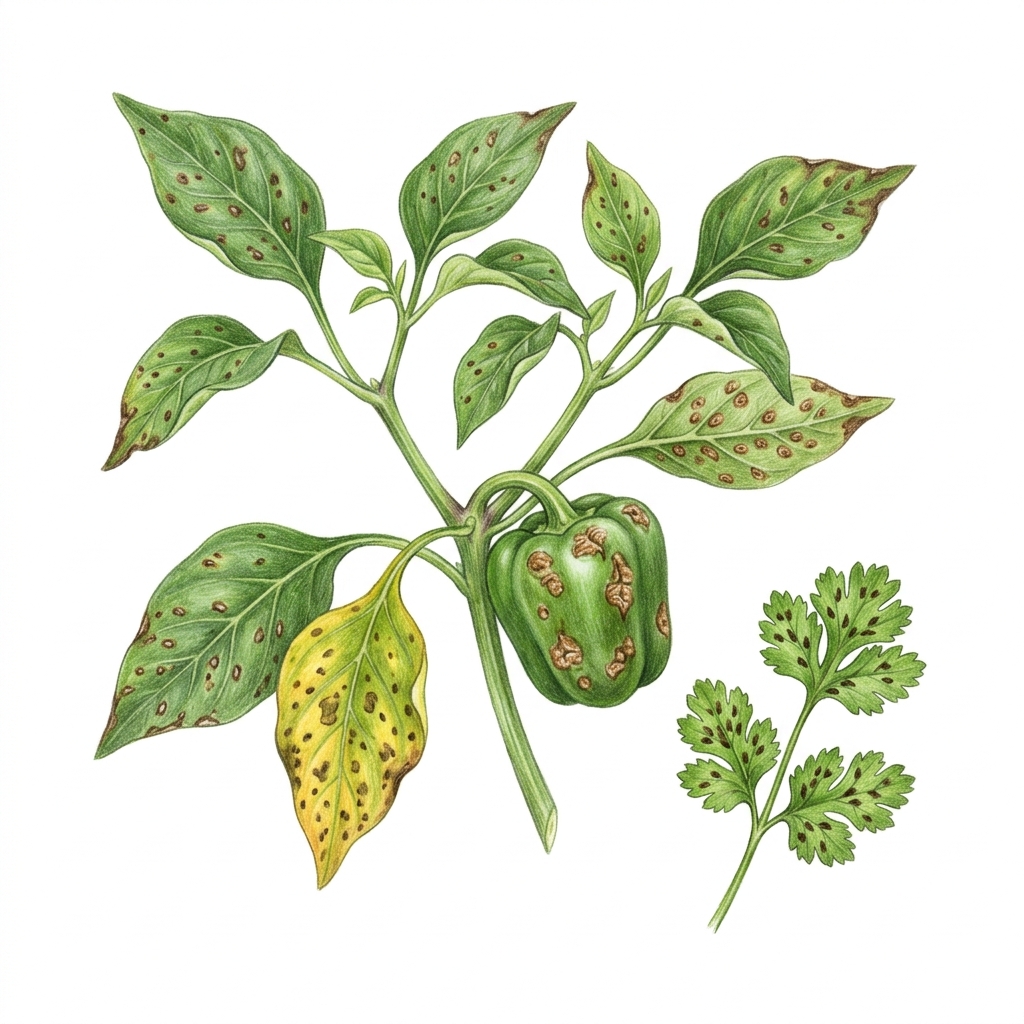
Illustration
Small, dark, water-soaked spots on the leaves of capsicum, chilli, coriander and rocket, caused by bacteria that arrive on seed and spread in splashing water; badly spotted leaves fall, and capsicum fruit get rough, scabby spots. There's no cure, so start with clean seed, keep the leaves dry, pull out spotted plants and rotate the bed.
How to spot it
- Capsicum and chilli: many small spots up to about 6 mm (¼ in), water-soaked at first, then brown with dark edges. They show most on the underside, sunken on top and slightly raised below.
- Capsicum and chilli: spots that merge at the leaf tips and edges, leaves that drop, and fruit left open to sunscald.
- Capsicum and chilli fruit: raised, brown, scabby spots with a rough, cracked surface.
- Coriander: dark brown to black spots with a water-soaked edge, angular and held in by the veins, visible from both sides of the leaf; seedlings may collapse.
- Rocket: small, water-soaked spots that turn black or tan, often with a yellow halo, and yellowing leaves.
- On capsicum it is worst in warm, wet, windy weather; on coriander, in cool, wet weather; on rocket, in damp, humid conditions, such as crowded plants under covers.
Easily confused with
Early blight
On capsicum, bigger brown spots with target-like rings, starting on the oldest leaves.
Sunscald
A pale, papery patch only on the side of the fruit that faced the sun, not raised, scabby spots. Leaf loss from bacterial leaf spot can let sunscald in, so the two can turn up together.
Downy mildew
On rocket, angular yellow patches with grey fuzz underneath; bacterial spots have no fuzz.
Black rot
On rocket and other cabbage-family plants, yellow V-shaped wedges from the leaf edge with blackened veins.
Where it's a problem
- Worldwide: Found in temperate and tropical regions; on capsicum and chilli it is recorded in Australia, New Zealand and across the Pacific.
- Australia: Queensland research found that capsicum and chilli are attacked by one species, Xanthomonas euvesicatoria, that some resistant capsicums hold off only some of its strains, and that local strains tolerate the usual protective spray.
- United Kingdom and Europe: On coriander it is carried on seed, confirmed in British, German and Australian seed studies, and plants can spread it before any spots show.
- North America: On coriander it has been severe in Oregon's Willamette Valley. In California, the capsicum form is considered a relatively minor disease.
What to do
- Start with good seed and healthy seedlings from a reliable supplier, throw out any seedlings with spots, and don't save seed from spotted plants.
- Water the soil, not the leaves, and mulch to stop soil splashing up onto them.
- Keep out of the bed while the plants are wet: hands and clothes carry the bacteria.
- Pull out badly spotted plants as soon as you see them.
- Pull out weeds and self-sown plants of the same family between crops, such as tomato-family weeds near capsicum and chilli.
- After harvest, clear away the old plants, and keep capsicum, chilli and tomatoes out of that bed for two to three years.
- For capsicum, grow resistant varieties where you can.
No spray cures it. Sprays only protect healthy leaves, they often fail in wet, windy weather, and Queensland research found the capsicum bacteria tolerate the usual protective spray: clean seed and dry leaves do most of the work.
Follow your local council's guidance for disposing of diseased plant material.
Vegetables it affects
Free account, no card needed. You sign up or sign in first, then the scanner opens.
Sources (6, from University of California IPM, Pacific Pests, Pathogens and Weeds, Hort Innovation (Queensland DAF) and others)
- University of California IPM: Bacterial spot of peppers
- Pacific Pests, Pathogens and Weeds: Tomato bacterial spot
- Hort Innovation (Queensland DAF): Bacterial leaf spot in capsicum and chilli, VG14010
- AHDB: Bacterial blight of coriander, symptoms and biology
- Pacific Northwest Plant Disease Management Handbook: Coriander, bacterial leaf spot
- Cornell Cooperative Extension: Bacterial blight of brassica leafy greens, a new threat to arugula
Facts checked Wednesday 28 October 2026. General guidance only: follow your local council, agency and product label.