Home › Garden pests › Root-knot nematodes
Garden pests
Root-knot nematodes
Meloidogyne species, such as M. javanica, M. incognita, M. arenaria and M. hapla · Nematode
Also called eelworms (Australia, an older name).
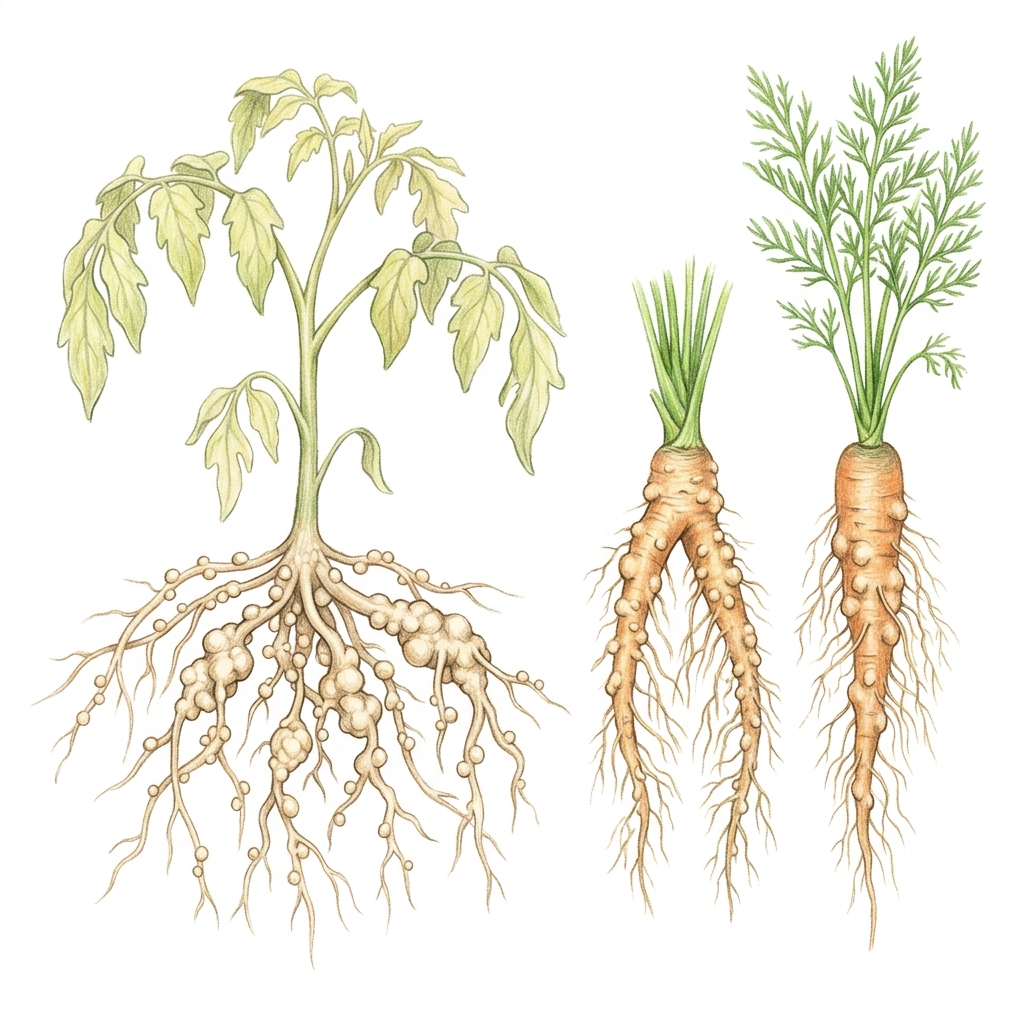
Illustration
Microscopic soil worms that feed inside roots and make them swell into knobbly galls, giving forked, stunted carrots and tomatoes that wilt on hot days. Once they are in a bed they are hard to get rid of, so rotate with crops they can't use, grow resistant varieties and add plenty of compost.
How to spot it
- Knobbly swellings (galls) on the roots, mostly 1–10 mm (up to ⅜ in) across but bigger on some plants. They are part of the root and can't be rubbed off.
- Carrots that are forked, stunted or misshapen, with many small lumps on the main root and side roots, and often lots of fine hairy roots.
- Plants that wilt in the heat of the day even though the soil is moist, and are stunted, with yellowing leaves.
- Poor plants in patches rather than all through the bed.
- Potatoes with a warty, bumpy skin.
Easily confused with
Root nodules on peas and beans
Helpful nitrogen-fixing nodules sit on the side of the root, rub or pull off easily, and are pink or green inside; galls are swellings of the root itself.
Forked roots from stony or compacted soil
Carrots fork in stony or compacted soil too, but the roots are clean, with no small lumps.
Carrot fly
Rusty tunnels with small maggots inside the root, not lumps.
Drought or hungry soil
Wilting and yellowing look the same from above. Dig up a plant and wash the roots: galls mean nematodes.
Where it's a problem
- Worldwide: Found worldwide on a great many broad-leaved plants, and they do most damage in warm, irrigated, sandy soils.
- Australia: Very common in soils throughout Queensland and most of New South Wales; M. javanica and M. incognita are the most widespread in Queensland. The guava root-knot nematode, first found in Australia in 2022 near Darwin and since in Queensland, attacks many vegetables. It is not known in Western Australia, where it is a declared pest: report a suspected find to DPIRD (MyPestGuide Reporter, or PaDIS on (08) 9368 3080).
- United States: University of California IPM says they can't get into roots when the soil is below 18°C (64°F), so they do most harm in summer.
What to do
- Check first: dig up a struggling plant, wash the soil off the roots and look for galls.
- Don't spread them: buy healthy plants, clean soil off tools and boots, and don't move soil from an infested bed.
- Pull out finished crops, roots and all, as soon as you harvest, and don't put galled roots in the compost.
- Rotate: for a season or two grow crops they barely affect, such as wheat, barley and corn, or resistant tomatoes and beans, and keep weeds out meanwhile.
- Grow resistant varieties: tomatoes labelled N or VFN, and resistant capsicum and potato varieties where you can get them.
- Dig in plenty of compost: it helps the soil hold water and builds up the fungi and other creatures that attack nematodes, and well-watered plants suffer less.
- Plant cool-season crops such as carrots, lettuce and peas once the soil has cooled below about 18°C (64°F). Where summers are hot, UC IPM suggests solarising an empty bed: wet it, cover it with clear plastic and leave it for 4–6 weeks in the hottest weather.
Sources say there is no chemical cure for a home garden (University of California IPM: no nematicides are available to home gardeners), so rotation, resistant varieties and clean-up do the work. If you use any product, choose one labelled for root-knot nematodes and follow the label and local rules.
Vegetables it affects
Free account, no card needed. You sign up or sign in first, then the scanner opens.
Sources
- University of California IPM: Nematodes
- Business Queensland: Root-knot nematode
- NSW DPI: Root knot nematode disease (Primefact 1095)
- University of Minnesota Extension: Carrot, forked or misshapen root
- IPPC: Australia's pest report, guava root-knot nematode in the NT and Queensland (2023)
- WA DPIRD: Guava root-knot nematode
Facts checked Wednesday 21 October 2026. General guidance only: follow your local council, agency and product label.