Home › Garden pests › Carrot fly
Garden pests
Carrot fly
Psila rosae · Insect
Also called carrot rust fly (North America (and Australian biosecurity agencies)).
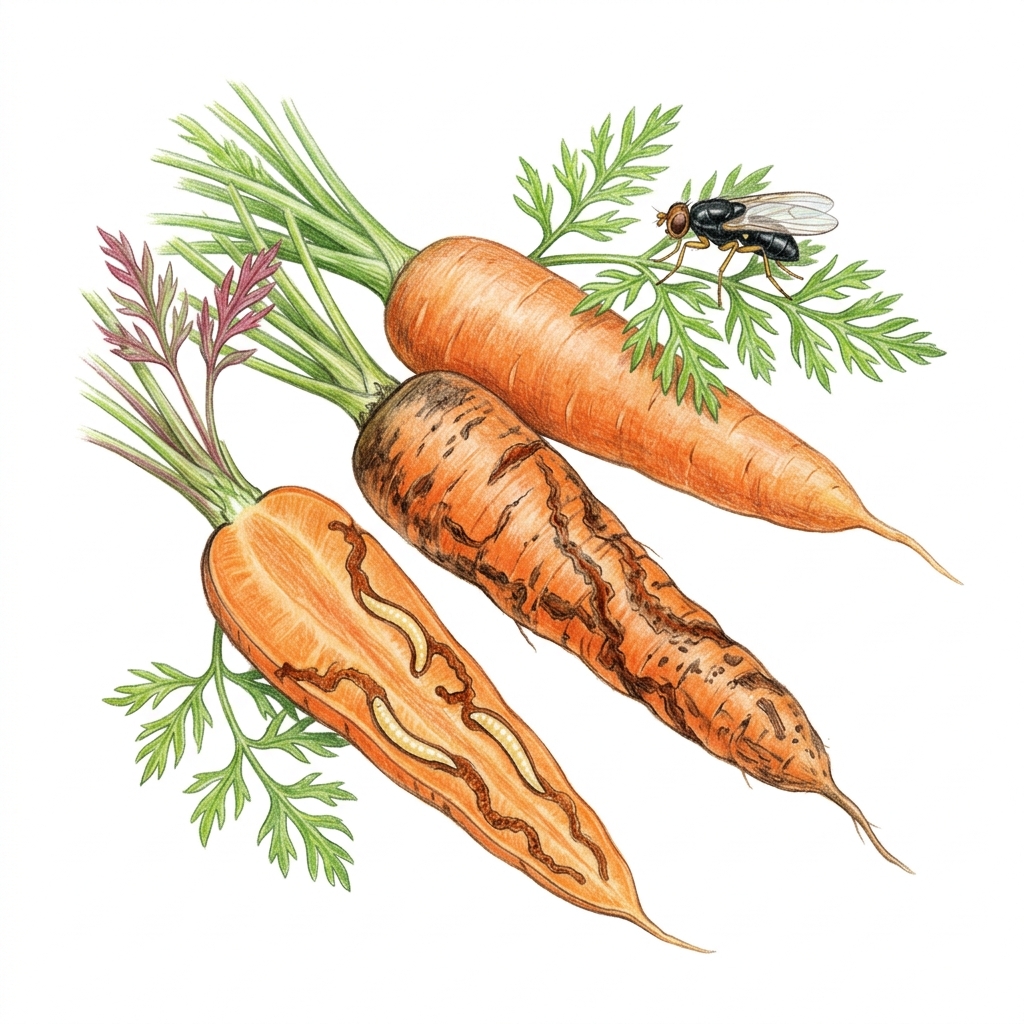
Illustration
A small black fly whose creamy maggots tunnel into the roots of carrots, parsnips, celery and parsley, leaving rusty-brown scars and tunnels. Keep the flies off with fine insect mesh from sowing to harvest; it is not found in Australia, where a suspected find should be reported.
How to spot it
- Rusty-brown scars and narrow, winding tunnels around the root, mostly in its lower two-thirds, often with maggots inside.
- Slender, creamy-white to yellow maggots up to about 9 mm (⅜ in) long, with no legs and no obvious head.
- Seedlings that die, leaving gaps in the row.
- Often nothing shows above ground; in bad attacks the leaves may yellow or redden and the plants grow slowly.
- The adult: a small, shiny black fly about 6–8 mm (¼ in) long, with a reddish head and yellow legs.
Easily confused with
Wireworms
Larger, open holes that go deeper into the root, made by thin, shiny larvae with legs; carrot fly tunnels are narrow, winding and rusty.
Root-knot nematodes
Forked, stunted roots covered in small lumps, with no tunnels or maggots.
Cutworms
Seedlings cut off at soil level, with much bigger grey-brown caterpillars, up to 4–5 cm (1½–2 in), curled into a C in the soil nearby.
Where it's a problem
- Worldwide: Widespread in Europe, Canada, the United States and New Zealand.
- Australia: Not found in Australia, and listed as a high-priority exotic pest of vegetables. If you find carrots tunnelled by small creamy maggots, report it to the Exotic Plant Pest Hotline on 1800 084 881.
- United Kingdom: Most active from May to October. Flies lay eggs in late May to June and again in August to September, and there are two or three generations a year.
- North America: Known as carrot rust fly. In British Columbia and Oregon the first flies appear from mid to late April. In British Columbia the second generation's maggots, in August and September, usually do the most damage.
What to do
- Cover the bed with fine insect mesh or row cover from sowing day, edges buried or weighed down, and leave it on until you lift the crop.
- Sow thinly so there is little thinning to do: the smell of bruised carrot leaves draws egg-laying flies. Put the cover straight back after thinning or weeding.
- Time sowing to miss the flies. In the UK the RHS suggests sowing after mid-May and lifting before late August; in North America, UC IPM suggests early summer sowing in cold areas, and late winter or late summer in mild ones.
- Rotate: don't sow carrots, parsnips, celery or parsley where any of them grew last year, as flies emerge from pupae left in the soil.
- Lift the whole crop rather than leaving roots in the ground over winter, and get rid of damaged roots: both carry the pest on to next year. Peel damaged parts away before using the roots.
In Australia, report it rather than treating it. Elsewhere, if you use an insecticide, choose one labelled for carrot fly and follow the label and local rules.
Vegetables it affects
Free account, no card needed. You sign up or sign in first, then the scanner opens.
Sources
- RHS: Carrot fly
- University of California IPM: Carrot rust fly
- Oregon State University Small Farms: Carrot rust fly biology and management
- Government of British Columbia: Carrot rust fly, small-scale IPM guide
- AUSVEG: Exotic plant pest profile, carrot rust fly
- Farm Biosecurity: Vegetable pests
Facts checked Wednesday 21 October 2026. General guidance only: follow your local council, agency and product label.