Home › Plant diseases › Forked roots
Plant diseases
Forked roots
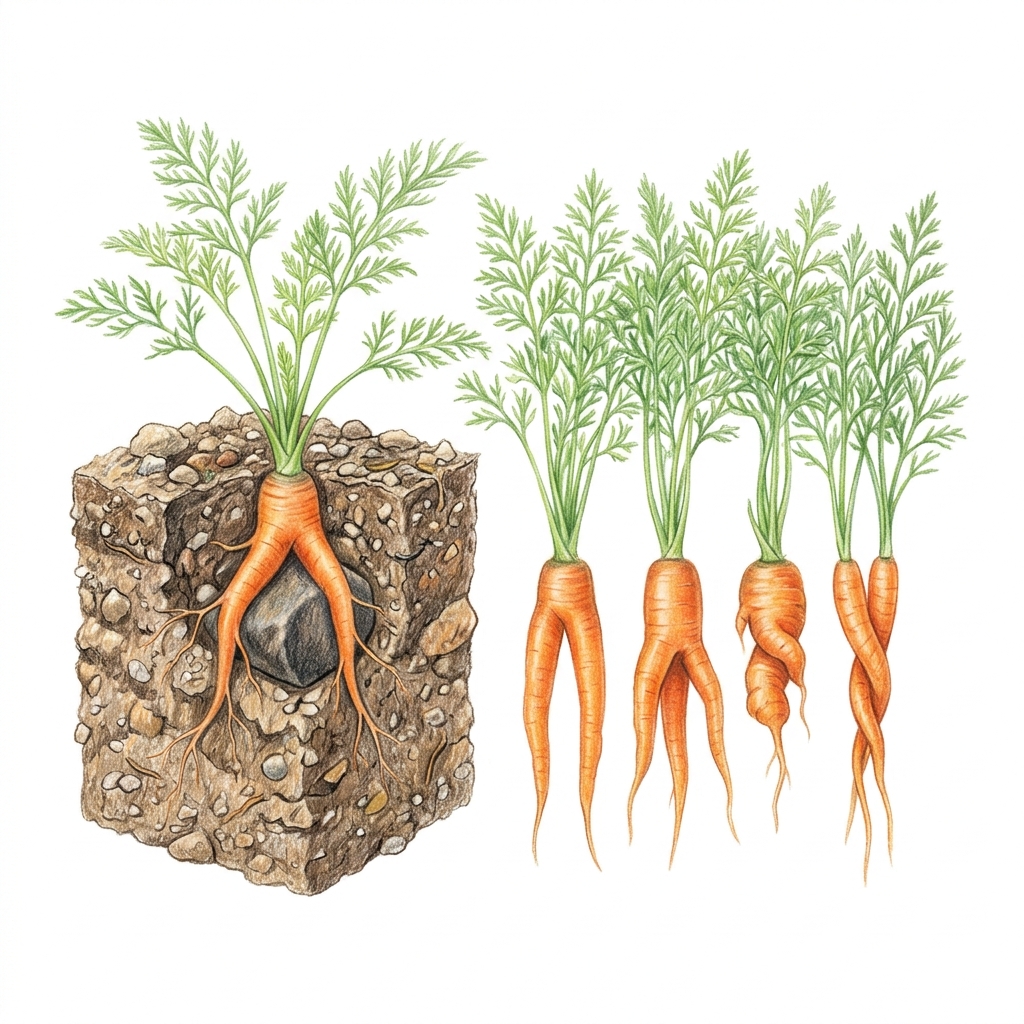
Illustration
Carrots whose roots split into two or more legs, or twist and stunt, because the growing tip was blocked or damaged as it grew. Sowing straight into deep, loose, stone-free soil, without fresh manure, prevents it.
How to spot it
- Roots split into two or more legs, or twisted, stubby and misshapen.
- Worst in stony, shallow, lumpy or heavy clay soil, and in long-rooted kinds.
- Common where seedlings were transplanted or moved.
- Hairy, forked roots where the soil has stayed too wet.
- Twisted roots where seed was sown thickly and not thinned.
Easily confused with
Root-knot nematodes
Forked roots that also carry small, firm lumps that don't rub off, on plants that are often stunted and wilt in hot weather.
Split fruit and roots
A carrot that has cracked open, from uneven watering, rather than growing legs.
Carrot fly
Small holes and tunnels made by maggots inside the root; heavy damage can also make roots fork.
Aster yellows
Masses of fine hairy roots with a bitter taste, several tops on one plant and yellowing leaves: a disease, not the soil.
Where it's a problem
- Worldwide: Common wherever carrots are sown into stony, heavy or freshly manured soil. Not regulated.
What to do
- Choose deep, loose soil. On stony, shallow or heavy clay soil, grow short kinds rather than long ones.
- Before sowing, dig the bed deeply, break up clods and take out stones.
- Don't dig in fresh manure or woodchips just before sowing; well-rotted compost is fine.
- Sow seed where the carrots are to grow, and don't transplant them.
- Thin seedlings early, so the roots have room.
- Water evenly but don't keep the soil soggy: too much water gives hairy, forked roots.
Spraying won't help: forked roots come from the soil and the way the seed was sown, not an infection. Official guides prevent it with soil preparation and sowing in place.
Vegetables it affects
Free account, no card needed. You sign up or sign in first, then the scanner opens.
Sources
- RHS: How to grow carrots
- University of Illinois Extension: Carrots
- Utah State University Extension: Carrots in the garden
- UC Small Farms Network: Fertilizing vegetables
- University of California IPM: Overwatering in carrots
- University of Maryland Extension: Root-knot nematodes on vegetables
Facts checked Wednesday 21 October 2026. General guidance only: follow your local council, agency and product label.