Home › Garden pests › Cabbage root fly
Garden pests
Cabbage root fly
Delia radicum · Insect
Also called cabbage maggot, cabbage root maggot (USA and Canada).
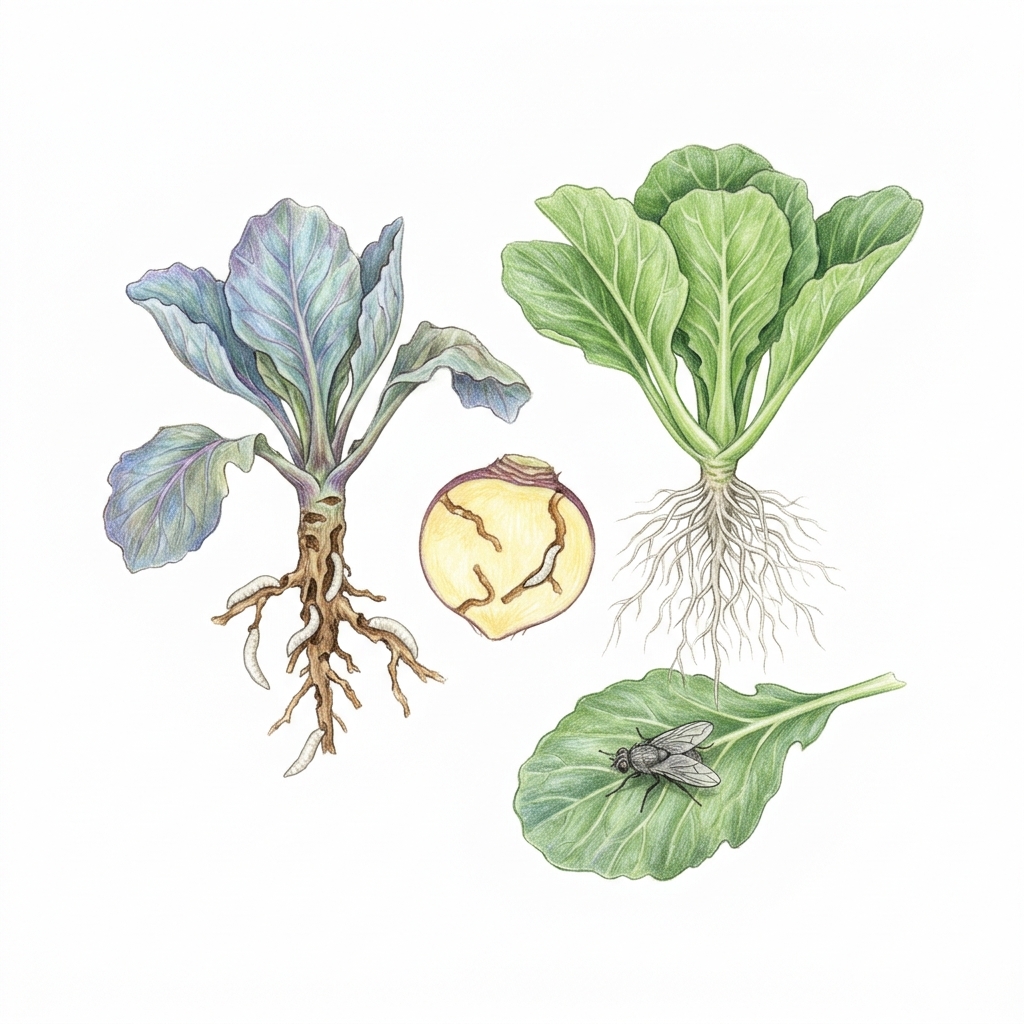
Illustration
A small grey fly whose white maggots eat the roots of young cabbages and other brassicas, so new transplants wilt and die, and tunnel into swedes, turnips and radishes. Put a collar around each transplant or grow the crop under insect mesh, and grow brassicas in a different bed each year.
How to spot it
- Young plants, especially recent transplants, that grow slowly, turn off-colour, wilt as the weather warms and die.
- Pull one up: few roots left, and white, legless maggots up to 9 mm (⅜ in) long, with no obvious head, on and in the roots and the base of the stem.
- Tunnels through swedes, turnips and radishes, which ruin the roots.
- Now and then, maggots tunnelling into Brussels sprout buttons.
- The adult: a grey, bristly fly that looks like a house fly, but a little smaller, around brassicas from spring.
Easily confused with
Club root
Plants wilt in hot weather too, but the roots are swollen and distorted, with no maggots or tunnels.
Bean seed fly
Its maggots look almost the same, but attack many crops, especially germinating beans and sweet corn; cabbage root fly maggots keep to brassicas.
Wireworms
Small round holes in radishes and turnips made by thin, shiny, yellow-brown larvae with three pairs of legs; cabbage root fly maggots have no legs.
Cutworms
Seedlings cut through at soil level by fat grey-brown caterpillars that curl into a C in the soil nearby, rather than roots eaten away.
Where it's a problem
- Worldwide: A pest of brassicas across Europe and North America.
- United Kingdom: Active from April to September, with three generations a year. The first, in late spring and early summer, does most harm to cabbages and other leafy brassicas; swedes, turnips and radishes are damaged by every generation.
- North America: Called cabbage maggot, and a pest of brassicas right across Canada and in states such as Wisconsin. Adults appear around mid-May, about when forsythia flowers. Early transplants and spring root crops suffer most, and damage is worse in cool, wet weather.
- Australia: Our sources record it in Europe and North America, not in Australia. A related fly that is established here, the seedcorn maggot, can attack brassicas among many other crops. Report any unusual plant pest to the Exotic Plant Pest Hotline on 1800 084 881.
What to do
- Put a collar around the stem of each new transplant: a square or circle 8–15 cm (3¼–6 in) across of carpet underlay, roofing felt or card, flat on the soil. Flies lay on the collar instead of the soil beside the plant, and the eggs often dry out.
- Or grow brassicas under insect mesh or fleece from planting, with the edges buried at least 5 cm (2 in), and keep it on through the season. Standard 1.3 mm mesh keeps this fly out.
- Rotate: don't grow brassicas, swedes, turnips or radishes where any of them grew last year, or flies can come out of pupae in the soil under the cover.
- Check transplants often from spring, when the first generation does the most damage.
- In North America, plantings made after mid-June generally suffer less; avoid planting brassicas in freshly manured ground.
- After harvest, clear or dig in old brassica roots and stumps, where the pupae spend the winter.
- Encourage birds, hedgehogs and ground and rove beetles, which eat the maggots.
If you use an insecticide, choose one labelled for cabbage root fly and follow the label and local rules. Sources put prevention first: collars, covers and crop rotation.
Vegetables it affects
Free account, no card needed. You sign up or sign in first, then the scanner opens.
Sources (6, from RHS, University of Wisconsin–Madison Extension, The Canadian Entomologist and others)
- RHS: Cabbage root fly · Insect-proof mesh · Club root
- University of Wisconsin–Madison Extension: Cabbage maggot
- The Canadian Entomologist: Cabbage root maggot research in Canada
- AUSVEG: Frontline exotic pest profile, onion fly
Facts checked Wednesday 28 October 2026. General guidance only: follow your local council, agency and product label.