Home › Plant diseases › Club root
Plant diseases
Club root
Plasmodiophora brassicae · Protist (related to slime moulds)
Also called clubroot (North America and Australia).
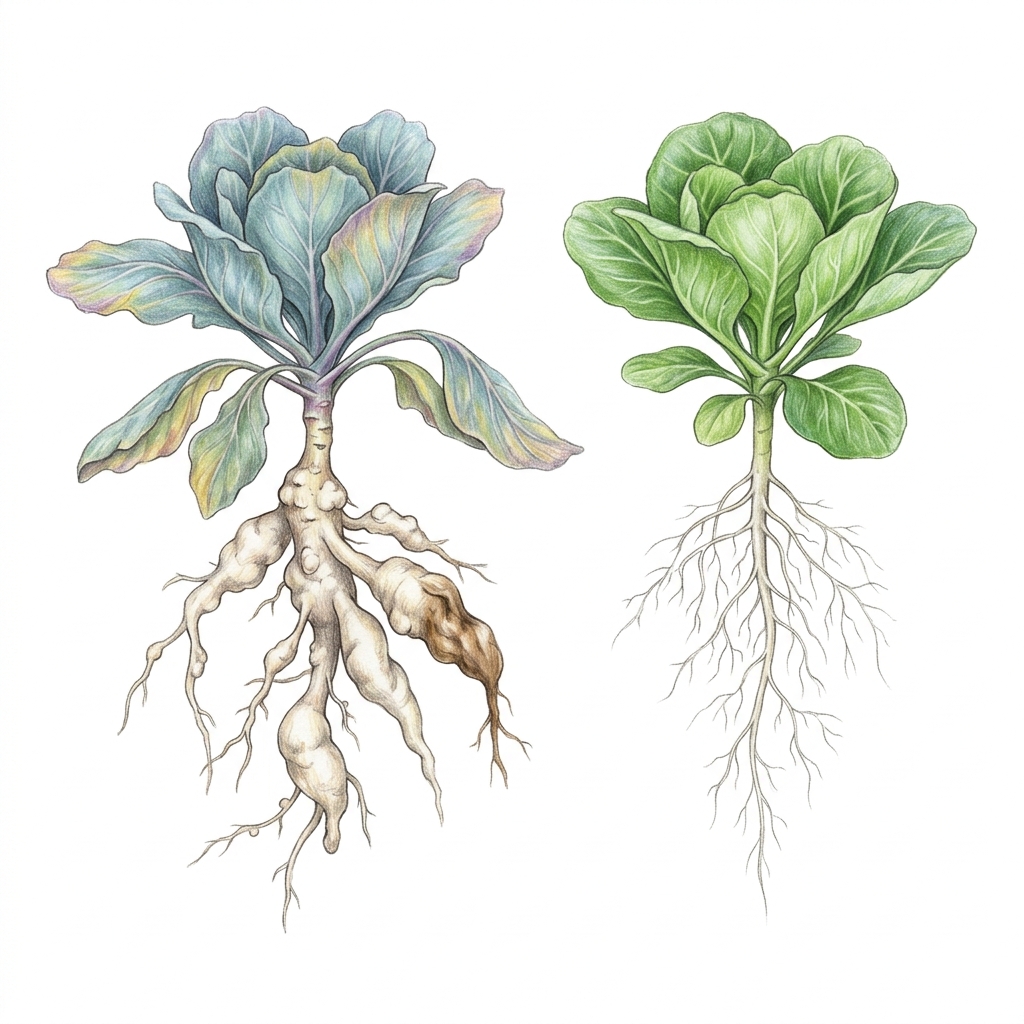
Illustration
A soil organism that makes the roots of cabbage-family plants swell into clubs, so the plants stunt, wilt and may die, and its spores stay in the soil for many years. There's no cure, so keep it out with clean plants and clean boots, and where it's already in the soil, lime acid soil, improve drainage, plant out strong pot-grown plants and choose resistant varieties.
How to spot it
- Plants that stop growing, with dull, yellowish or purplish leaves.
- Wilting on warm days, even in moist soil, with the plants picking up again in the cool of the evening.
- Dig a plant up: the roots are swollen into club- or spindle-shaped lumps, with few fine roots.
- Later the swollen roots go soft and rot, and badly affected plants die or never form a head.
- Most new infections happen from midsummer to late autumn, when the soil is warm and moist, and it is worst in acid, poorly drained soil.
Easily confused with
Root-knot nematodes
Smaller, rounder lumps along the roots, rather than big, irregular clubs that distort the whole root.
Cabbage root fly
Plants wilt and stunt too, but the roots are eaten and tunnelled by small white maggots instead of swelling.
Drought
A thirsty plant wilts too, but its roots are normal when you dig one up.
Where it's a problem
- Worldwide: Found wherever cabbage-family crops are grown, and worst in warm, wet, acid soils. Its resting spores can survive in the soil for 10 to 20 years.
- Australia: A problem for Western brassicas such as cabbage, cauliflower, broccoli, kale and Brussels sprouts, and for Asian brassicas such as bok choy, choy sum and daikon.
- United Kingdom: The RHS lists several partly resistant varieties of cabbage, cauliflower, calabrese, Brussels sprouts and swede.
- Canada: A declared pest in Alberta under the Agricultural Pests Act, where the owner or occupier of the land must act to stop it spreading. It has turned up in home gardens around Edmonton: ask your municipality or Alberta Agriculture what applies to you.
What to do
- Buy brassica seedlings only from a reliable source, or raise your own from seed in fresh potting mix. Don't accept plants from gardens where you don't know the soil.
- Clean the soil off boots, tools and barrows after working in an affected bed, so you don't carry it to clean ground.
- Where it's already in the soil, grow plants on in pots at least 9 cm (3½ in) across before planting out, so they have a strong root system.
- Test the soil. If it is acid, lime it to just above neutral (about pH 7.2), as much as the soil test says: this reduces club root but doesn't get rid of it. Improve drainage too, for example with raised beds.
- Dig up affected plants with the whole root, before the clubs rot and release their spores.
- Pull out cabbage-family weeds such as shepherd's purse and wild radish, which carry it too.
- Keep the cabbage family, including wallflowers and stocks, out of that bed for at least three years and preferably five to seven, and grow resistant varieties.
No spray helps: the RHS says there are no chemicals available to gardeners to treat it, and once a plant is infected nothing controls it. Keeping it out is the real defence.
Follow your local council's guidance for disposing of diseased plant material. Official guides usually advise against putting it in a home compost heap.
Vegetables it affects
Free account, no card needed. You sign up or sign in first, then the scanner opens.
Sources (6, from RHS, Pacific Pests, Pathogens and Weeds, Ohio State University and others)
- RHS: Club root
- Pacific Pests, Pathogens and Weeds: Cabbage club root
- Ohio State University: Club root, for diagnosticians
- AUSVEG: Clubroot management in brassica vegetables
- Government of Alberta: Alberta clubroot management plan
- UConn Extension IPM: Clubroot of brassicas
Facts checked Wednesday 28 October 2026. General guidance only: follow your local council, agency and product label.