Home › Garden pests › Bean seed fly
Garden pests
Bean seed fly
Delia platura and Delia florilega · Insect
Also called seedcorn maggot (North America).
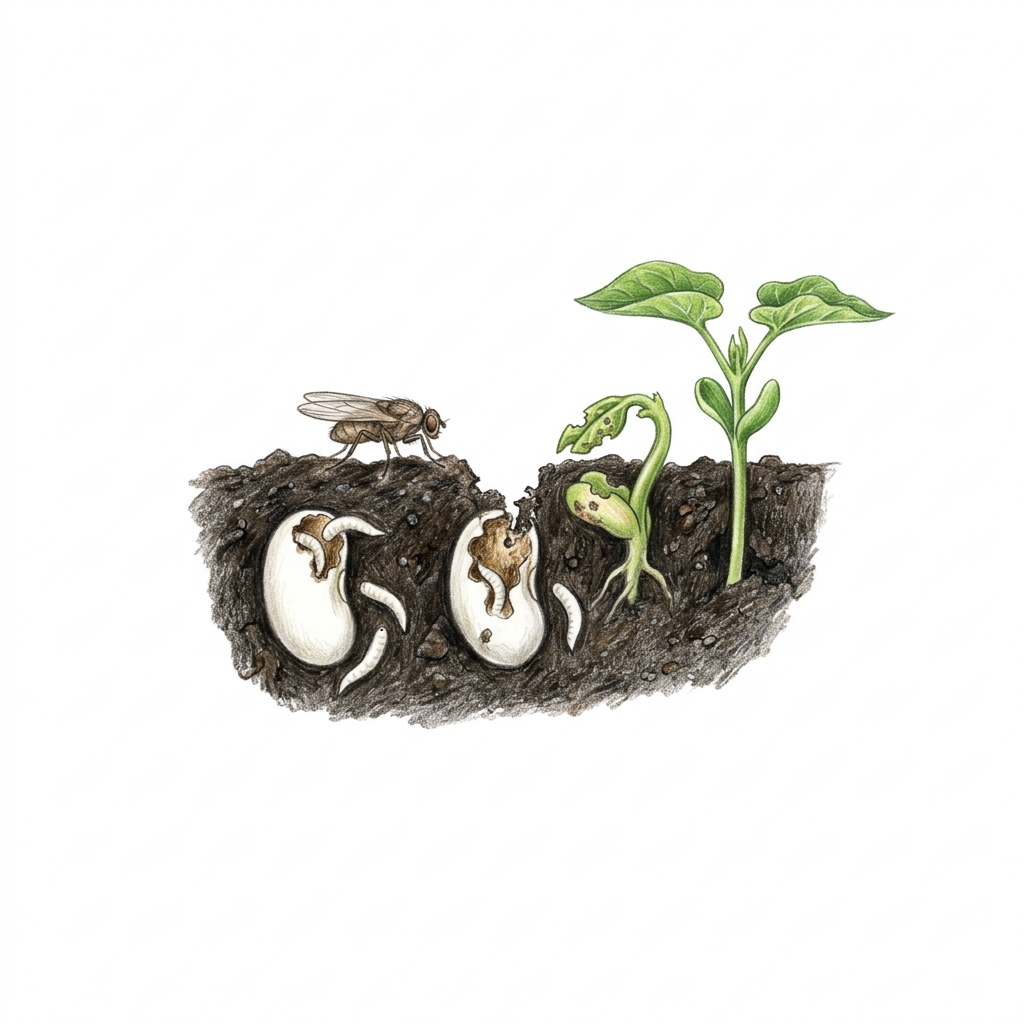
Illustration
A small grey-brown fly whose white maggots eat bean seeds and young shoots in the soil, so rows come up gappy or the seedlings emerge twisted and blind. Sow into warm soil, or raise beans in pots and plant them out, and dig in manure and compost well ahead of sowing.
How to spot it
- Gaps in the row where beans never come up; dug-up seeds are eaten into, often with maggots in them or in the soil around them.
- Seedlings that come up twisted, with the growing tip damaged or missing, and then stall or die.
- White, legless maggots up to about 6–8 mm (¼–⅓ in) long, with no obvious head.
- The adult: a slightly hump-backed, brownish fly about 5–7 mm (¼ in) long, like a small house fly.
- Worst in cold, wet soil, where seeds are slow to come up, and in freshly dug ground rich in manure, compost or dug-in green material.
Easily confused with
Poor germination
Seeds that rot or fail to sprout in cold, wet soil, or old seed, with no maggots in or around them.
Damping off
Seedlings come up normally, then collapse with a thin, water-soaked stem at soil level; there are no maggots.
Wireworms
Thin, hard, shiny yellow-brown larvae with three pairs of short legs near the head; bean seed fly maggots are soft and legless.
Bean fly
A tropical pest whose maggots tunnel in the leaves and stems of seedlings that have already come up, so they wilt; the stem swells and cracks near the soil.
Where it's a problem
- Worldwide: Found in the United Kingdom, across Europe, Canada and the United States, and in Australia (recorded in New South Wales, South Australia, Tasmania and Western Australia) and New Zealand.
- United Kingdom: The first generation, in May, often does the most damage. There are three to five generations in spring and summer, so later sowings of beans can be hit too.
- North America: Known as seedcorn maggot. It becomes active two weeks or more before the cabbage and onion maggots each spring, and the first generation causes the most damage.
What to do
- Wait until the soil has warmed before sowing beans outside, so they come up quickly; don't sow into cold, wet soil.
- Or raise beans in pots or trays and plant them out once they have germinated, which largely avoids the fly.
- Dig in manure, compost and green manures well before sowing: the autumn before, or at least four weeks ahead. Freshly dug, rich soil draws the flies to lay.
- Cover outdoor sowings with fleece or fine insect mesh. It only helps if the flies come from elsewhere: flies that spent the winter in that soil end up under the cover.
- If a sowing fails, resow: wait at least 5 days if the maggots you find are about 6 mm (¼ in) long, and at least 10 days if they are smaller, so they have finished feeding.
- Encourage birds, hedgehogs and ground beetles, which eat soil maggots.
If you use an insecticide, choose one labelled for bean seed fly and follow the label and local rules. Sources say there is no rescue treatment: by the time the damage shows, it is too late, so prevention is what works.
Vegetables it affects
Free account, no card needed. You sign up or sign in first, then the scanner opens.
Sources (4, from RHS, AHDB, UMass Amherst Extension and others)
- RHS: Bean seed fly
- AHDB: Risk factors and crop damage caused by bean seed flies
- UMass Amherst Extension: Seedcorn maggot
- EPPO Global Database: Delia platura, distribution
Facts checked Wednesday 28 October 2026. General guidance only: follow your local council, agency and product label.