Home › Garden pests › Wireworms
Garden pests
Wireworms
Agriotes and other click beetle (Elateridae) larvae · Insect
Also called true wireworms (to tell them from false wireworms) (Australia), click beetles (the adults) (UK, North America, Australia).
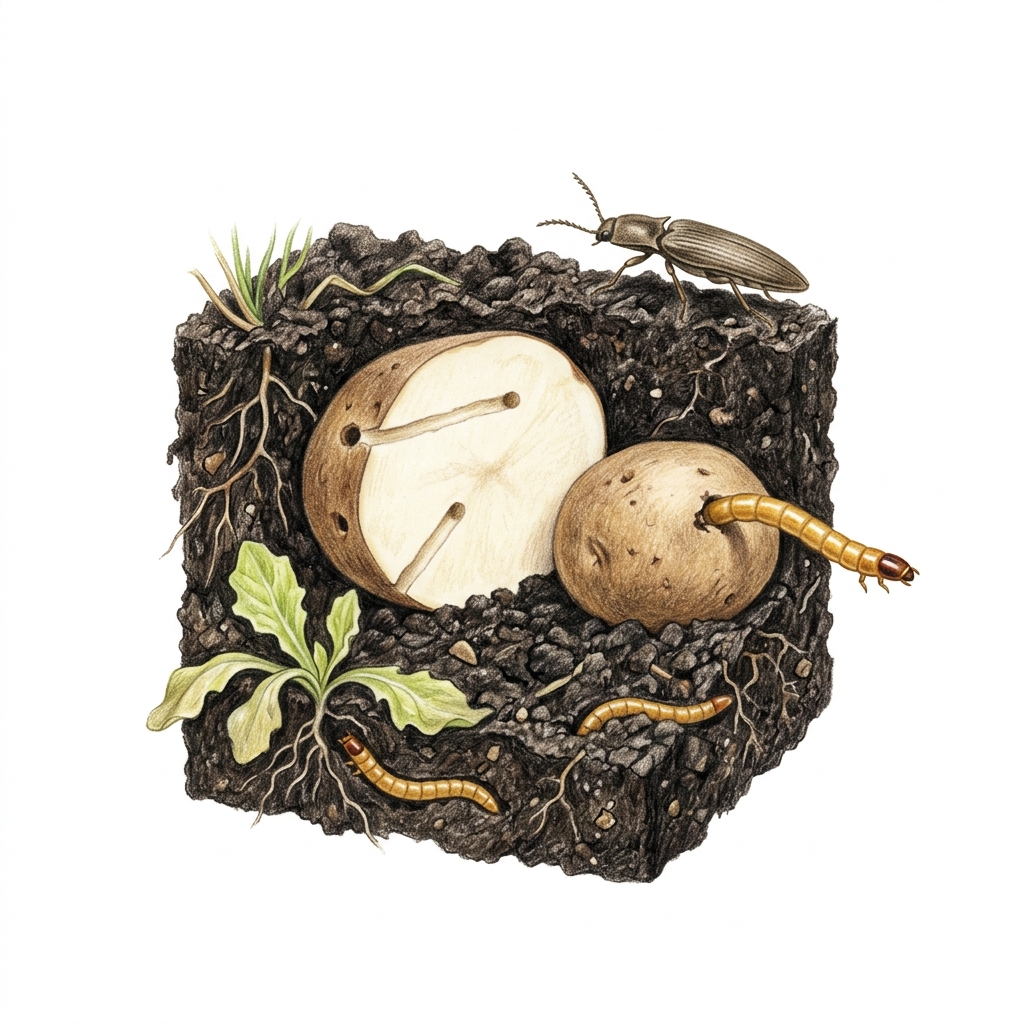
Illustration
Thin, shiny, yellow-brown larvae of click beetles that live in the soil for years and bore small holes through potatoes, carrots and other roots, worst in ground recently dug from lawn or grass. Trap them with buried baits, lift crops as soon as they are ready, and regular digging usually brings numbers down within a couple of years.
How to spot it
- Small, round holes about 3 mm (⅛ in) across, leading into narrow tunnels that go straight into potatoes, carrots and other roots.
- Thin, shiny, jointed larvae up to about 25–35 mm (1–1⅜ in) long, depending on the kind, cream, yellow or reddish-brown, with three pairs of short legs just behind the head.
- Seeds that fail to come up, and seedlings that wilt or die from holes chewed in the roots and stem base.
- Most damage in the first year or two after lawn or grass is dug up for a vegetable bed.
- The adults: slim brown or black beetles that flip upright with a click when turned on their backs.
Easily confused with
Millipedes
Many pairs of legs along the whole body; wireworms have just three pairs, right behind the head.
False wireworms
Larvae of darkling beetles, mainly a pest of field crops. They are hard-bodied and rounder, with a rounded head; true wireworms are softer and flatter, with a flattened head.
Slugs and snails
Slug holes in potatoes open into large hollows inside, where the slug often rests; wireworms leave only narrow tunnels.
Potato tuber moth
Its caterpillars enter at the eyes and leave tunnels packed with droppings, often with webbing at the hole; wireworm tunnels are clean.
Where it's a problem
- Worldwide: Found worldwide. Wireworms are the larvae of click beetles, and most click beetles are harmless: Britain has more than 70 species, and only a handful have larvae that eat garden roots.
- Australia: True wireworms, including the potato wireworm, are common in vegetable districts of Queensland and New South Wales, where they chew holes in potatoes and sweet potatoes and in the roots of new transplants. False wireworms, the larvae of darkling beetles, are mainly a pest of field crops.
- United Kingdom: Most common in newly dug grassland and turf. Regular cultivation brings numbers down, usually within about two years.
- North America: Worst on poorly drained land and in ground that was in grass (sod) within the last few years. Some species feed in the soil for several years before they turn into beetles.
What to do
- On ground newly dug from lawn or grass, grow crops other than potatoes and root vegetables for the first year or two if you can.
- Dig or fork the soil over before planting and pick out any wireworms you find; birds will take others brought to the surface.
- Set bait traps: push pieces of potato or carrot onto sticks and bury them 5–10 cm (2–4 in) deep and 1–3 m (3–10 ft) apart. After a week, dig them up and destroy them with the wireworms feeding inside.
- Keep beds well drained: wireworms do most harm in poorly drained ground.
- Rotate crops, so potatoes and root vegetables don't grow in the same spot each year.
- Lift potatoes as soon as they are mature rather than leaving them in the ground, and where wireworms are a problem grow early kinds, which can be lifted sooner.
- Encourage birds, ground beetles and hedgehogs, which eat wireworms.
If you use an insecticide, choose one labelled for wireworms and follow the label and local rules. Sources say insecticides are rarely warranted in home gardens, and treating once the damage shows is usually too late.
Vegetables it affects
Free account, no card needed. You sign up or sign in first, then the scanner opens.
Sources
- RHS: Wireworms
- University of Wisconsin–Madison Extension: Wireworms
- Business Queensland: Wireworm, true and false
- Business Queensland: Wireworms (field crops)
- University of Maryland Extension: Wireworms and maggots, vegetables
- Teagasc: Potato pests
Facts checked Wednesday 21 October 2026. General guidance only: follow your local council, agency and product label.