Home › Garden pests › Leaf miners
Garden pests
Leaf miners
Liriomyza, Phyllocnistis citrella and many other species · Insect
Also called leafminers (USA and Australia).
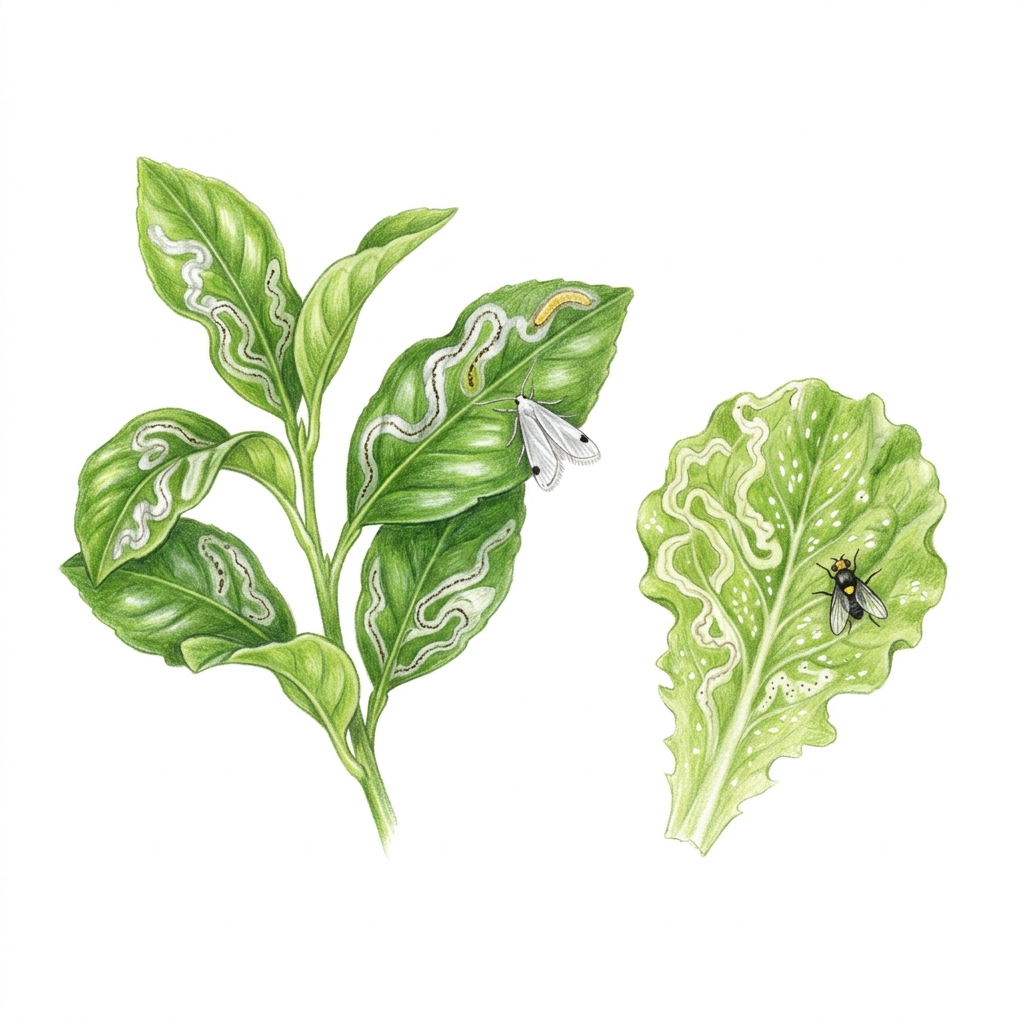
Illustration
Wiggly white or silvery trails, or pale blotches, inside leaves: the tunnels of tiny larvae feeding between the leaf surfaces. Most do little lasting harm and tiny wasps often keep them down, so tolerate them or pick off mined leaves on vegetables.
How to spot it
- Winding white, pale green or silvery trails inside the leaf that widen as the larva grows, often with a thin dark line of droppings along them.
- Pale blotches that turn brown and shrivel, on beetroot, chard and spinach beet, or yellowish-purple blotches on older holly leaves.
- On citrus, silvery trails in soft new leaves, which curl and distort.
- Tiny white speckles where the adult flies have fed on the leaf.
- The adults are tiny: Liriomyza flies are 1–2.5 mm long, black with a yellow head; the citrus leafminer is a small silvery-white moth.
Easily confused with
Citrus peelminer
Mines the fruit and stems rather than the leaves, and leaves no dark line of droppings.
Where it's a problem
- Australia: Serpentine leafminer has been found in New South Wales, Queensland and Victoria since 2020, and American serpentine leafminer is widespread in Queensland; Queensland doesn't need reports of either. Vegetable leafminer is known only from the tip of Cape York and the Torres Strait: report it if found anywhere else (Biosecurity Queensland 13 25 23, or the Exotic Plant Pest Hotline 1800 084 881).
- Western Australia: Serpentine leafminer is a declared pest and isn't known to occur in WA. Report suspect mines through MyPestGuide Reporter or DPIRD's PaDIS on (08) 9368 3080.
- United Kingdom: Nearly 900 kinds of insect mine leaves in Britain. Common garden ones, such as holly and beet leaf miners, are usually best tolerated.
What to do
- Squeeze the mined patch to crush the larva inside, or pick off and bin mined leaves on vegetables and small plants.
- On hollies and big shrubs, just tolerate them; removing every mined leaf would strip the plant.
- On citrus, leave damaged leaves on the tree: they still feed it, and removing them triggers new growth that attracts more leafminers. Prune live branches no more than once a year, and don't feed with nitrogen fertiliser while numbers are high.
- Grow beetroot, chard and other leafy crops under fine insect netting, and rotate crops so flies don't emerge from the soil under the net.
- Keep plants well watered and growing strongly, and let parasitic wasps and birds such as blue tits do their work.
If you use an insecticide, choose one labelled for leaf miners and follow the label and local rules. Sprays often kill the tiny parasitic wasps that keep leaf miners down, and a fresh outbreak can follow.
Free account, no card needed. You sign up or sign in first, then the scanner opens.
Sources
- RHS: Beet leaf miner
- RHS: Holly leaf miner
- University of California IPM: Vegetable leafminers
- University of California IPM: Citrus leafminer
- Business Queensland: Liriomyza leafminers
- Business Queensland: Vegetable leafminer
- WA DPIRD: Serpentine leafminer
Facts checked Sunday 27 September 2026. General guidance only: follow your local council, agency and product label.