Home › Garden pests › Japanese beetle
Garden pests
Japanese beetle
Popillia japonica · Insect
Illustration
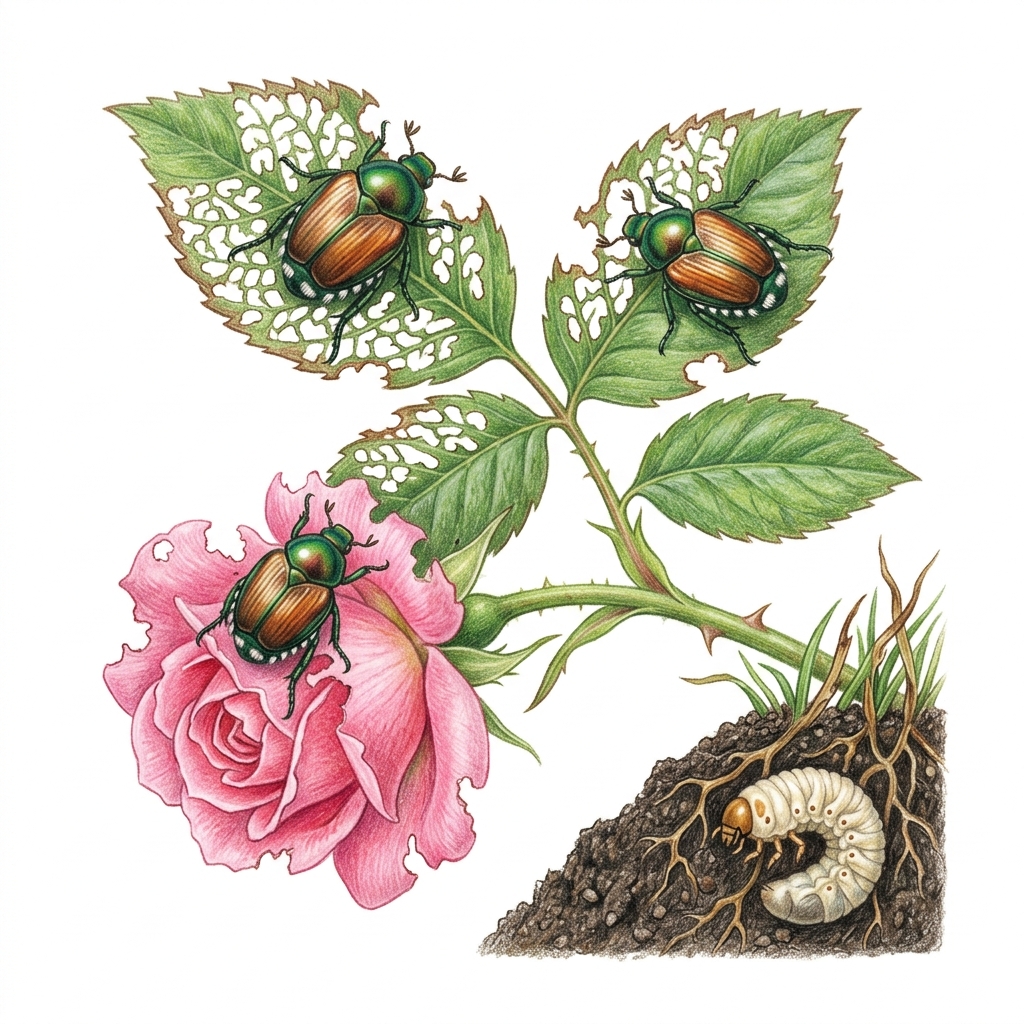
A shiny green-and-copper beetle that chews the leaves of roses, grapes and hundreds of other plants into lace, while its grubs eat lawn roots. Common in eastern North America and spreading in Europe; in Australia and the UK, report it.
How to spot it
- An oval, shiny beetle about 8–11 mm long, with a metallic green head and thorax and coppery-brown wing cases that don't quite cover the tail.
- Small tufts of white hair along each side of the abdomen and two white spots at the tail end: the surest sign.
- Leaves eaten between the veins into a lace-like skeleton, with beetles often feeding in groups from the top of the plant down.
- Chewed flowers and damaged fruit, such as roses, grapes and raspberries.
- In lawns, creamy-white C-shaped grubs in the roots, and brown patches of dead grass that can be rolled back like carpet.
Easily confused with
Garden chafer and rose chafer
Similar-looking chafers in Britain and Europe, but without distinct white tufts along the sides and at the tail.
Green fruit beetle
Much bigger, about 2–3.5 cm long, with no white tufts.
Other lawn grubs
Japanese beetle grubs have a V-shaped pattern of spines on the last body segment.
Where it's a problem
- Australia: Not found in Australia. If you see a metallic green beetle with white tufts along its sides, call the Exotic Plant Pest Hotline on 1800 084 881.
- United Kingdom: A notifiable pest: you must report any suspected Japanese beetle, wherever it's found, to the plant health authority (APHA).
- Europe: Established in parts of northern Italy (first found near Milan in 2014) and Switzerland, and in the Azores; there have been a few finds in Germany. It's regulated in the EU.
- North America: Established across much of the eastern United States and southern Ontario. California has eradicated repeated introductions; report suspected beetles there to your county agricultural commissioner or the CDFA Pest Hotline, 800-491-1899.
What to do
- In Australia and the UK, report any suspected Japanese beetle before doing anything else.
- Check plants often in summer and knock beetles into a bucket of soapy water. They drop and play dead when disturbed, and this works best in the early morning.
- Cover prized plants with fine insect netting (mesh 6 mm or smaller) while the adults are flying.
- Don't hang beetle traps: they draw in more beetles than they catch and can increase damage nearby.
- In lawns, let the top of the soil dry out in midsummer when eggs are laid; the eggs and young grubs die easily when dry.
In Australia and the UK, report it rather than treating it. Elsewhere, if you use an insecticide, choose one labelled for Japanese beetle and follow the label and local rules; sources warn that some harm bees visiting the flowers.
Free account, no card needed. You sign up or sign in first, then the scanner opens.
Sources
- Plant Health Australia: Japanese beetle fact sheet
- Defra Plant Health Portal: Japanese beetle factsheet
- GOV.UK: Popillia japonica, plant health information
- EPPO Global Database: Popillia japonica distribution
- University of California IPM: Japanese beetle repeatedly eradicated from California
- University of Wisconsin–Madison Extension: Japanese beetle
- Colorado State University Extension: Japanese beetle
Facts checked Sunday 27 September 2026. General guidance only: follow your local council, agency and product label.