Soil
Soil pH
Also called soil acidity or alkalinity (gardeners and farmers), pHCa (pH in calcium chloride) (Australian soil test reports), pHw (pH in water) (soil test reports).
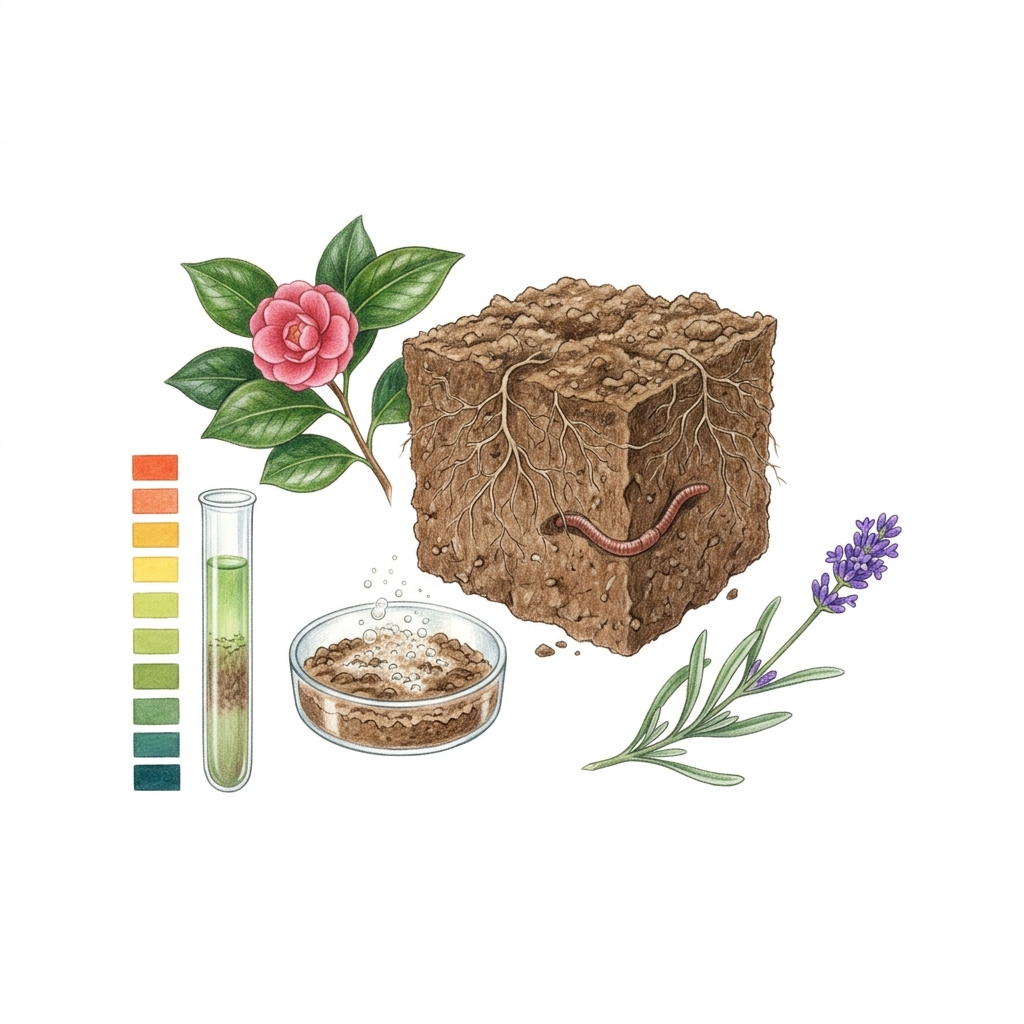
Illustration
Soil pH tells you how acid or alkaline your soil is, on a scale of 0 to 14 where 7 is neutral. Most garden plants do best in slightly acid to neutral soil, where nutrients are easiest for roots to take up.
How to tell
- A home test kit is cheap and gives a good indication. For the most accurate reading, send a sample to a soil lab.
- Don't test within three months of adding lime, fertiliser or organic matter, as the result can mislead.
- Add a little vinegar to a soil sample. If it fizzes, the soil holds free chalk or lime, and it usually can't be made more acid.
- Read the plants: yellow leaves with green veins on lime-hating plants such as rhododendrons hint at alkaline soil.
- Australian lab reports may give pH in calcium chloride (pHCa), which reads lower than pH in water (pHw), so check which one you have.
Easily confused with
Acidic soil
Soil whose pH sits below 7. Strongly acid soil locks up nutrients and can release aluminium that harms roots.
Alkaline and chalky soil
Soil whose pH sits above 7, often full of chalk or lime that fizzes with vinegar.
Where it's common
- Worldwide: Rain slowly washes calcium and magnesium out of soil, so wetter places lean acid and drier places lean alkaline. In Queensland, soils typically run pH 5 to 7 in higher-rainfall areas and 6.5 to 9 in drier ones.
- North America: pH can change a lot within one state: northern Wisconsin's forest and lowland soils are often acidic, while soils in the south are much more likely to be alkaline.
- Australia: Labs often measure pH in calcium chloride, which gives a lower number than pH in water. Compare results measured the same way.
How to improve it
- Test before you change anything. Don't add lime or sulphur to a lawn or garden without a recent soil test.
- For most gardens, slightly acid to neutral suits the widest range of plants. The RHS calls pH 6.5 the best general-purpose level; other sources give slightly different ranges.
- To raise pH (make soil less acid), add lime. It takes several months to react, so add it well before planting.
- To lower pH, sulphur works slowly as soil bacteria turn it into acid. Soil with free chalk or lime usually can't be treated.
- Or work with what you have, and choose plants that suit your soil's pH.
- Retest every three to five years to see how it's changing.
Plants that do well
- Most vegetables (slightly acid soil)
- Lawns and most ornamentals (slightly acid soil)
- Azaleas and rhododendrons (acid soil)
- Camellias and heathers (acid soil)
- Blueberries (strongly acid soil)
- Conifers (acid soil)
Free account, no card needed. You sign up or sign in first, then the scanner opens.
Sources
- RHS: Soil: understanding pH and testing
- NC State Extension: Extension Gardener Handbook, Soils and plant nutrients
- Clemson Cooperative Extension: Changing the pH of your soil
- Penn State Extension: Understanding soil pH
- Queensland Government: Soil pH
- Soil Quality Knowledge Base (Murdoch University and WA DPIRD): Soil acidity
- University of Wisconsin-Madison Extension: Do garden soils need limestone or sulfur?
Facts checked Sunday 27 September 2026. General guidance only: follow your local council, agency and product label.