Soil
Clay soil
Also called heavy soil (gardeners), sodic or dispersive clay (Australia, when high in sodium).
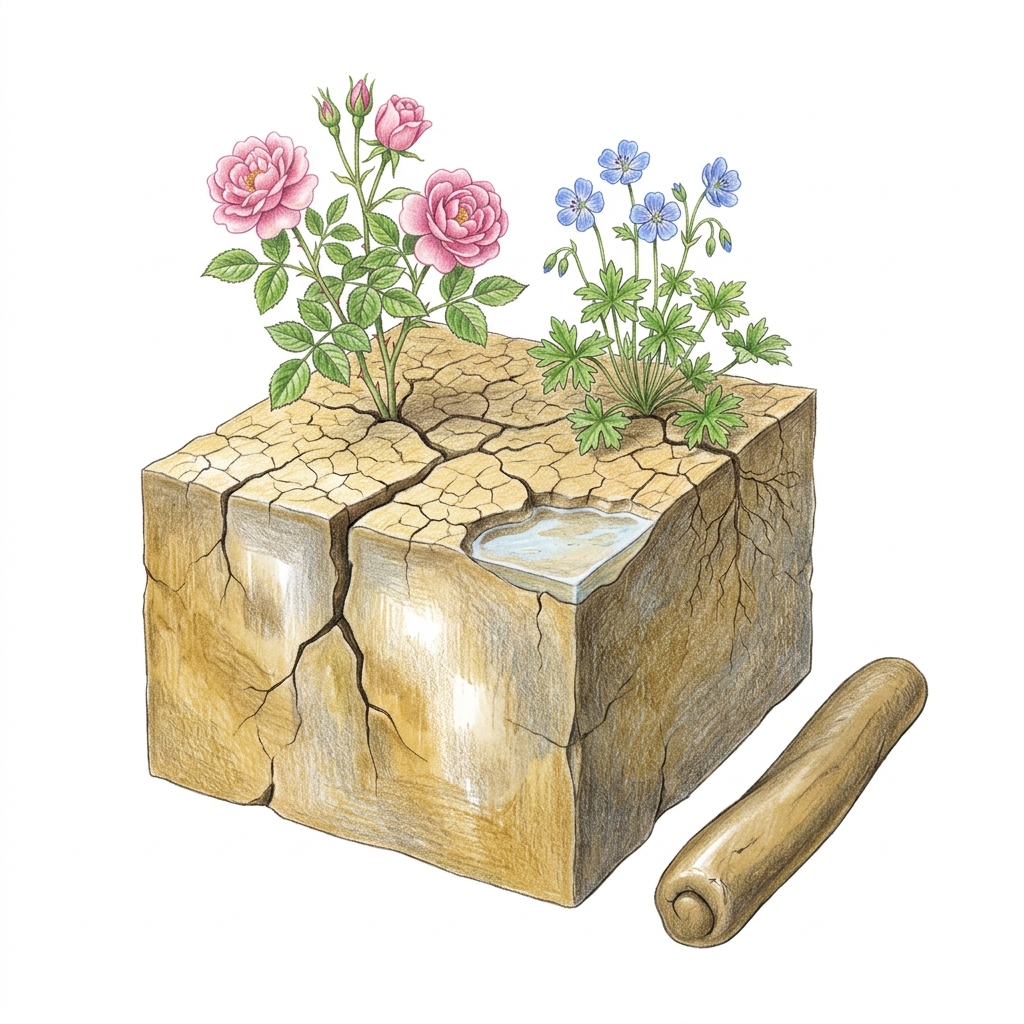
Illustration
Rich but slow to drainWet and cold in winter, cracks in summer
Clay soil is sticky when wet and sets hard when dry. It's rich in nutrients and holds water well, but drains slowly, warms up late in spring and compacts easily. Add organic matter, keep off it when wet, and grow plants that like it.
How to tell
- Squeeze test: a moist lump rolls into a ball, then a sausage, without cracking. If rubbing makes the surface shiny, it's heavy clay.
- Ribbon test: work a moist pinch between thumb and finger. Clay pushes out a ribbon about 5 cm or longer before it breaks.
- Puddles linger after rain, and the ground stays cold and wet into spring.
- It bakes hard and cracks in summer.
- Cloudy puddles, a hard surface crust and a soapy feel when wet point to sodic clay, which is common in Australia.
Easily confused with
Silty soil
Makes a much shorter ribbon before it breaks.
Compacted soil
Any soil trodden or worked while wet can go dense and puddle. If a moist pinch makes only a short ribbon, it isn't clay.
Where it's common
- Australia: Sodic, dispersive clays are widespread. About 45% of Queensland's soils are sodic, and Victoria's state soil has a dispersive subsoil that water builds up on after heavy rain.
- Queensland: Cracking clays (Vertosols) are the state soil and cover 28% of Queensland. They shrink and swell, opening deep, wide cracks as they dry.
How to improve it
- Keep off it when it's wet, and dig in autumn or early winter while it's fairly dry. Worked or walked on wet, clay loses its structure and packs down.
- Dig in plenty of bulky organic matter, such as well-rotted manure or composted bark, and mulch around trees, shrubs and other permanent plants.
- Make raised beds to help drainage and to stop the soil being trampled.
- Sources differ on calcium. The RHS says some, but not all, clays respond to it: lime if the soil is acid, gypsum if not. Iowa State University finds gypsum of little use except on sodic soils, which is where Australian agencies use it. Test first.
- Don't count on sand or grit. The RHS says you'd need impractically large amounts to make a difference; US extension services go further and warn that sand can bind with clay into something denser. Both prefer organic matter.
- Favour long-lived plants, such as roses, shrubs and trees, over annual bedding.
Plants that do well
- Roses, including climbing roses
- Fruit trees
- Hydrangeas and viburnums
- Mahonia
- Hardy geraniums, hellebores and hostas
- Trees such as birch and crab apple
- Clematis and other climbers
Free account, no card needed. You sign up or sign in first, then the scanner opens.
Sources
- RHS: Clay soils
- RHS: Clay soils: plants for
- Queensland Government: Soil texture
- Queensland Government: Soil sodicity
- Iowa State University Extension: Will an application of gypsum improve a clay soil?
- University of Arkansas Cooperative Extension: Will adding sand help my clay soil?
- Soil Science Australia: State soils
Facts checked Sunday 27 September 2026. General guidance only: follow your local council, agency and product label.