Home › Plant diseases › Black rot
Plant diseases
Black rot
Xanthomonas campestris pv. campestris · Bacterium
Also called black rot of crucifers (USA), cabbage black rot (the Pacific).
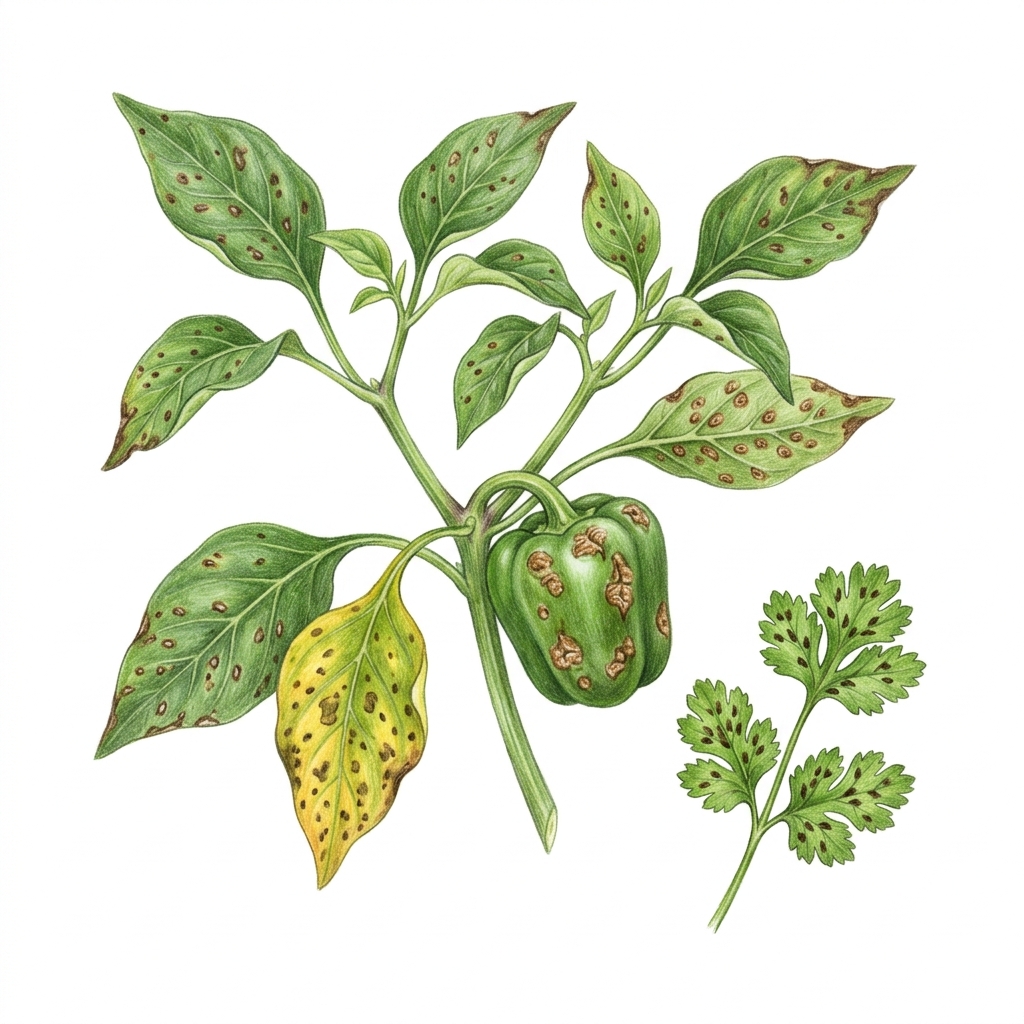
Illustration
A bacterial disease of the cabbage family that makes yellow, V-shaped patches at the leaf edges with blackened veins, and can rot heads and kill plants. There's no cure, so start with clean seed and seedlings, keep the leaves dry, pull out sick plants and keep the cabbage family out of that bed for three to four years.
How to spot it
- Dull yellow patches at the leaf edges that widen into V-shaped wedges, broad at the edge and pointing in towards the leaf stalk.
- The centres of the wedges turn brown and dry, with a yellow border.
- Blackened veins inside the yellow patches, in a net-like pattern that shows best when you hold the leaf up to the light.
- A dark ring inside the stem when it is cut across, and plants that wilt.
- Rotting heads, often followed by a soft rot. It can take more than a month after planting for the first signs to show.
Easily confused with
Alternaria leaf spot
Round brown to black spots with target-like rings, anywhere on the leaf, rather than V-shaped wedges from the edge; the veins don't blacken.
Downy mildew
Yellow patches held in by the veins on top, with grey-white fuzz underneath, and no black veins.
Bacterial leaf spot
Small, dark, water-soaked spots scattered over the leaf, rather than yellow wedges from the edge with blackened veins.
Where it's a problem
- Worldwide: Found wherever cabbage-family crops are grown, and an important disease of them. It is worst in warm, humid weather, around 27°C (80°F), and usually arrives on seed or bought seedlings.
- United Kingdom: Seen most on late autumn and winter crops, whose seedlings are raised in the hottest months. Almost all serious outbreaks have been traced back to infected seed.
What to do
- Start with good seed and healthy seedlings from a reliable supplier, and throw out any seedling with yellow or blackened leaf edges.
- Water the soil, not the leaves, with a soaker hose or drip line rather than a sprinkler, and space plants so they dry quickly.
- Keep out of the bed while the plants are wet: hands, clothes and tools carry the bacteria from plant to plant.
- Pull out infected plants as soon as you see them. Where it's bad, also remove the cabbage-family plants within 1–1.5 m (3–5 ft) of them.
- Clean tools, pots and trays that touched infected plants before using them again.
- Pull out cabbage-family weeds such as shepherd's purse and wild mustard, which can carry it.
- After harvest, clear away the old plants: the bacteria can live in their remains for up to two years. Keep the cabbage family out of that bed for three to four years.
No spray cures it once a plant is infected. Official guides don't recommend relying on sprays: at best they slow it on lightly affected plants, so clean seed, dry leaves and removing sick plants do the work.
Follow your local council's guidance for disposing of diseased plant material.
Vegetables it affects
Free account, no card needed. You sign up or sign in first, then the scanner opens.
Sources (5, from University of Wisconsin–Madison Plant Disease Diagnostics Clinic, Utah State University Extension, Pacific Pests, Pathogens and Weeds and others)
- University of Wisconsin–Madison Plant Disease Diagnostics Clinic: Black rot of crucifers
- Utah State University Extension: Black rot
- Pacific Pests, Pathogens and Weeds: Cabbage black rot
- Penn State: Bacterial pathogens of crucifers
- AHDB: Black rot of brassicas, symptoms and biology
Facts checked Wednesday 28 October 2026. General guidance only: follow your local council, agency and product label.