Home › Garden pests › Onion fly
Garden pests
Onion fly
Delia antiqua · Insect
Also called onion maggot (USA and Canada).
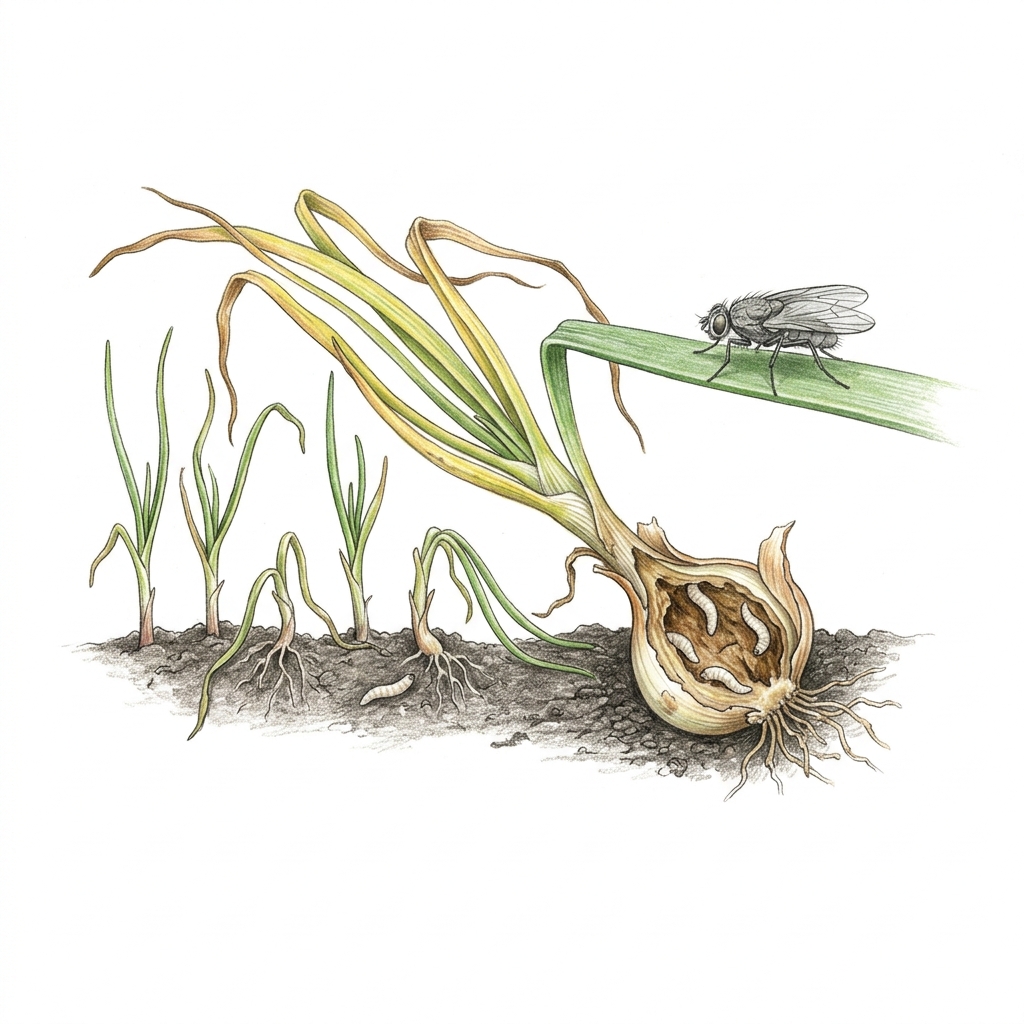
Illustration
A small grey fly whose white maggots eat the roots of onions, shallots and leeks and bore into the bulbs, killing seedlings and destroying bulbs. Cover the crop with fine insect mesh, rotate beds and destroy infested plants; it is not found in Australia or New Zealand, where a suspected find should be reported.
How to spot it
- Seedlings that wilt, go floppy and die, often several in a row.
- On older plants, outer leaves that yellow and wilt, and plants that collapse.
- White, legless maggots up to about 8–10 mm (⅜ in) long, tapering to the head end, in the roots and the base of the bulb.
- Bulbs tunnelled and destroyed from the base, as later generations of maggots feed inside them.
- Slender grey flies about 5–7 mm (¼ in) long, like small house flies, around the plants from spring.
Easily confused with
Allium leaf miner
Its maggots feed inside the leaves, bore down into the stem and bulb, and pupate there; onion fly maggots feed on the roots, not within the leaves, and pupate in the soil.
Seedcorn maggot (bean seed fly)
A very similar fly and maggot that also attacks beans, sweet corn and other crops. The adult has three dark stripes on its back; onion fly has five.
Onion white rot
White, fluffy mould on the base of the bulb and the roots, dotted with tiny black specks like poppy seeds, and no maggots.
Where it's a problem
- Worldwide: Native to Europe and common throughout the Northern Hemisphere, including North America.
- Australia: Not found in Australia, and listed as a high-priority exotic pest of onions. A similar fly already here, Delia platura (seedcorn maggot, also called onion maggot in Australia), attacks a wider range of crops. Report a suspected onion fly to the Exotic Plant Pest Hotline on 1800 084 881.
- New Zealand: Not known to be present in New Zealand, where MPI lists it as an unwanted organism. Report a suspected find to MPI's exotic pest and disease hotline on 0800 80 99 66.
- United Kingdom: Most often found in central and eastern England. Adults appear from May, damage is worst in June and July, and there can be three generations a year.
- North America: Called onion maggot. There are several generations a year, but most of the damage falls on early spring plantings, especially in cool, wet springs.
What to do
- Cover onions with fine insect mesh or row cover from planting, edges secured, in a bed where onions didn't grow last year: flies coming out of the soil would otherwise be trapped underneath.
- Rotate: grow onions and their relatives in a different bed each year.
- Grow onions and shallots from sets rather than seed: the bigger young plants survive the first generation of maggots better.
- Pull up and destroy wilting or damaged plants, maggots and all, as soon as you see them, so the maggots can't finish growing.
- After harvest, clear away leftover onions, roots and plant debris rather than leaving them in the bed.
- Encourage birds, hedgehogs and ground and rove beetles, which prey on onion fly.
In Australia and New Zealand, report it rather than treating it. Elsewhere, if you use an insecticide, choose one labelled for onion fly and follow the label and local rules. Sources say nothing rescues a crop once the maggots are feeding, so prevention is what works.
Vegetables it affects
Free account, no card needed. You sign up or sign in first, then the scanner opens.
Sources
- RHS: Onion fly
- University of Minnesota Extension: Cabbage and onion maggots
- AUSVEG: Frontline exotic pest profile, onion fly
- Farm Biosecurity: Onion pest threats
- MPI Official New Zealand Pest Register: Onion fly
- MPI: Report a pest or disease
Facts checked Wednesday 21 October 2026. General guidance only: follow your local council, agency and product label.