Home › Plant diseases › White rot
Plant diseases
White rot
Stromatinia cepivora (formerly Sclerotium cepivorum) · Fungus
Also called onion white rot (UK and Australia), Allium white rot (USA).
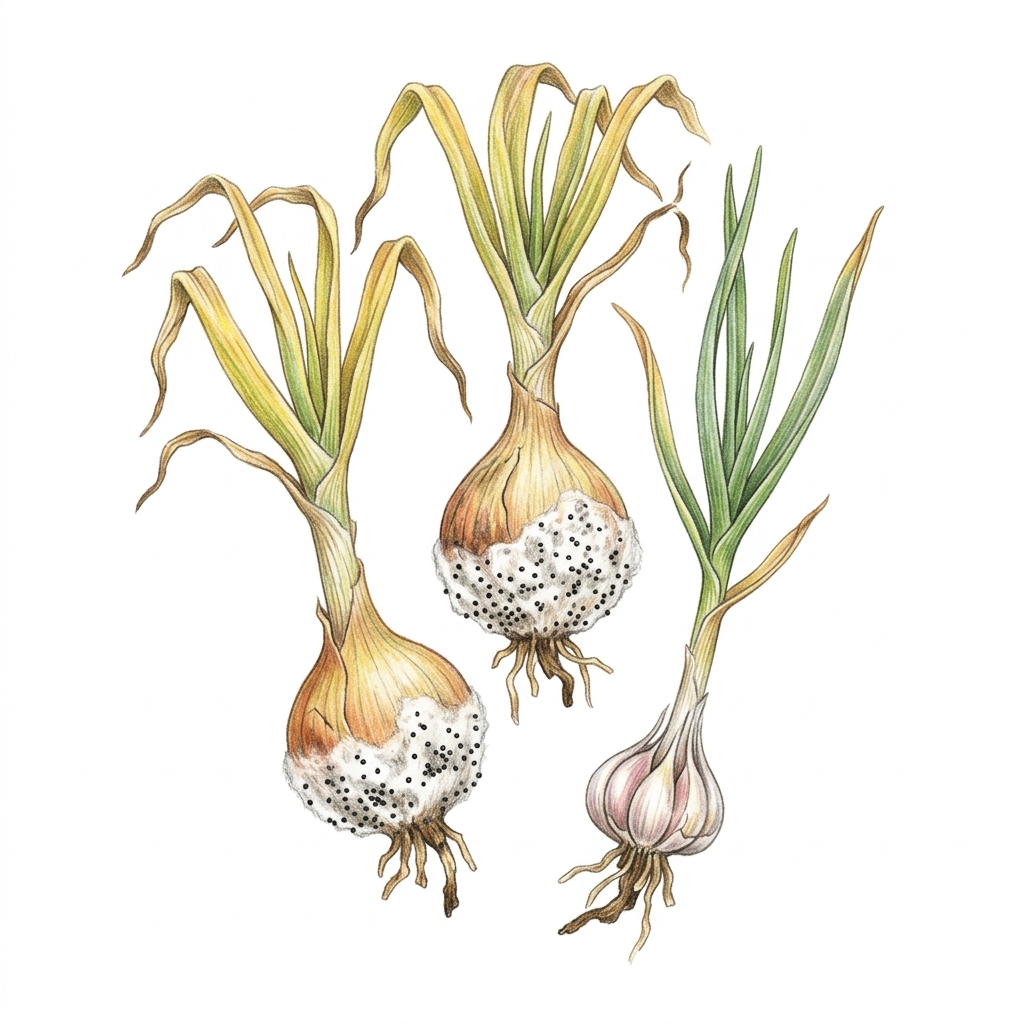
Illustration
A soil fungus that rots the roots and bulb base of onions, garlic and leeks, leaving white, fluffy mould dotted with tiny black specks. It can't be cured and can last in the soil for 20 years or more, so lift affected plants with their soil, keep the onion family out of that bed, and take care not to carry its soil anywhere else.
How to spot it
- Older leaves yellow and die back and the plant wilts, most obviously in dry weather.
- Plants pull out of the ground easily: the roots have rotted.
- White, fluffy mould on the base of the bulb and the roots.
- Tiny round black dots in the mould, about the size of a poppy seed, 0.5 mm (1/32 in) across. Later the mould packs down and is harder to see.
- It likes cool, moist soil, around 10–24°C (50–75°F), and is held back in warmer soil. In Britain it shows from midsummer into early autumn.
Easily confused with
Fusarium basal rot
A soft, watery rot spreading up from the base, favoured by warm soil, around 25–28°C (77–82°F), and without the poppy-seed black dots.
Neck rot
Shows in stored onions weeks after harvest, starting at the neck with dusty grey mould.
Downy mildew
Pale patches on the leaves with grey-purple fuzz, while the roots and the base of the bulb stay sound.
Where it's a problem
- Worldwide: A serious disease of onions and garlic wherever they're grown in cool, moist soil.
- United Kingdom: Easily spread around allotments on shared tools and boots, and worst in cool, wet summers.
- Australia: Brought in during the 1960s, it spread to every onion-growing state except Western Australia, which kept strict movement controls to stay free of it. Western Australia's official organism list now records it as present there too.
- North America: A regulated pest in Oregon, Washington and Idaho and under Canadian plant health rules, so check local rules before bringing in onion or garlic bulbs, sets or seedlings for planting.
What to do
- Lift affected plants carefully, with the soil around their roots, and bag them straight away: rotting bulbs fill the soil with new black dots.
- Don't grow onions, garlic, leeks, shallots or chives in that bed again: the dots wait in the soil, and rotation alone won't clear them.
- Keep that bed's soil where it is: clean tools, boots and barrows before working elsewhere, and don't give away plants or soil from it.
- Plant only healthy sets, garlic cloves and seedlings from a reliable source, never ones from a garden that has had white rot.
There are no treatments for gardeners, even for the soil, and farm fungicides only hold it back. Keeping it out is the real defence.
Follow your local council's guidance for disposing of diseased plant material. Official guides usually advise against putting it in a home compost heap.
Vegetables it affects
Free account, no card needed. You sign up or sign in first, then the scanner opens.
Sources
- RHS: Onion white rot
- University of California IPM: White rot of onion and garlic
- Farm Biosecurity: Onion pest eradication or control examples
- WA DPIRD: Western Australian Organism List (search Sclerotium cepivorum)
- USDA Agricultural Research Service: White rot of garlic and onion
- Texas A&M Plant Disease Handbook: Onion
Facts checked Wednesday 21 October 2026. General guidance only: follow your local council, agency and product label.