Home › Plant diseases › Aster yellows
Plant diseases
Aster yellows
'Candidatus Phytoplasma asteris' · Phytoplasma
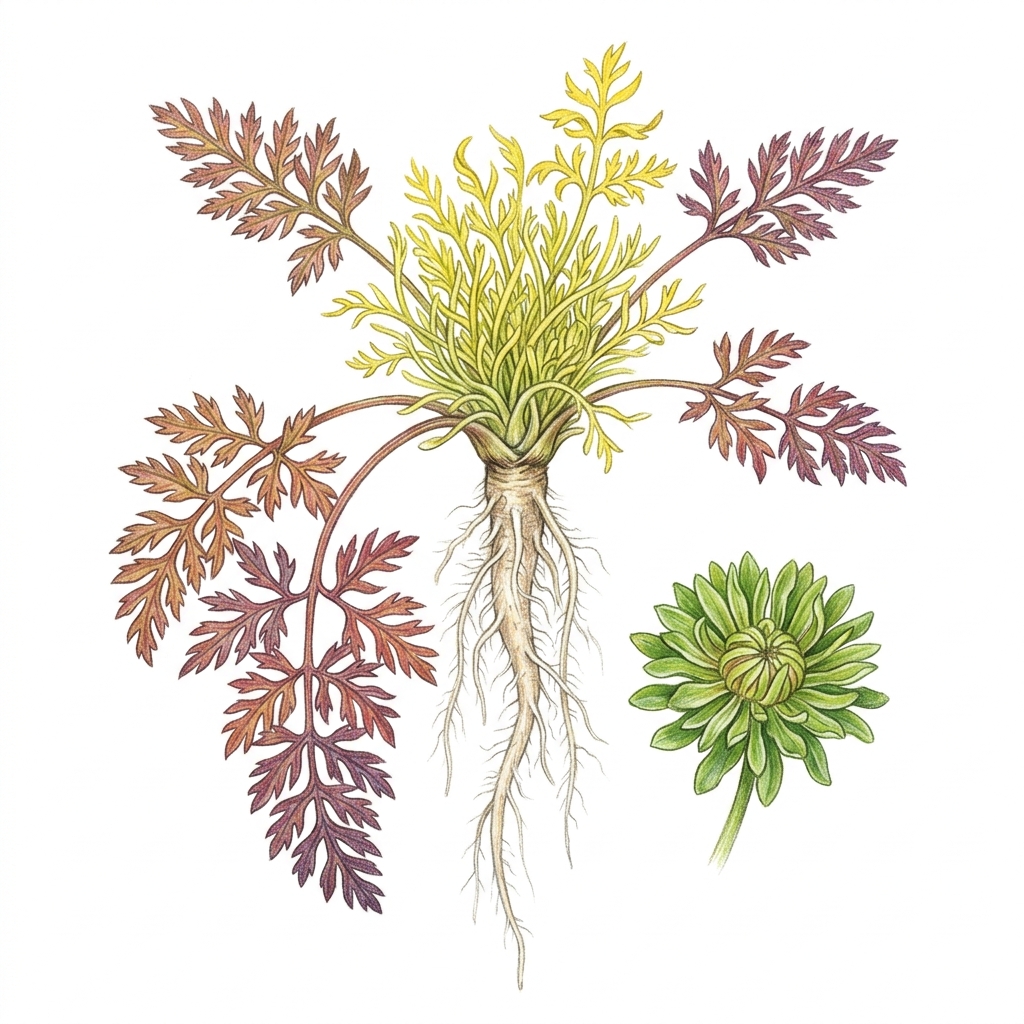
Illustration
A tiny bacteria-like organism, carried by leafhoppers, that turns carrot tops yellow, twisted and bunched and makes the roots hairy and bitter. There's no cure, so pull out affected plants and the weeds that harbour it and keep leafhoppers off with fine covers; in Australia and New Zealand, where it isn't present, report it instead.
How to spot it
- New leaves in the centre turn yellow and twist, then a dense tuft of thin, pale shoots grows from the crown (a 'witches' broom').
- Older leaves turn bronze, red or purple and snap off easily.
- Roots covered in fine, white, hairy rootlets, often slender and bitter-tasting.
- In flowers such as asters and marigolds, petals that turn green and leafy, and misshapen blooms.
- Stunted, yellowing plants of many kinds, often worse in hot weather.
Easily confused with
Herbicide damage
Twisted, distorted growth that appears suddenly on many plants and weeds at once, after spraying nearby.
Alternaria leaf blight
Dark spots with yellow edges on the older leaves, and normal roots.
Mosaic virus
A light-and-dark green mottle across the leaves rather than yellow, bunched new growth.
Where it's a problem
- Worldwide: Found in North America, Europe, Asia, South Africa and parts of South America.
- North America: A familiar problem in carrots and lettuce. The aster leafhopper that carries it flies north on warm winds each spring.
- Australia: Exotic: not found in Australia. If you think you've found it, photograph it, leave the plants alone and report it to the Exotic Plant Pest Hotline, 1800 084 881.
- New Zealand: Not reported in New Zealand. Photograph suspect plants and call 0800 80 99 66.
What to do
- In Australia, report it to the Exotic Plant Pest Hotline, 1800 084 881; in New Zealand, call 0800 80 99 66. Photograph the plants and leave them where they are.
- Elsewhere, pull out affected plants as soon as you see them: there's no cure, and leafhoppers carry it on from them.
- Pull weeds that can harbour it, such as dandelions, wild carrot (Queen Anne's lace) and ragweed.
- Cover carrots and lettuce with fine insect netting or a floating row cover to keep leafhoppers off.
- Where it keeps coming back, grow carrot varieties sold as resistant or tolerant.
- Check new plants for symptoms before you buy or plant them.
There's no cure. Official guides say spraying leafhoppers in a home garden is usually not practical or effective: in a garden, covers and pulling out infected plants are what works.
Follow your local council's guidance for disposing of diseased plant material.
Vegetables it affects
Free account, no card needed. You sign up or sign in first, then the scanner opens.
Sources
- Australian Government DAFF: Phytoplasmas 16SrI group (aster yellows)
- Ministry for Primary Industries (NZ): Aster yellows phytoplasma
- University of Wisconsin–Madison Extension: Aster yellows
- University of Wisconsin–Madison Vegetable Entomology: Aster leafhopper
- Iowa State University Extension: Aster yellows
- Connecticut Agricultural Experiment Station: Carrot
Facts checked Wednesday 21 October 2026. General guidance only: follow your local council, agency and product label.