Home › Plant diseases › White blister
Plant diseases
White blister
Albugo candida and related Albugo and Pustula species · Water mould
Also called white rust (USA and the Pacific).
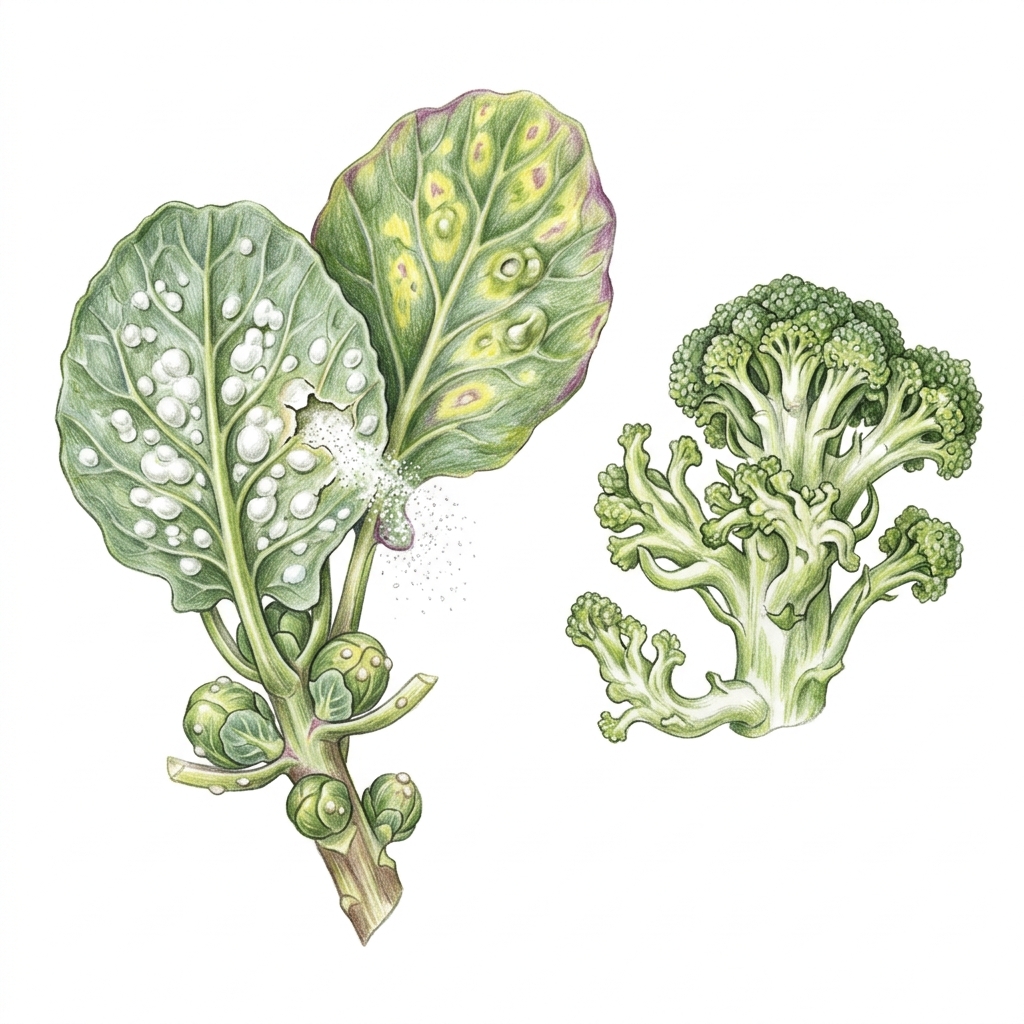
Illustration
A water mould that raises chalk-white blisters, mostly under the leaves of cabbage-family plants, and can twist leaves, stems and heads. Pick off affected leaves, space plants so they dry quickly, clear weeds and old plants, and rotate the bed.
How to spot it
- Pale or yellowish spots on top of the leaf, with raised, chalk-white blisters under them, usually on the underside.
- Blisters that burst and release a white powder.
- Purple colouring around the affected patches.
- Twisted growth: bulges or pits in the leaves, curved stems, and Brussels sprout buttons with bumps on them.
- On broccoli and cauliflower, swollen, misshapen flower heads with antler-like growths, called stagheads.
- Most common in cool, damp weather with heavy dews; in the UK, in spring and summer.
Easily confused with
Downy mildew
Yellow patches with soft grey or purple fuzz underneath, not raised white blisters. The two often turn up together in wet weather.
Powdery mildew
A thin white dust over the leaf surface that wipes off, not raised blisters.
Rust
Powdery orange, yellow or brown pustules; white blister's are white.
Where it's a problem
- Worldwide: Found across Europe, the Americas, Asia, Africa and Oceania. Strains differ, and those on weeds may not attack vegetables.
- Australia: In Western Australia it is found in all the main brassica-growing areas, where one strain attacks broccoli and cauliflower and can distort their heads. It is most common in autumn and spring, but can turn up at any time of year.
- United Kingdom: Attacks vegetable brassicas, and also honesty, aubrieta and the weed shepherd's purse. The RHS lists some Brussels sprouts varieties as resistant or tolerant.
What to do
- Pick off affected leaves as soon as you see them, and remove badly affected plants.
- Space plants widely so the leaves dry quickly.
- Water the soil, not the leaves, early in the day.
- Pull out weeds that carry it, such as shepherd's purse, and any self-sown cabbage-family plants.
- After harvest, clear away the old plants: its resting spores survive in plant remains and soil.
- Keep the cabbage family out of that bed for at least three years, and grow resistant or tolerant varieties where you can.
In the UK there are no fungicides for gardeners against it. Where farms use sprays, they only work started early, before it takes hold: spacing, dry leaves and clearing old plants are what work in a garden.
Follow your local council's guidance for disposing of diseased plant material. Official guides usually advise against putting it in a home compost heap.
Vegetables it affects
Free account, no card needed. You sign up or sign in first, then the scanner opens.
Sources (3, from RHS, Pacific Pests, Pathogens and Weeds and Department of Agriculture, Western Australia)
- RHS: White blister
- Pacific Pests, Pathogens and Weeds: Cabbage white rust
- Department of Agriculture, Western Australia: White blister control in vegetable brassica crops (Farmnote 112)
Facts checked Wednesday 28 October 2026. General guidance only: follow your local council, agency and product label.