Home › Garden pests › Spittlebugs
Garden pests
Spittlebugs
Philaenus spumarius (meadow spittlebug) and other froghoppers (Aphrophoridae, Cercopidae) · Insect
Also called froghoppers (the adults) (UK, Australia, New Zealand), cuckoo spit (the froth) (UK, Australia, New Zealand), meadow spittlebug, common froghopper (UK, USA, Canada, New Zealand).
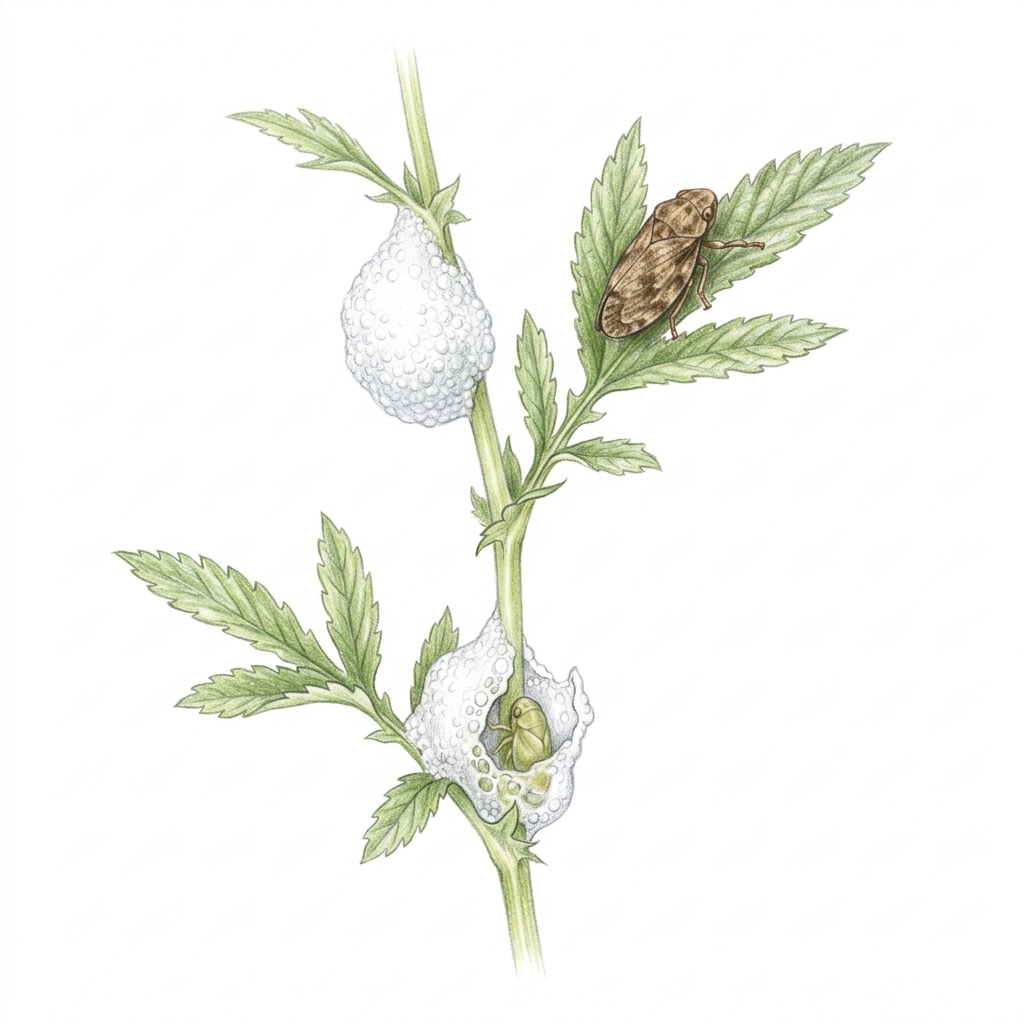
Illustration
Small sap-sucking insects whose young hide in blobs of white froth, called cuckoo spit, on stems in spring and early summer. They rarely harm plants, so in most gardens no action is needed; hose the froth off if it bothers you.
How to spot it
- Blobs of white froth like spit on young stems, leaves and leaf joints in late spring and summer; in the UK mostly from May to July.
- Inside each blob, a soft creamy-white, pale green or yellow nymph up to 4–6 mm (¼ in) long; a blob can hold more than one.
- Later in summer, stout brown, grey, tan or mottled adults up to about 8 mm (⅓ in) long that jump or fly off when disturbed and make no froth.
- Usually no damage at all; sometimes a twisted shoot tip where a nymph has fed.
- Heavy numbers can slow the growth of soft-stemmed plants.
Easily confused with
Mealybugs
Dry, fluffy white wax that stays put, usually in leaf joints; spittle is wet bubbles that wash off and hide a pale nymph.
Leafhoppers
Adults have long, unbroken rows of spines down the hind legs, and their young live in the open, never in froth; adult spittlebugs are stout, with two stout spines along each hind leg.
Glassy-winged sharpshooter
A kind of leafhopper about 13 mm (½ in) long on average, bigger than garden spittlebugs, with rows of spines down the hind legs; its young make no froth. It carries Xylella and is not in Australia or New Zealand: report a suspected one.
Where it's a problem
- Worldwide: Common in gardens across much of the world. The meadow spittlebug alone feeds on more than 400 kinds of plants, mostly soft-stemmed ones, weeds among them.
- United Kingdom: There are ten froghopper species. The RHS says spittlebugs are not a pest and asks gardeners not to remove them. Xylella, a plant disease froghoppers can spread, has not been found in Britain, but could arrive in imported plants.
- Europe: Xylella is causing serious problems in southern Europe, where it has devastated olive trees in Puglia, Italy, and froghoppers are among the insects that spread it. Follow your national plant-health authority's rules.
- Australia: Australia has its own native spittlebugs. The meadow spittlebug is not here and, with Xylella, is kept out by biosecurity: Xylella is the country's number one priority plant pest. If you see leaf scorch you can't explain, or an insect you think is exotic, don't disturb it, photograph it, and call the Exotic Plant Pest Hotline on 1800 084 881.
- New Zealand: The meadow spittlebug is present, but Xylella is not known to be. Report leaf scorch you can't explain to MPI's exotic pest and disease hotline, 0800 80 99 66.
- United States: Xylella is present in parts of the country, causing Pierce's disease of grapes and oleander leaf scorch. Spittlebugs may carry it, but sharpshooters and other leafhoppers are the main carriers.
What to do
- Look inside the froth: a small soft nymph, creamy-white, pale green or yellow, confirms it's a spittlebug.
- In most gardens, leave them be. Plants usually grow on unharmed, and birds and spiders eat spittlebugs.
- If the froth bothers you, say on herbs you're about to pick, wash it off with a strong jet of water.
- Cut down weedy patches nearby in spring, before the young grow up and move onto garden plants.
- On soft-stemmed crops, act only if there are many: heavy numbers can slow their growth.
- In Australia and New Zealand, report unexplained leaf scorch, or an insect you suspect is exotic, to the hotline (Australia 1800 084 881, New Zealand 0800 80 99 66). In Australia, don't buy plants or seeds from overseas online.
Spraying is rarely needed: the RHS says spittlebugs are not a pest and asks gardeners not to remove them, and a strong jet of water washes the froth off. Where heavy numbers threaten a crop, ask your local agriculture department or extension service before using an insecticide, and follow the label and local rules.
Vegetables it affects
Free account, no card needed. You sign up or sign in first, then the scanner opens.
Sources (6, from RHS, University of California IPM, DAFF (Australia) and others)
- RHS: Cuckoo spit (spittlebugs)
- University of California IPM: Spittlebugs
- DAFF (Australia): Xylella and exotic vectors
- Wine Australia: Tools and knowledge to mitigate the potential spread of Xylella fastidiosa
- New Zealand Plant Protection: Managing the risk of Xylella fastidiosa to New Zealand
- MPI: Report a pest or disease
Facts checked Friday 30 October 2026. General guidance only: follow your local council, agency and product label.