Home › Garden pests › Rosemary beetle
Garden pests
Rosemary beetle
Chrysolina americana · Insect
Illustration
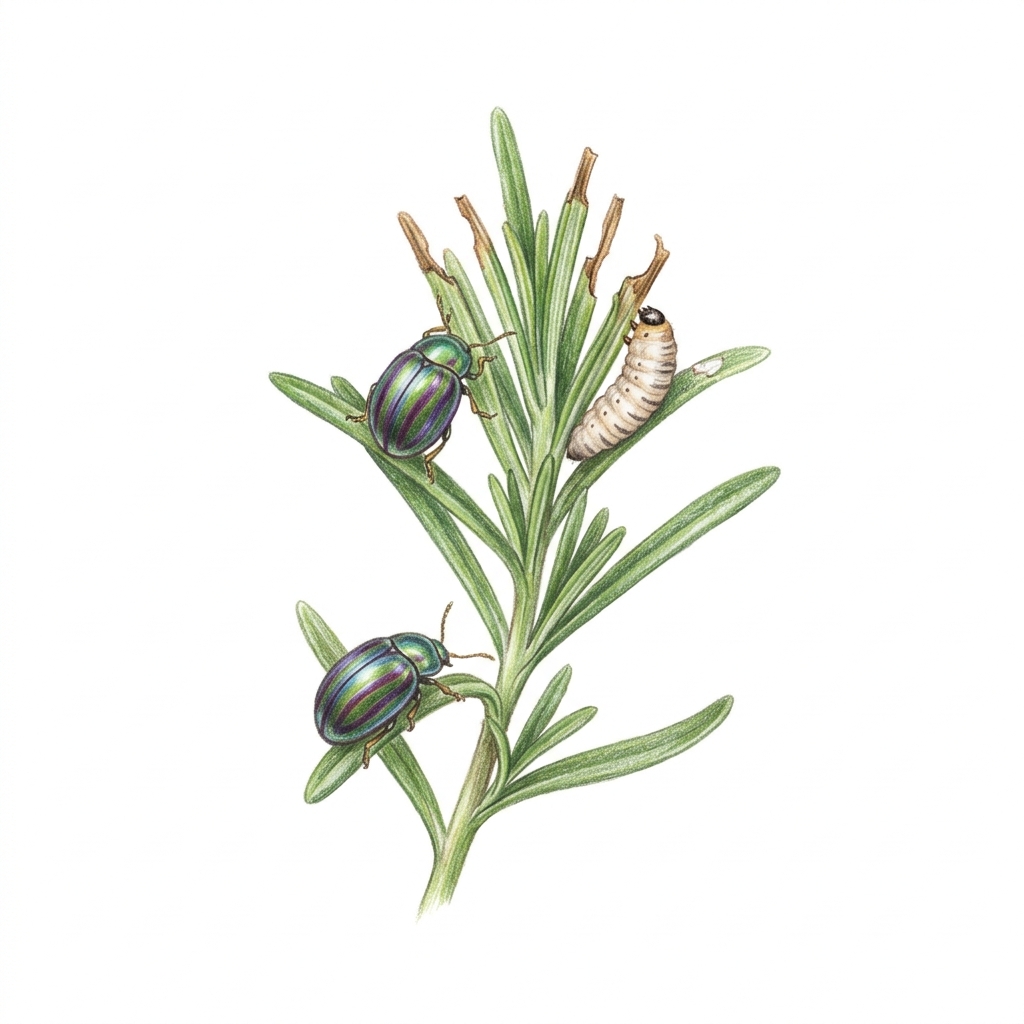
A small, shiny leaf beetle striped metallic green and purple, whose adults and grey larvae eat the leaves and flowers of rosemary, lavender, sage and thyme, mostly from late summer to spring. Plants usually cope, so tap the beetles off onto newspaper and let birds and frogs help; in Australia and New Zealand, where it isn't recorded, report it instead.
How to spot it
- Shiny, oval beetles 6–8 mm (¼–⅓ in) long, with metallic green and purple stripes running along the wing cases and the neck shield.
- Fat, greyish-white larvae up to 8 mm (⅓ in) long, with darker stripes along the body and a dark head.
- Leaves eaten back to short stumps that dry greyish-brown, and flowers eaten too.
- Tiny eggs laid on the undersides of the leaves from late summer.
- Beetles on the plants in almost any month, feeding most from late summer to spring and resting in midsummer.
Easily confused with
Colorado potato beetle
Also oval and domed, but cream to yellow with ten black stripes, and it eats potatoes, tomatoes and eggplant, not herbs.
Mint beetle
Plain shiny emerald green with no stripes (its relative the blue mint beetle is metallic dark blue), with blackish larvae, and it feeds on mint.
Caterpillars
They chew herb leaves too, but have rows of stubby extra legs along the body; rosemary beetle larvae are fat grey grubs with darker stripes.
Where it's a problem
- Worldwide: Native to the Mediterranean: southern Europe, North Africa and the Middle East. Despite its name, it has not been found in the Americas.
- Europe: Moving herbs has carried it north and east of its native range: it is now found in countries including Belgium, the Netherlands, Germany and Austria, and in Cyprus and Israel.
- United Kingdom: First recorded in 1963 and found again in 1994, it was breeding in central London by the late 1990s and has spread since. It is now widespread in England and Wales, established in Scotland and present in Northern Ireland. The RHS says control is usually unnecessary, and asks gardeners to record sightings in its online rosemary beetle survey.
- Australia: Not recorded in Australia. If you find a shiny beetle striped metallic green and purple on rosemary, lavender, sage or thyme, report it to the Exotic Plant Pest Hotline on 1800 084 881.
- New Zealand: Not recorded in New Zealand. If you think you've found one, catch it if it's safe, photograph it and call MPI's exotic pest and disease hotline on 0800 80 99 66.
What to do
- In Australia or New Zealand, don't let it go: catch it in a sealed container if you can, photograph it and report it (contacts under Where it's a problem).
- Where it is established, check rosemary, lavender, sage and thyme from late summer through to spring, when the beetles and larvae feed.
- Hold a sheet of newspaper or an old tray under the plant, tap or shake the branches, and remove the beetles and larvae that fall. Repeat often to keep numbers down.
- Check new potted herbs before you plant them, as the beetle travels on moved plants.
- Encourage birds, frogs and ground beetles, which eat the larvae and sometimes the adults.
- Tolerate light damage: the plants usually cope, and the RHS treats the beetle as a colourful part of garden wildlife.
In Australia and New Zealand, report it rather than treating it. Elsewhere, the RHS says control is not usually needed, as plants generally tolerate the beetle; if you do use an insecticide, choose one labelled for rosemary beetle on the plant you are treating, and follow the label and local rules.
Vegetables it affects
Free account, no card needed. You sign up or sign in first, then the scanner opens.
Sources (6, from RHS, The Wildlife Trusts, Biodiversity Data Journal and others)
- RHS: Rosemary beetle
- The Wildlife Trusts: Rosemary beetle
- Biodiversity Data Journal: First records of the rosemary beetle in Cyprus
- GBIF: Chrysolina americana occurrence records
- Australian Government DAFF: Report a pest or disease concern
- MPI: Report a pest or disease
Facts checked Friday 30 October 2026. General guidance only: follow your local council, agency and product label.