Home › Garden pests › Mint beetle
Garden pests
Mint beetle
Chrysolina herbacea · Insect
Also called mint leaf beetle (UK), green mint beetle (UK).
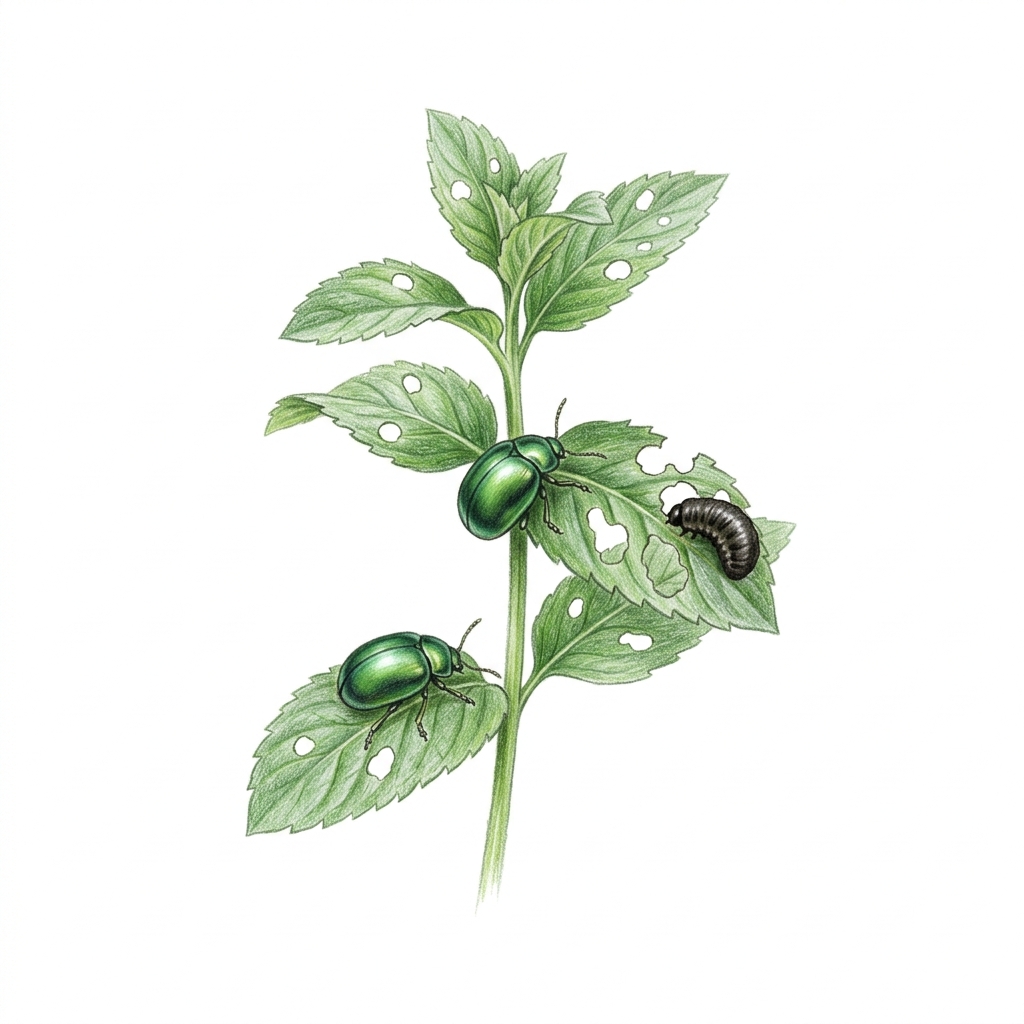
Illustration
A shiny, metallic emerald-green leaf beetle, 8–9 mm (⅓ in) long, whose adults and fat black larvae chew holes in mint leaves in the UK and Europe. Pick them off by hand and let the mint grow back: it is vigorous, and the beetles seldom do a healthy plant lasting harm.
How to spot it
- Holes chewed in mint leaves, made by both the adults and the larvae.
- Shiny, metallic emerald-green beetles 8–9 mm (⅓ in) long sitting on the leaves. A rare blue form also turns up.
- Fat, soft, rounded blackish larvae, up to about 1 cm (⅜ in) long, feeding on the leaves alongside the adults.
- Beetles on mint from late spring to early autumn (May to September in the UK).
Easily confused with
Rosemary beetle
Slightly smaller, about 6–8 mm (¼–⅓ in), with stripes of metallic purple and green along the wing cases, and greyish-white larvae with darker stripes. It feeds on rosemary, lavender, sage and thyme, mostly from late summer to spring.
Blue mint beetle
A close relative on mint, a little smaller at about 7 mm (¼ in) and metallic dark blue, with the same blackish larvae. It has bred in Britain since 2011, in southern and eastern England and Edinburgh, and the same hand-picking works.
Tansy beetle
A large metallic green leaf beetle with a coppery sheen, very hard to tell from mint beetle by eye. Where it is found tells them apart: it is known only along the River Ouse near York, mainly on tansy, and at Woodwalton Fen in Cambridgeshire, on water mint. It is critically endangered, so leave a green beetle in those places alone.
Flea beetles
Much smaller, mostly 2–3 mm (⅛ in), and they jump like fleas when disturbed, peppering the leaves of brassicas, radishes and rocket with tiny round holes.
Where it's a problem
- Worldwide: Native to Europe and western Asia, from Britain, Spain and Portugal east to Turkey, the Caucasus and Iran. It has not been recorded in Australia, New Zealand, the United States or Canada.
- United Kingdom: A native beetle, found mainly in southern England and Wales. The beetles are about from late spring to early autumn. Its relative the blue mint beetle has been breeding in Britain since 2011 and may spread further.
- Europe: Widespread across mainland Europe, from Spain and France to Germany, Poland and Ukraine.
- Australia: Not recorded in Australia. If you find a shiny metallic green beetle with fat black larvae eating your mint, photograph it and report it to the Exotic Plant Pest Hotline on 1800 084 881.
- New Zealand: Not recorded in New Zealand. MPI asks people to report any pest they think is new to the country: photograph it, catch it if it's safe, and call the exotic pest and disease hotline on 0800 80 99 66.
What to do
- From late spring to early autumn, check mint with holed leaves for shiny green beetles and fat black larvae.
- Pick the beetles and larvae off by hand and squash them.
- Tolerate light damage. Mint grows vigorously, and the beetles are rarely numerous enough to do a healthy plant serious harm.
- If a plant is badly eaten, cut the whole plant down to about 5 cm (2 in) once it has finished flowering; fresh young leaves follow within a few weeks.
- In England, a green beetle on tansy or water mint by the River Ouse near York or at Woodwalton Fen in Cambridgeshire may be the critically endangered tansy beetle: leave it be.
- In Australia or New Zealand, don't squash a suspect: photograph it and report it (contacts under Where it's a problem). New Zealand's MPI also asks you to catch it if it's safe; in Australia, ask before moving or collecting it.
In Australia and New Zealand, report a suspected find rather than treating it. Elsewhere, the RHS says the beetles are unlikely to do a healthy mint serious harm, and picking them off by hand is usually enough; if you do use an insecticide, choose one labelled for mint beetle on the plant you are treating, and follow the label and local rules.
Vegetables it affects
Free account, no card needed. You sign up or sign in first, then the scanner opens.
Sources (6, from RHS, GBIF, GOV.UK (Natural England) and others)
- RHS: Blue mint beetle (with the green mint beetle) · How to grow mint
- GBIF: Chrysolina herbacea occurrence records
- GOV.UK (Natural England): Critically endangered tansy beetle re-discovered at Woodwalton Fen
- Plant Health Australia: Reporting suspect pests
- MPI: Report a pest or disease
Facts checked Friday 30 October 2026. General guidance only: follow your local council, agency and product label.