Home › Garden pests › Mint moth
Garden pests
Mint moth
Pyrausta aurata, and related Pyrausta species · Insect
Also called small purple and gold (UK).
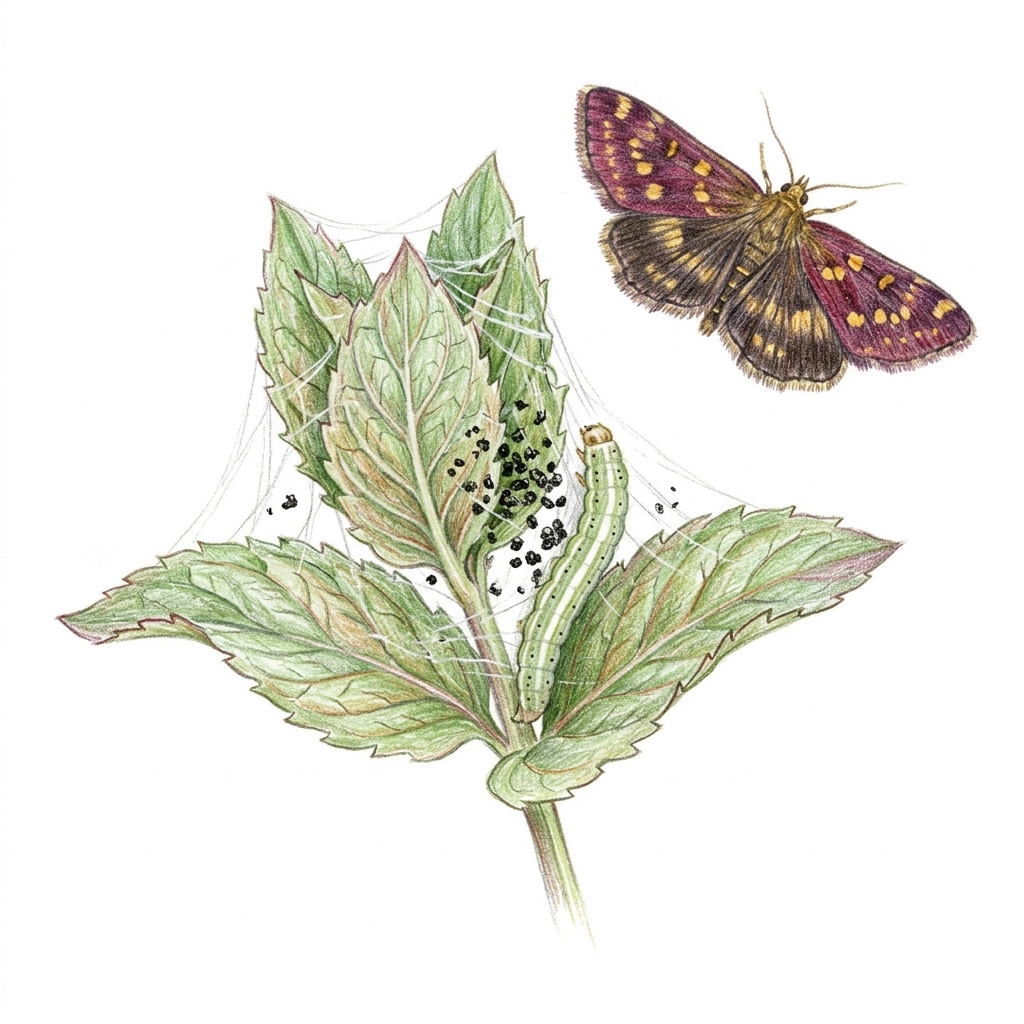
Illustration
A tiny purple-and-gold moth whose small caterpillars feed at the shoot tips of mint, oregano and other herbs in the mint family, curling the leaves and leaving fine webbing. It rarely does real harm, so it seldom needs action: pick off the caterpillars or cut back the worst shoots, which soon regrow.
How to spot it
- Young shoot tips with leaves curled over or webbed together, sometimes the flower heads too.
- Small amounts of fine silk webbing, with tiny black droppings caught in it.
- Small caterpillars, up to about 13 mm (½ in) long, pale green to reddish or purplish brown, with two paler stripes down the back and small black spots in neat groups.
- Young caterpillars feed under the leaves; older ones hide in the webbed tips.
- The adult: a small moth about 2 cm (¾ in) across the wings, purple to reddish brown with golden spots, resting on the herbs on sunny summer days.
Easily confused with
Other caterpillars
Loopers grow much bigger, up to about 38 mm (1½ in), and chew holes in the open; budworms bore into buds. Neither webs the shoot tips together. Mint moth caterpillars stay under about 13 mm (½ in) and hide in webbed shoot tips of mint-family herbs.
Spider mites
Fine webbing too, but the leaves fade to a pale speckle, and there are no caterpillars or black droppings, only tiny mites under the leaves.
Mint beetles
Shiny emerald-green or dark blue beetles about 7–9 mm (⅓ in) long, and soft blackish larvae, that chew holes in mint leaves and leave no webbing.
Where it's a problem
- Worldwide: Mint moth is found across most of Europe, in gardens and the wild, and into North Africa and Asia, east to China and Japan. It has not been recorded in Australia, New Zealand, the United States or Canada, so caterpillars on mint and oregano there are other kinds.
- United Kingdom: Locally common in England, Wales and southern Scotland, in gardens as well as the wild. There are two generations a year, flying in May and June and again in July and August, and the caterpillars feed in spring and summer.
- United States: Native relatives take its place. The mint-loving pyrausta feeds on mints, and the southern purple mint moth, or rosemary webworm, feeds on rosemary in the south-east. Rosemary webworm can do more harm: its webbing and droppings can spoil more than half of a plant, and a bad attack left alone can kill it. The moths fly from June to August, so check rosemary through summer.
What to do
- From late April, look at the shoot tips of mint and oregano for curled, webbed leaves.
- Tolerate light damage: a healthy plant still has plenty of clean leaves to pick, and the caterpillars and moths are food for birds and other wildlife.
- Pick off the caterpillars by hand, or pinch out the webbed tips.
- Cut back badly affected shoots; mint and oregano soon send up fresh growth.
- Leave birds, hedgehogs and ground beetles to help keep numbers down.
If you use an insecticide, choose one labelled for mint moth and follow the label and local rules. The RHS gives no spray for mint moth: it advises tolerating it, picking off the caterpillars and cutting back. For rosemary webworm in the US, extension services suggest pruning out the webbed shoots, or a spray labelled for caterpillars on rosemary grown to eat.
Vegetables it affects
Free account, no card needed. You sign up or sign in first, then the scanner opens.
Sources (6, from RHS, UK Moths, GBIF and others)
- RHS: Mint moth · Blue mint beetle
- UK Moths: Pyrausta aurata, mint moth
- GBIF: Pyrausta aurata, occurrence records
- NC State Extension: Southern purple mint moth
- Clemson Cooperative Extension (HGIC): Southern purple mint moth
Facts checked Friday 30 October 2026. General guidance only: follow your local council, agency and product label.