Home › Plant diseases › Poorly filled cobs
Plant diseases
Poorly filled cobs
Also called poor kernel fill (USA), poorly filled ears (USA).
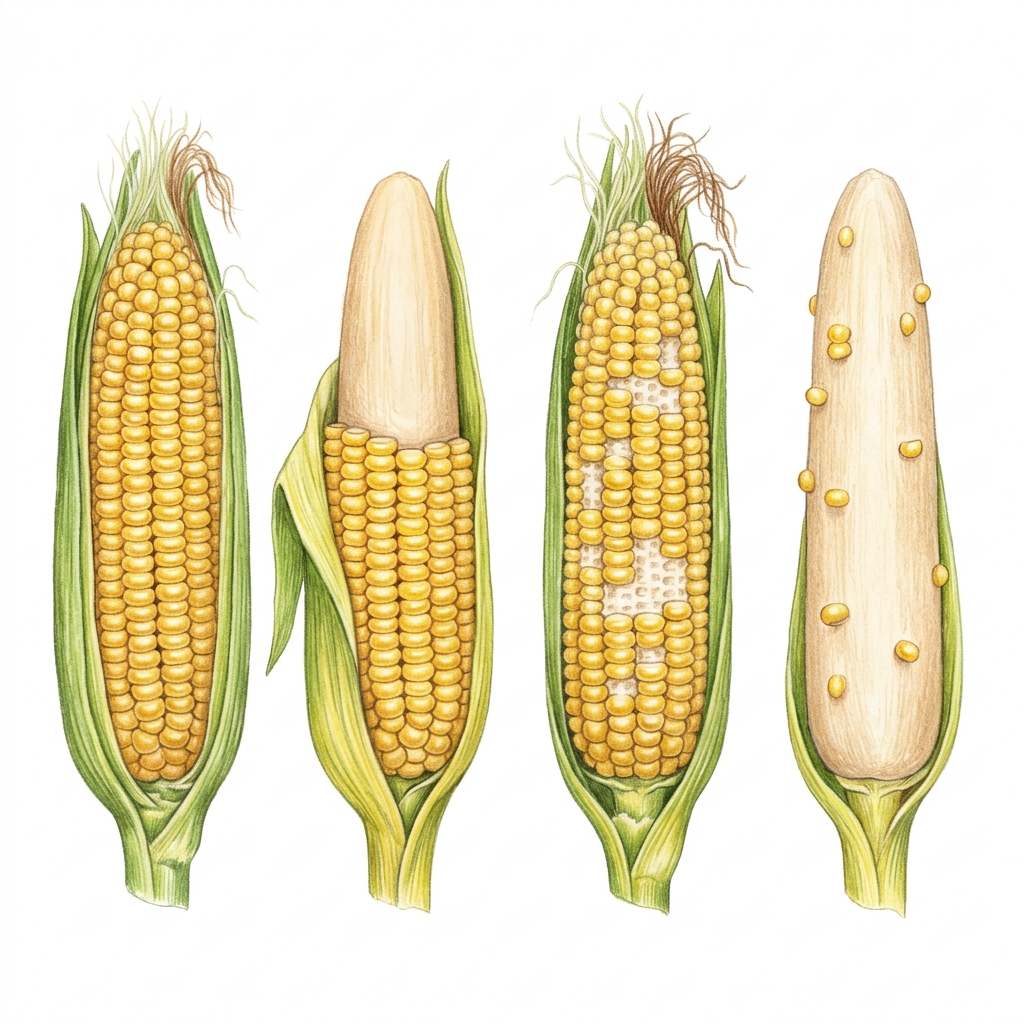
Illustration
Sweet corn cobs with gaps or bare patches where kernels never formed, usually because too little wind-blown pollen reached the silks. Planting in a block rather than a single row, and keeping the soil moist while the tassels and silks are out, fill the cobs.
How to spot it
- Cobs with missing kernels: a few scattered gaps, bare patches, or in bad cases hardly any kernels at all.
- Bare tips are the most common: the silks from the tip of the cob come out last, so they are the first to miss the pollen.
- Silks that stay long and fresh after the others have browned were never pollinated.
- Common after very hot, dry, windy weather while the silks are out, and in single rows or very small plantings.
Easily confused with
Corn earworm
Kernels eaten away at the tip, with damp droppings and often a caterpillar under the husk.
Birds
Husks torn open and kernels pecked out or emptied, on cobs that had filled.
Corn smut
Kernels swollen into large grey-white galls that burst into black powder, rather than missing.
Picked too early
Kernels at the tip are there but small and pale, with clear, watery juice when pierced.
Where it's a problem
- Worldwide: Common wherever sweet corn grows, especially in small home plantings and hot, dry summers. Not regulated.
What to do
- Plant in a block of at least four short rows, not one long row, so pollen reaches the silks whichever way the wind blows.
- Space plants about 30–45 cm (12–18 in) apart, or as the seed packet says: crowded plants fill their cobs poorly too.
- Keep the soil moist, especially once the tassels and silks appear: about 25 mm (1 in) of water a week, from rain or watering.
- When the tassels at the top are shedding pollen, tap or gently shake the stalks so it falls onto the silks below.
- Feed for steady growth, as a soil test shows: hungry plants fill poorly.
- Watch for beetles and caterpillars chewing the silks before they have been pollinated.
Spraying won't fill the cobs: the gaps come from pollen not reaching the silks, not from an infection. Official guides prevent it with block planting and steady watering at silking.
Vegetables it affects
Free account, no card needed. You sign up or sign in first, then the scanner opens.
Sources (6, from Iowa State University Extension, University of Minnesota Extension, Penn State Extension and others)
- Iowa State University Extension: Poorly filled sweet corn ears
- University of Minnesota Extension: Sweet corn, poor kernel fill
- Penn State Extension: Why corn ears don't fill
- Purdue University: Silk emergence, silk length and missing kernels
- RHS: How to grow sweetcorn
- Clemson University HGIC: Sweet corn
Facts checked Wednesday 28 October 2026. General guidance only: follow your local council, agency and product label.