Home › Garden pests › Corn earworm
Garden pests
Corn earworm
Helicoverpa zea (the Americas); Helicoverpa armigera (Australia, New Zealand, Europe, Asia and Africa) · Insect
Also called tomato fruitworm (on tomatoes), cotton bollworm (USA), cotton bollworm, helicoverpa (Australia), corn earworm (New Zealand), cotton bollworm (UK and Europe).
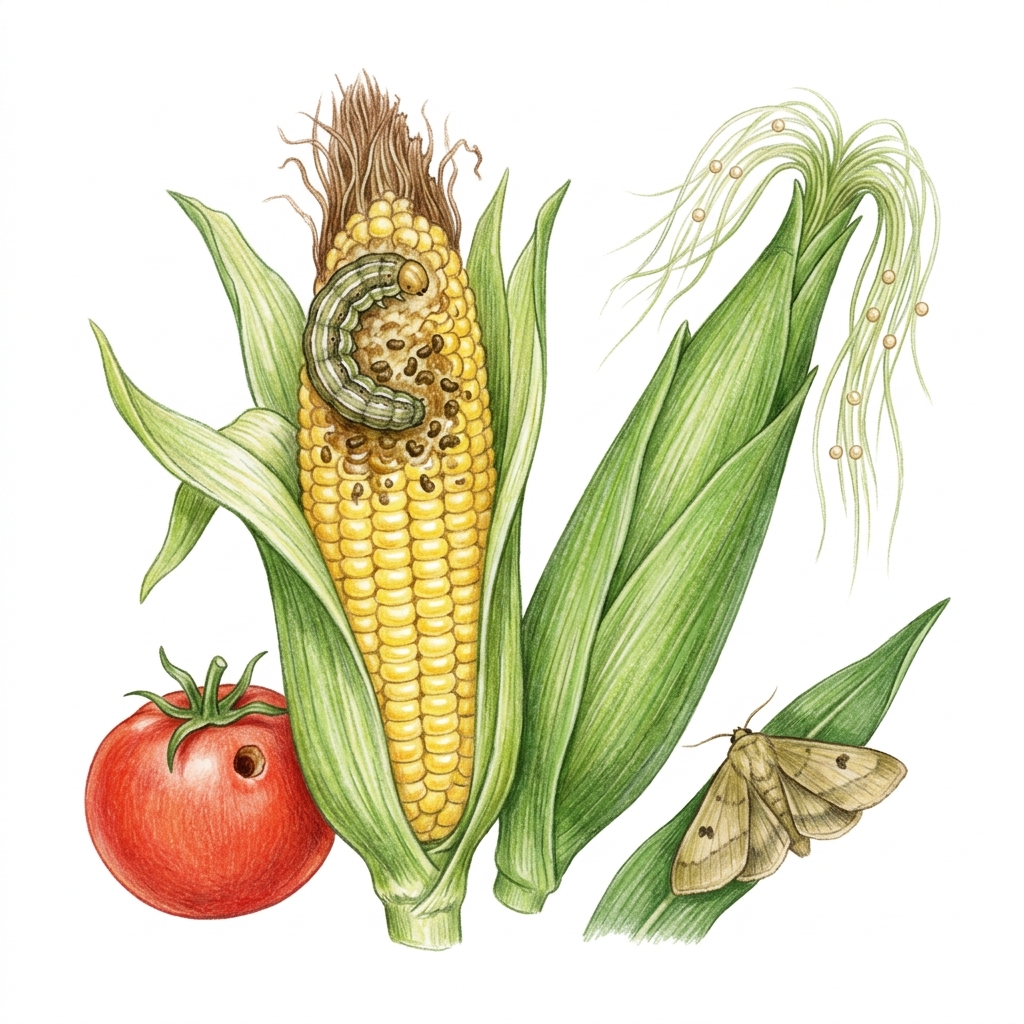
Illustration
A striped moth caterpillar that crawls down the silks into the tip of a sweet corn cob and eats the kernels, leaving a mess of droppings. Sow early, grow varieties with tight husks, check the silks for eggs, and at harvest simply cut off the damaged tip.
How to spot it
- Silks chewed off, and kernels eaten at the tip of the cob under the husk, with plenty of droppings.
- A caterpillar up to 4–5 cm (1½–2 in) long at the cob tip: green, brown, pink or black, with light and dark stripes along the back and sides, and a plain yellow or light brown head with no spots.
- Usually only one caterpillar in each cob, even when many eggs were laid.
- Tiny eggs laid one by one on fresh silks: white to light yellow at first, turning dark brown before they hatch.
- Later in the season, holes in tomatoes and bean pods.
Easily confused with
Fall armyworm
Has a pale upside-down Y on its dark head and four dark spots in a square near the tail. It feeds in the leaf whorl first and moves to the cob as the plant tassels.
European corn borer
Pale, with rows of small dark spots and a dark brown head. It tunnels into the stalks as well as the cobs, so tassels and stalks break.
Poorly filled cobs
Gaps or missing kernels at the tip from poor pollination, with no chewed kernels, droppings or caterpillar.
Where it's a problem
- Worldwide: Two close relatives do the same damage: corn earworm in the Americas, and cotton bollworm in Australia, New Zealand, Europe, Asia and Africa. Both feed on many crops besides corn.
- Australia: Cotton bollworm (Helicoverpa armigera) attacks corn and most other field crops, and has become resistant to a wide range of insecticides, so correct identification matters. Its close relative, native budworm, attacks many broadleaf crops but not corn.
- New Zealand: Called corn earworm there, it is present across the country.
- North America: It can't survive cold northern winters: moths fly north on the winds each summer. Early-sown corn often escapes, and the second generation, from mid-August to early September in Wisconsin, does the most damage.
- United Kingdom/Europe: Cotton bollworm moths fly in from the Continent in summer, and two short-lived populations were found in maize in southern England in 2024. It is not expected to survive the winter outdoors in Britain, and since October 2025 the government in Great Britain no longer takes official action against finds.
What to do
- Sow early, and choose a quick variety, so cobs are ready before moth numbers build up; late-sown corn is usually hit hardest.
- Grow varieties with long, tight husks over the cob tip, which resist the caterpillars better. Try a few varieties and sowing dates to see what works in your garden.
- From the time silks appear, check fresh silks every few days for tiny eggs and young caterpillars.
- Leave the natural enemies to work: tiny Trichogramma wasps, lacewings and minute pirate bugs eat or parasitise the eggs and young caterpillars.
- At harvest, cut off the damaged tip: the rest of the cob is fine to eat.
If you use an insecticide, choose one labelled for corn earworm and follow the label and local rules. Sources say sprays only reach newly hatched caterpillars on the silks, from when the silks appear until they turn brown; once a caterpillar is inside the cob, nothing reaches it. In Australia, cotton bollworm resists many insecticides.
Vegetables it affects
Free account, no card needed. You sign up or sign in first, then the scanner opens.
Sources (6, from University of California IPM, University of Wisconsin–Madison Extension, Nebraska Extension in Lancaster County and others)
- University of California IPM: Corn earworm (corn)
- University of Wisconsin–Madison Extension: Corn earworm
- Nebraska Extension in Lancaster County: Corn earworm
- Business Queensland: Helicoverpa
- Foundation for Arable Research (NZ): Fall armyworm update, 14 March 2025
- Defra: Response to the policy review for Helicoverpa armigera (October 2025)
Facts checked Wednesday 28 October 2026. General guidance only: follow your local council, agency and product label.