Home › Plant diseases › Pink root
Plant diseases
Pink root
Setophoma terrestris (formerly Phoma terrestris or Pyrenochaeta terrestris) · Fungus
Also called pink root rot (Australia).
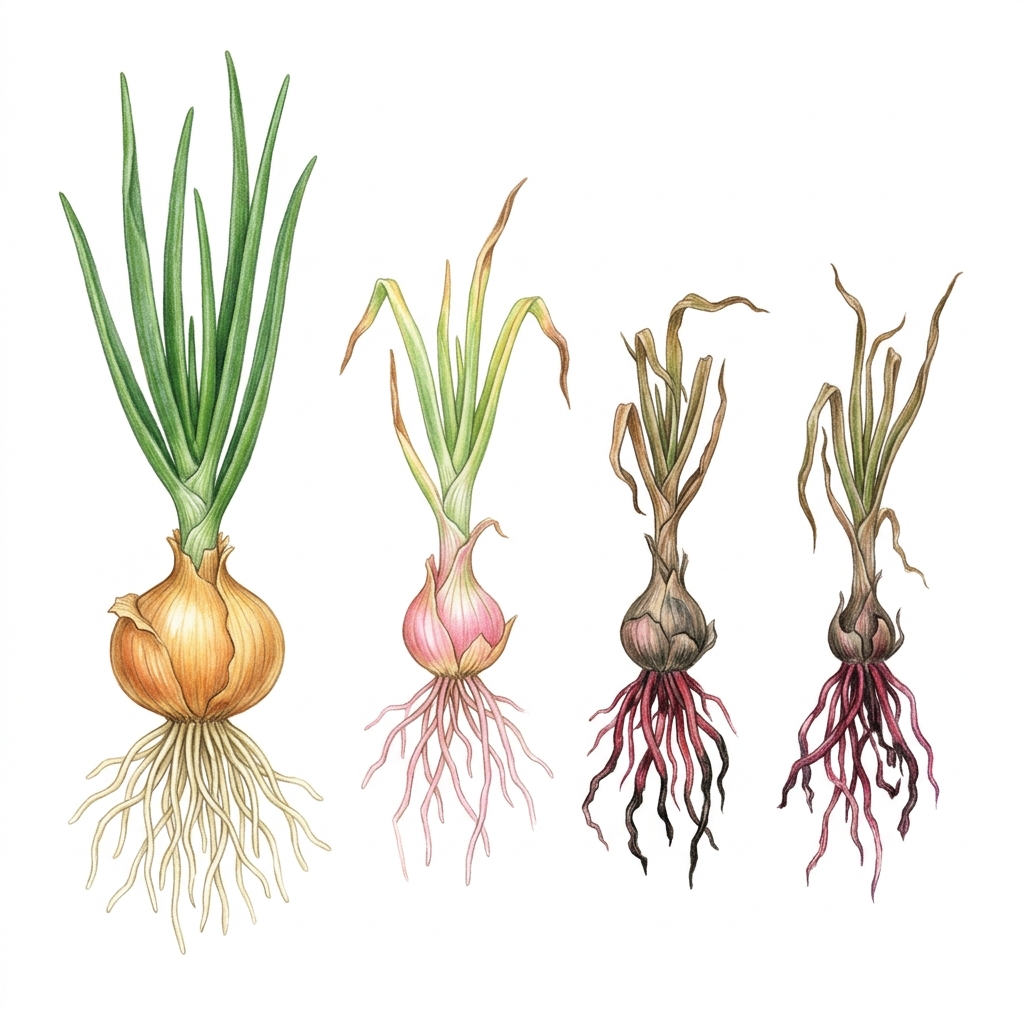
Illustration
A soil fungus that turns onion roots pink, then red and purple, until they shrivel and die, so plants are stunted and bulbs stay small. It can't be cleared from the soil, so grow resistant varieties, keep plants unstressed in well-drained soil, and keep onions out of that bed for several years.
How to spot it
- Roots that turn light pink, then darken through red and purple, shrivel, blacken and die. New roots are infected as they grow.
- Stunted plants with yellow or brown leaf tips that die back, much like drought stress.
- Plants that pull out of the ground easily, and bulbs that stay small. The pink colour can spread up into the outer scales of the bulb.
- Plants seldom die of it.
- Worst in warm soil, around 24–29°C (75–85°F), and in heavy, badly drained soil.
Easily confused with
Fusarium basal rot
A soft, watery rot spreading up from the base of the bulb. Fusarium can also tint old, dead roots pink, but in pink root the living roots turn pink and their centre goes dark red to purple.
White rot
White, fluffy mould and poppy-seed black dots on the base of the bulb, in cool, moist soil.
Onion fly
Small white maggots tunnelling into the base of the bulb, and young plants that wilt and collapse.
Drought stress
Leaf tips that yellow and die back too, but the roots stay white and firm.
Where it's a problem
- Worldwide: A common soil fungus wherever onions are grown, and worse the more years onions have been grown in the same ground. Mainly a disease of onions, including spring onions grown from onion varieties. Garlic is infected but seldom badly harmed, and leeks and chives have recently been confirmed as hosts in Brazil.
- Australia: Found in most onion-growing regions.
- North America: A long-standing problem in warm onion-growing areas such as California, Utah and Texas.
What to do
- Start with healthy seedlings or sets, and turn down any with pink roots: it travels on transplants grown in infested soil.
- Lift plants with pink roots, with as much of their soil as you can.
- Keep onions and their relatives out of that bed for as long as you can: official guides suggest three to six years. Onions straight after sweetcorn or cereals are at greater risk.
- Grow resistant onion varieties. Resistance can vary from place to place, depending on the local strains of the fungus.
- Keep plants unstressed: improve drainage and add organic matter to heavy soil, avoid waterlogging and drought, and feed adequately.
- Where summers are hot, solarise the bed before planting: cover moist soil with clear plastic for several weeks.
- Clean soil off tools and boots before moving to another bed.
Official guides say sprays do little against it, and at best give a short-term fix. Long rotation, resistant varieties and healthy, unstressed plants are the defence.
Follow your local council's guidance for disposing of diseased plant material. Official guides usually advise against putting it in a home compost heap.
Vegetables it affects
Free account, no card needed. You sign up or sign in first, then the scanner opens.
Sources (6, from University of California IPM, Utah State University Extension, Oklahoma State University and others)
- University of California IPM: Pink root of onion and garlic
- Utah State University Extension: Pink root
- Oklahoma State University: Pink root of onion
- Texas A&M Plant Disease Handbook: Onion
- AUSVEG and Hort Innovation: Management of pink root rot in onions
- Journal of Fungi (2025): Setophoma terrestris in pink root disease, new hosts in Brazil
Facts checked Wednesday 28 October 2026. General guidance only: follow your local council, agency and product label.