Home › Plant diseases › Halo blight
Plant diseases
Halo blight
Pseudomonas savastanoi pv. phaseolicola (also known as Pseudomonas syringae pv. phaseolicola) · Bacterium
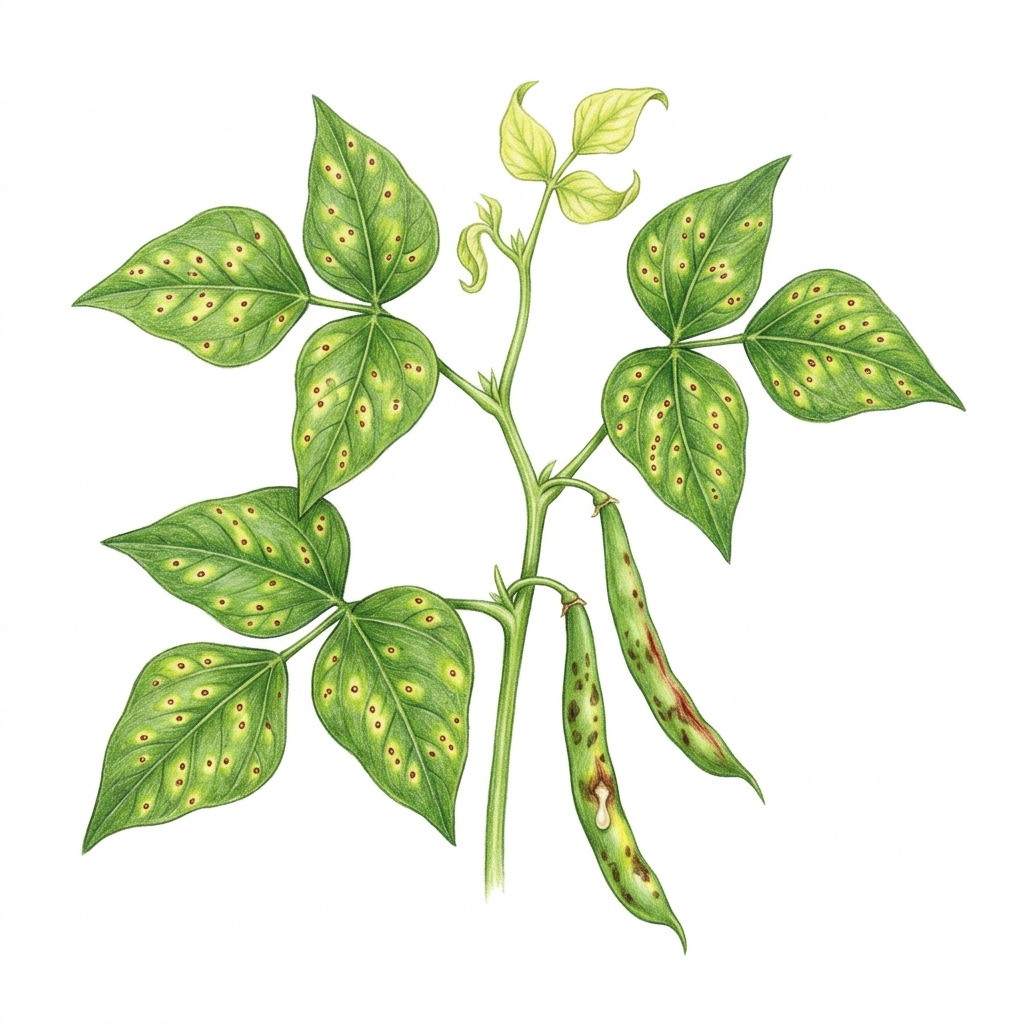
Illustration
A seed-borne bacterial disease of beans that leaves small, greasy spots ringed by wide yellow-green halos on the leaves, and greasy patches on the pods. There's no cure, so sow fresh certified seed, keep off the plants while they're wet, clear away the old plants after harvest and keep beans out of that bed for two to three years.
How to spot it
- Tiny water-soaked spots under the leaves, about 1.5 mm (1/16 in) across, like pinpricks.
- The spots turn reddish-brown or tan, each with a wide light green to yellow halo around it.
- In hot weather, above about 27 °C (80 °F), the halos are small or missing.
- When it spreads through the plant, the new leaves come up pale yellow-green and curled, without spots.
- Pods: greasy, water-soaked spots or streaks that turn reddish-brown, with cream ooze in damp weather.
Easily confused with
Common bacterial blight
Larger, irregular brown spots with a narrow bright yellow edge, which join up and dry out; it's worse in hot weather, when halo blight's halos fade.
Rust
Raised, powdery rust-brown pustules, mostly under the leaves, that leave coloured powder on a white tissue.
Anthracnose
Dark red to black lines along the veins under the leaves, and dark, sunken pod spots with a raised rim.
Mosaic virus
A light-and-dark green mottle with wrinkled leaves, and no greasy spots on the leaves or pods.
Where it's a problem
- Worldwide: Found wherever beans are grown, and worst in mild, wet weather, around 16–23 °C (60–73 °F). Infected seed is the main way it arrives.
- North America: Certified seed grown in dry western areas, where the disease rarely takes hold, is the main defence; it is uncommon in dry California.
- Australia: Found on beans in Australia. In southern Queensland, a wet spring set off outbreaks in several mung bean crops.
- United Kingdom: The RHS lists it as an occasional disease of runner beans.
What to do
- Sow fresh, certified seed, and never save seed from plants that had spots.
- Stay out of the bean patch while the leaves are wet, and don't pick or weed then.
- Water at the base rather than over the leaves.
- Clean your tools, and wash your hands, after working among spotted plants.
- After harvest, clear away the old plants, weeds and any self-sown beans.
- Keep beans out of that bed for at least two to three years, and choose blight-resistant varieties where they're offered.
No spray cures it. Official guides say a protective spray at the first sign only slows it on healthy leaves, and the bacteria can become resistant: clean seed, dry leaves and rotation do the work. If you use one, choose one labelled for halo blight and follow the label and local rules.
Follow your local council's guidance for disposing of diseased plant material. Official guides usually advise against putting it in a home compost heap.
Vegetables it affects
Free account, no card needed. You sign up or sign in first, then the scanner opens.
Sources (6, from Cornell University, University of California IPM, University of Nebraska–Lincoln CropWatch and others)
- Cornell University: Bacterial diseases of beans
- University of California IPM: Halo blight of dry beans
- University of Nebraska–Lincoln CropWatch: Halo blight
- Washington State University HortSense: Bean bacterial blights
- RHS: Runner beans
- Queensland DPI, The Beatsheet: Bacterial diseases in mungbean
Facts checked Wednesday 28 October 2026. General guidance only: follow your local council, agency and product label.