Home › Plant diseases › Anthracnose
Plant diseases
Anthracnose
Colletotrichum and related fungi · Fungus
Illustration
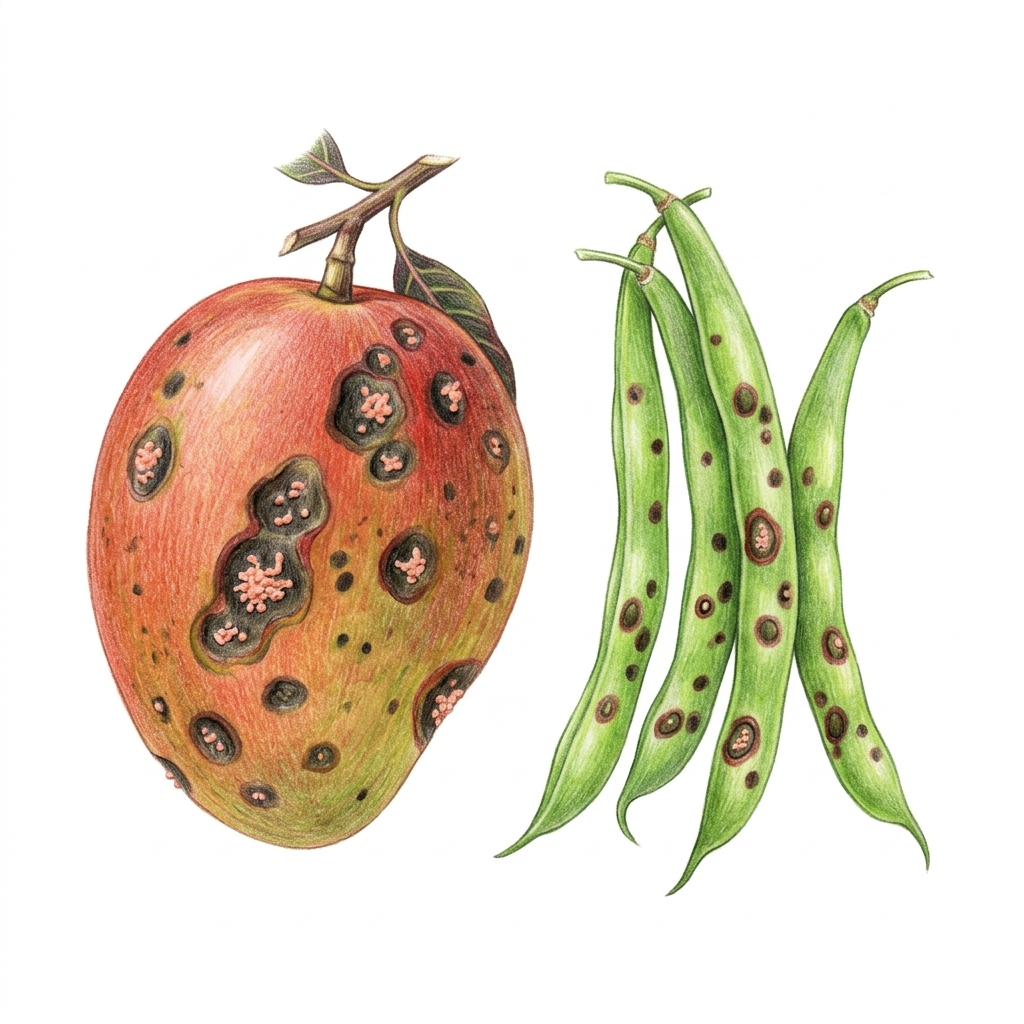
A group of fungal diseases that leave dark, sunken spots on fruit, pods and leaves, often with salmon-pink spore masses in wet weather. Dry leaves, clean seed and clearing crop debris keep it in check.
How to spot it
- Dark, sunken, roughly round spots on fruit and pods, often with a raised rim.
- Salmon-pink spore masses in the spots in wet weather.
- Beans: dark red to black lines along the veins under the leaves.
- Cucurbits: round brown leaf spots whose centres drop out, leaving holes.
- Mango and avocado: fruit looks clean on the tree but develops spots as it ripens.
Easily confused with
Angular leaf spot (cucurbits)
Spots held in by the veins, so they're angular rather than round.
Bacterial blight of beans
Water-soaked spots with yellow halos and cream ooze.
Frost damage (plane trees)
No tiny fungal specks under a hand lens.
Where it's a problem
- Warm, humid areas: The fruit forms are worst in places like Queensland.
- Worldwide: Common in wet springs; on most trees it's mainly cosmetic, though dogwood anthracnose can kill trees.
What to do
- Use certified disease-free seed, and don't save seed from infected plants.
- Water in the morning at the base, and don't splash soil onto plants.
- Keep out of the patch while plants are wet.
- Remove infected fruit and plants, and prune fruit trees to open up the canopy.
- Clear crop debris after harvest, and don't grow the same crop there for 2–3 years.
If you use a fungicide, choose one labelled for anthracnose and follow the label and local rules. Fungicides only protect healthy tissue; they won't cure spots that are already there.
Follow your local council's guidance for disposing of diseased plant material.
Free account, no card needed. You sign up or sign in first, then the scanner opens.
Sources
- University of Florida IFAS: Anthracnose of landscape plants
- University of California IPM: Anthracnose
- Cornell University: Bean anthracnose
- NC State Extension: Anthracnose of cucurbits
- Business Queensland: Anthracnose
- RHS: Plane anthracnose
Facts checked Sunday 27 September 2026. General guidance only: follow your local council, agency and product label.