Home › Plant diseases › Gummy stem blight
Plant diseases
Gummy stem blight
Stagonosporopsis species (formerly Didymella bryoniae) · Fungus
Also called black rot (on the fruit).
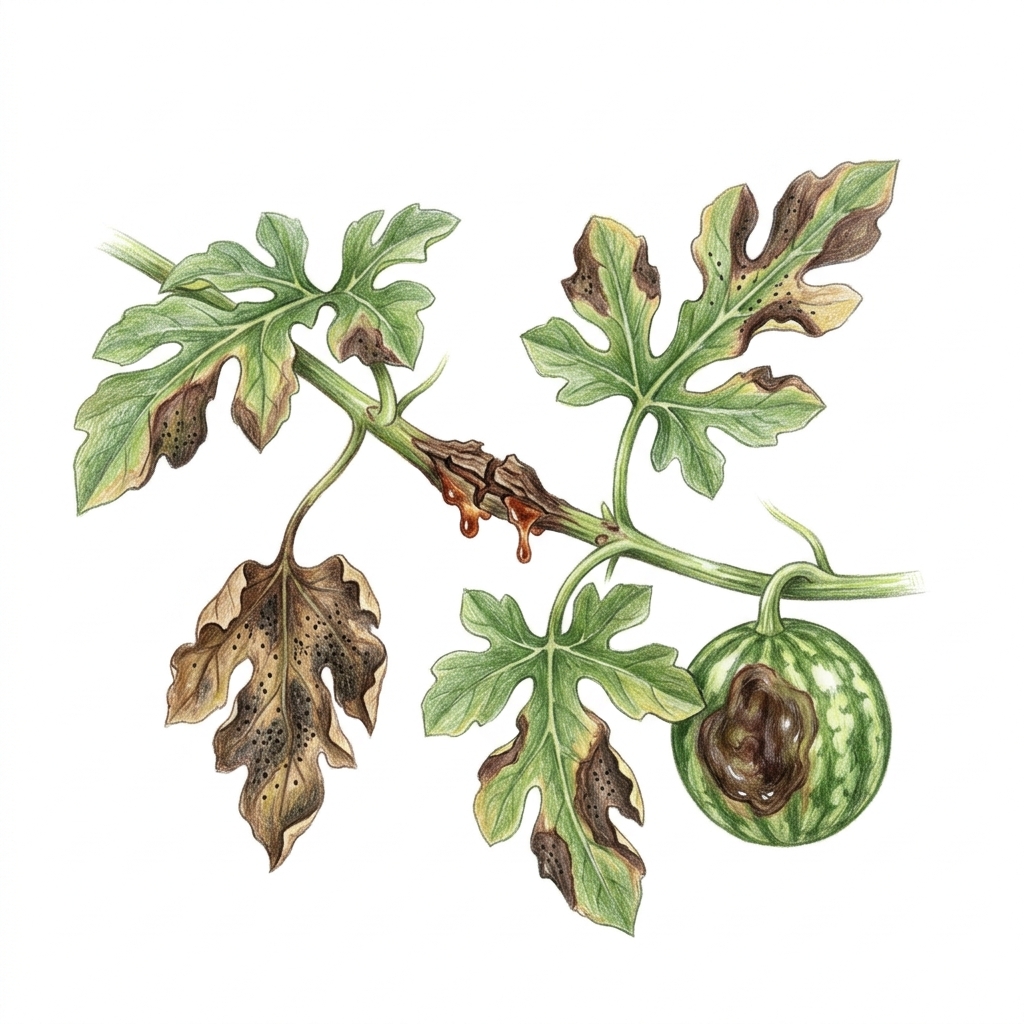
Illustration
A fungus of melons and other cucurbits that makes dark spots spreading in from the leaf edges and cracked, gummy cankers on the stems, so the vines wilt and die; on the fruit it causes black rot. Use clean seed and seedlings, keep the leaves dry, clear away the old vines after harvest, and keep cucurbits out of that bed for two to three years.
How to spot it
- Brown to almost black spots that start at the leaf edges and spread fast across the leaf; older leaves die first.
- Cankers on the stems, often at a joint, that split and ooze a brown to reddish, sticky gum.
- Tiny black dots in the dead patches, easiest to see with a hand lens.
- Vines wilt from mid-season, and the stems die one after another.
- Fruit: small water-soaked spots that grow into large brown to black rotting patches.
Easily confused with
Anthracnose
Round brown spots whose centres drop out, leaving holes, rather than dark spots spreading in from the leaf edge.
Downy mildew
Angular yellow patches held in by the veins, with fuzz underneath; gummy stem blight spots are larger and can show rings.
Angular leaf spot
Small, angular spots that fall out as holes, with milky ooze under the leaf in damp weather, and no gummy stem cankers.
Blossom end rot
A sunken patch only at the flower end of the fruit, opposite the stalk, on a plant with healthy leaves.
Where it's a problem
- Worldwide: Found in most places melons are grown, including Australia, New Zealand, Europe and the Americas. Worst in warm, wet weather, 16–24 °C (61–75 °F), when the leaves stay wet for 4–10 hours.
- Pacific Islands: Common on watermelons, and spreads very fast in heavy, continuous rain.
What to do
- Buy clean seed and healthy seedlings, check seedlings every few days, and throw out any with spots.
- Water at the base, not over the leaves, and don't let the bed stay wet.
- Pick off spotted leaves as soon as you see them.
- Don't plant new melons next to an older crop that's already infected.
- After harvest, clear away the old vines and fruit, and pull out self-sown cucurbits.
- Keep melons, cucumbers, pumpkins and squash out of that bed for two to three years; sweet corn is a good crop in between.
If you use a fungicide, choose one labelled for gummy stem blight and follow the label and local rules. Sprays only protect, and the fungus can become resistant, so growers rotate between different kinds.
Follow your local council's guidance for disposing of diseased plant material. Official guides usually advise against putting it in a home compost heap.
Vegetables it affects
Free account, no card needed. You sign up or sign in first, then the scanner opens.
Sources (4, from NC State Extension, Pacific Pests, Pathogens and Weeds, NC State Extension, Caswell County and others)
- NC State Extension: Gummy stem blight of cucurbits
- Pacific Pests, Pathogens and Weeds: Watermelon gummy stem blight
- NC State Extension, Caswell County: Gummy stem blight is a fungus
- University of Illinois Extension: Gummy stem blight or black rot of cucurbits
Facts checked Wednesday 28 October 2026. General guidance only: follow your local council, agency and product label.