Home › Plant diseases › Angular leaf spot
Plant diseases
Angular leaf spot
Pseudomonas syringae pv. lachrymans · Bacterium
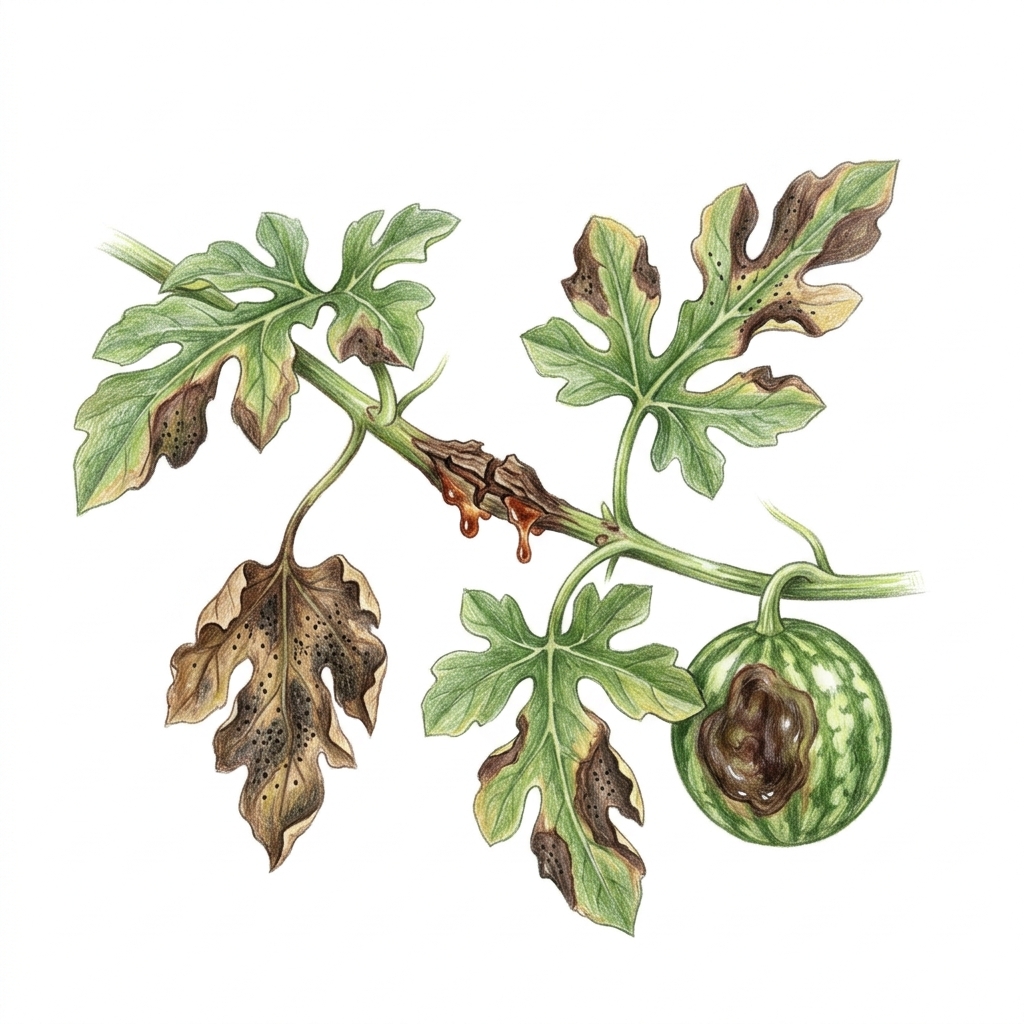
Illustration
A bacterial disease of cucumbers that leaves small, angular spots held in by the leaf veins; the spots dry, tear and fall out, leaving ragged holes. Sow clean seed, water at the base, stay out of the patch while it's wet, and keep cucurbits out of that bed for two to three years.
How to spot it
- Small, water-soaked spots on the leaves that grow until the veins stop them, so they're angular.
- The spots turn tan, grey or brown, sometimes with a yellow halo, more often on squash and melons.
- In damp weather, milky drops of ooze under the spots, which dry to a thin white crust.
- Dried spots tear and fall out, leaving ragged holes, and the leaves look tattered and yellowish.
- Fruit: small, round spots, usually only skin-deep; on rockmelons they turn chalky white and crack, letting in rot.
Easily confused with
Downy mildew
Angular yellow patches too, but with grey-purple fuzz underneath, no milky ooze, and no holes falling out.
Anthracnose
Round brown spots rather than angular ones, whose centres also drop out, with salmon-pink spore masses in wet weather.
Gummy stem blight
Larger brown to black spots that spread in from the leaf edge, and cracked, gummy cankers on the stems.
Where it's a problem
- Worldwide: Found in many places cucumbers are grown, including North America and Australia, and worst in long spells of warm summer rain, or under sprinklers.
- North America: Can cause serious losses in cucumbers, honeydew melons and zucchini, above all after frequent summer rain at around 24–28 °C (75–82 °F).
- Australia: Recorded in Western Australia, where the state's agriculture department described it in 1964 as common on cucumbers and gherkins grown late in the season.
What to do
- Sow certified, disease-free seed, and choose resistant cucumber varieties where you can.
- Water at the base rather than with sprinklers, so the leaves stay dry.
- Stay out of the patch, and don't pick, while the plants are wet.
- Don't overdo nitrogen fertiliser.
- After harvest, clear away all the old vines and leaves: the bacteria live in plant debris for up to two years.
- Keep cucumbers, zucchini and melons out of that bed for two to three years.
No spray cures it, and fungicides don't work on bacteria. Where official guides advise a spray, it's one labelled for bacterial diseases, used at the first sign to protect healthy leaves; follow the label and local rules. Clean seed, dry leaves and rotation do most of the work.
Follow your local council's guidance for disposing of diseased plant material. Official guides usually advise against putting it in a home compost heap.
Vegetables it affects
Free account, no card needed. You sign up or sign in first, then the scanner opens.
Sources (5, from University of Illinois Extension, University of California IPM, Utah State University Extension and others)
- University of Illinois Extension: Angular leaf spot
- University of California IPM: Angular leaf spot
- Utah State University Extension: Angular leaf spot
- University of Wisconsin–Madison Extension: Angular leaf spot
- WA Department of Agriculture: Angular leaf spot of cucurbits (1964)
Facts checked Wednesday 28 October 2026. General guidance only: follow your local council, agency and product label.