Home › Plant diseases › Blackheart
Plant diseases
Blackheart
Also called black heart (widely).
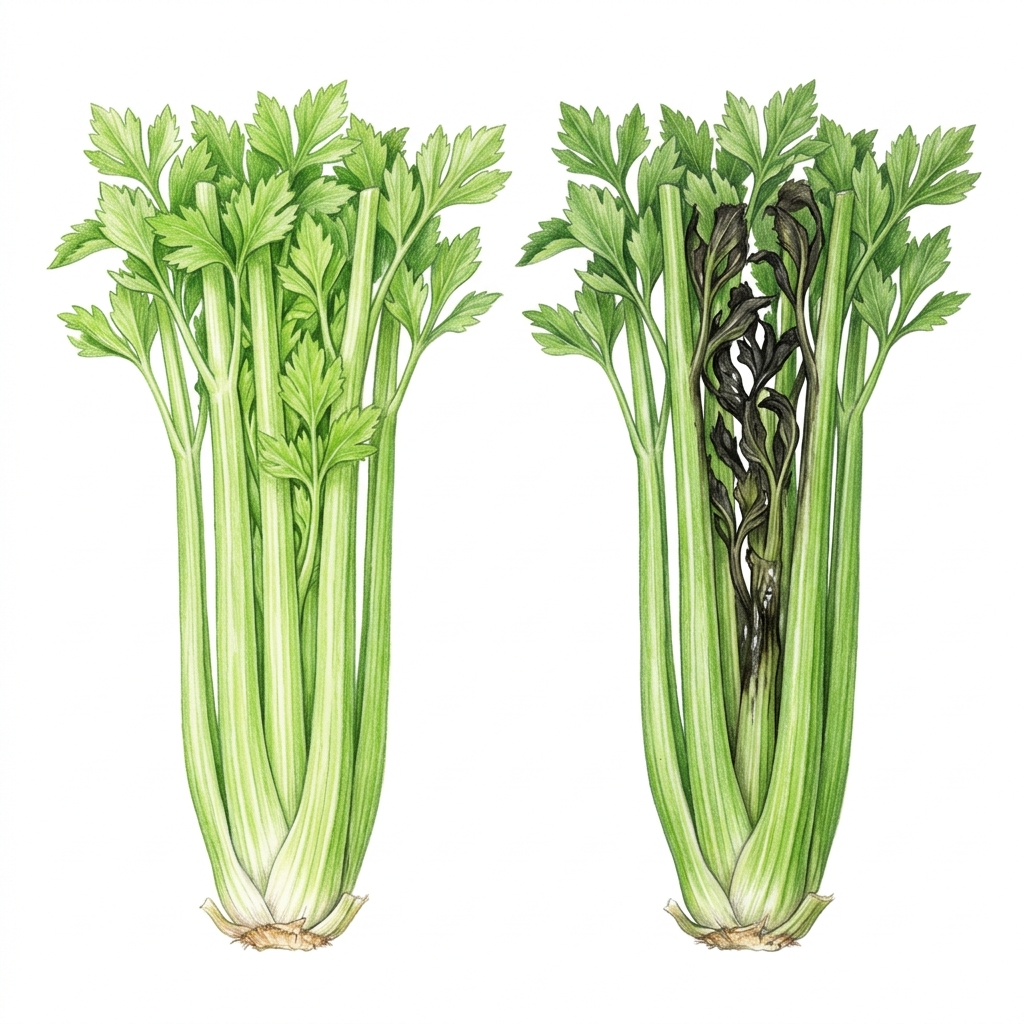
Illustration
The young leaves in the heart of a celery plant turn brown, then black, and often rot, from a shortage of calcium inside the fast-growing heart, usually brought on by uneven watering and too much fertiliser. Steady watering and moderate feeding prevent it.
How to spot it
- The young leaves in the centre of the plant turn brown, then black.
- The blackening spreads until the whole heart is dead.
- The dead heart may then turn into a slimy rot as bacteria move in.
- Worse as plants near maturity, and after a heavy soaking that follows a long dry spell.
Easily confused with
Tipburn
The same calcium shortage in lettuce and other leafy greens, where it browns the edges of the young inner leaves rather than killing the whole heart.
Boron deficiency
Brown-black cracks across the outside of the celery stalks, which turn brittle, rather than a black heart.
White mould (pink rot)
Soft, watery rot on the stalks, often at the base, with pink edges, white cottony mould and hard black bodies, in cool, wet weather.
Where it's a problem
- Worldwide: Common wherever celery is grown with uneven watering or heavy feeding. The problem is getting calcium into the fast-growing heart. Not regulated.
What to do
- Keep the soil evenly moist: water regularly so it never dries out and is then flooded.
- Feed moderately: too much nitrogen or potassium (potash) fertiliser makes it worse.
- Avoid salty soil and water, which make it worse.
- Test the soil, and add lime or calcium only if the test shows it's needed.
- Prevent it rather than wait for it: once the heart has blackened, it is too late to put right.
A fungicide won't help: blackheart is a calcium shortage in the heart, not an infection. Commercial growers' guides spray or drench calcium into the heart before any symptoms appear, as once the heart is black it may be too late. All agree the real fix is steady watering and moderate feeding.
Vegetables it affects
Free account, no card needed. You sign up or sign in first, then the scanner opens.
Sources (6, from Pacific Northwest Plant Disease Management Handbook, Purdue University Plant and Pest Diagnostic Lab, Utah State University Extension and others)
- Pacific Northwest Plant Disease Management Handbook: Celery blackheart · Celery cracked stem
- Purdue University Plant and Pest Diagnostic Lab: Blackheart of celery
- Utah State University Extension: Celery in the garden
- University of California IPM: Celery pink rot
- University of Maryland Extension: Mid-Atlantic commercial vegetable recommendations, celery
Facts checked Wednesday 28 October 2026. General guidance only: follow your local council, agency and product label.