Home › Plant diseases › White mould
Plant diseases
White mould
Sclerotinia sclerotiorum · Fungus
Also called white mold (USA and Canada), Sclerotinia rot (USA), Sclerotinia disease (UK), pink rot (on celery).
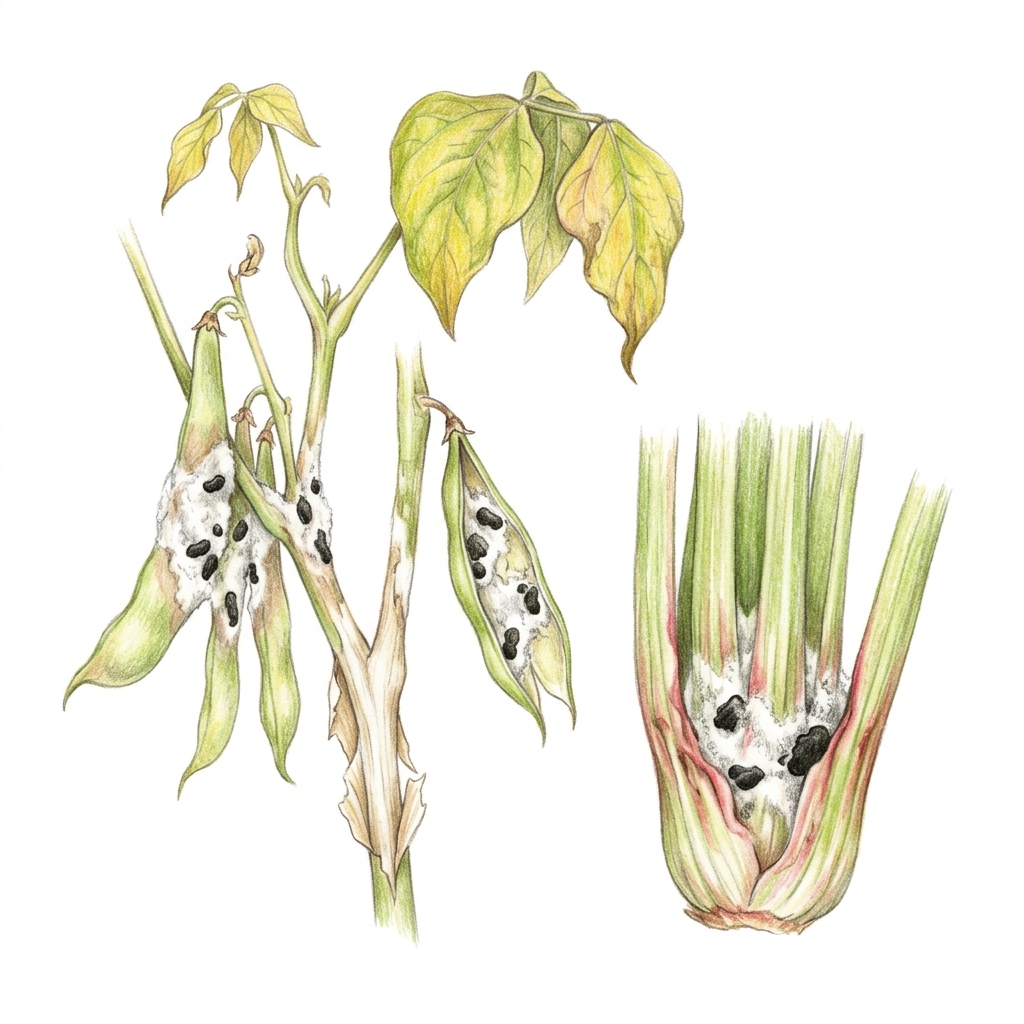
Illustration
A soil fungus that rots beans from the flowers, covering stems and pods in white, cottony mould with hard black lumps inside; it's one of the fungi that cause lettuce drop, and pink rot on celery. Pull out affected plants before the black lumps fall into the soil, space plants so they dry quickly, water the soil rather than the leaves, and keep beans and other hosts out of that bed for at least three years.
How to spot it
- Pale, water-soaked patches on stems, leaves and pods, usually about a week after full flowering, starting where old flowers have dropped.
- Within a few days, white, cottony mould covers the patches.
- Hard black lumps, often 5 mm to 1 cm (¼–⅜ in) long, like mouse droppings, form in the mould and inside stems and pods.
- Dried patches turn white to beige, and the skin of the stem can peel like paper.
- Leaves yellow and wilt; a stem rotted near the ground makes the whole plant wilt and die.
- Celery: a soft, watery rot on the stalks, usually at the base, often with pink edges, then white mould and black lumps.
Easily confused with
Lettuce drop
The same fungus, or a close relative, on lettuce, where it rots the base so the whole plant collapses. The two share the soil, so rotate beans and lettuce apart.
Grey mould
Dusty grey or light brown fuzz rather than white cotton, and any black specks are small and flat.
Pythium blight
A wet rot of stems and pods too, but with no hard black lumps. Beige-white dried patches with black lumps in them point to white mould.
Where it's a problem
- Worldwide: Found wherever beans are grown, and worst in a thick, damp canopy in cool to mild, wet weather around flowering. The black lumps keep it going in the soil for several years.
- North America: A serious disease of snap and dry beans, worst when it's wet in the week or two before flowering and the rows are dense.
- United Kingdom: Also attacks lettuce, celery, cucumbers, tomatoes and peas, and hollow-stemmed flowers such as dahlias and sunflowers.
What to do
- Pull out an affected plant straight away, with any fallen leaves and pods, and bag it before the black lumps drop into the soil.
- Space plants and rows widely, and choose open, upright varieties, so the leaves dry quickly.
- Water the soil early in the day, not the leaves, and don't overwater once the plants flower.
- Go easy on nitrogen fertiliser: soft, dense growth is more easily infected.
- Keep beans, lettuce, celery, tomatoes, carrots and other hosts out of that bed for at least three years; sweet corn and cereals are safe in between.
- Check bought or saved seed, and pick out any black lumps mixed in with it.
If you use a fungicide, choose one labelled for white mould and follow the label and local rules. Sprays protect better than they cure, so farms apply them at early flowering, aimed at the flowers; once the mould shows, they do little. In the UK, no chemical treatments are available to gardeners.
Follow your local council's guidance for disposing of diseased plant material. Official guides usually advise against putting it in a home compost heap.
Vegetables it affects
Free account, no card needed. You sign up or sign in first, then the scanner opens.
Sources (6, from Cornell University, University of California IPM, RHS and others)
- Cornell University: White mould in cabbage, beans and other vegetables
- University of California IPM: Celery pink rot
- RHS: Sclerotinia disease
- University of Wisconsin–Madison Extension: White mold
- Pacific Northwest Plant Disease Management Handbook: Snap bean white mold
- Manitoba Agriculture: White mould
Facts checked Wednesday 28 October 2026. General guidance only: follow your local council, agency and product label.