Home › Garden pests › Squirrels
Garden pests
Squirrels
Eastern grey squirrel (Sciurus carolinensis), fox squirrel (Sciurus niger), California ground squirrel (Otospermophilus beecheyi) and others · Mammal
Also called grey squirrel (UK), eastern gray squirrel, fox squirrel, ground squirrel (USA).
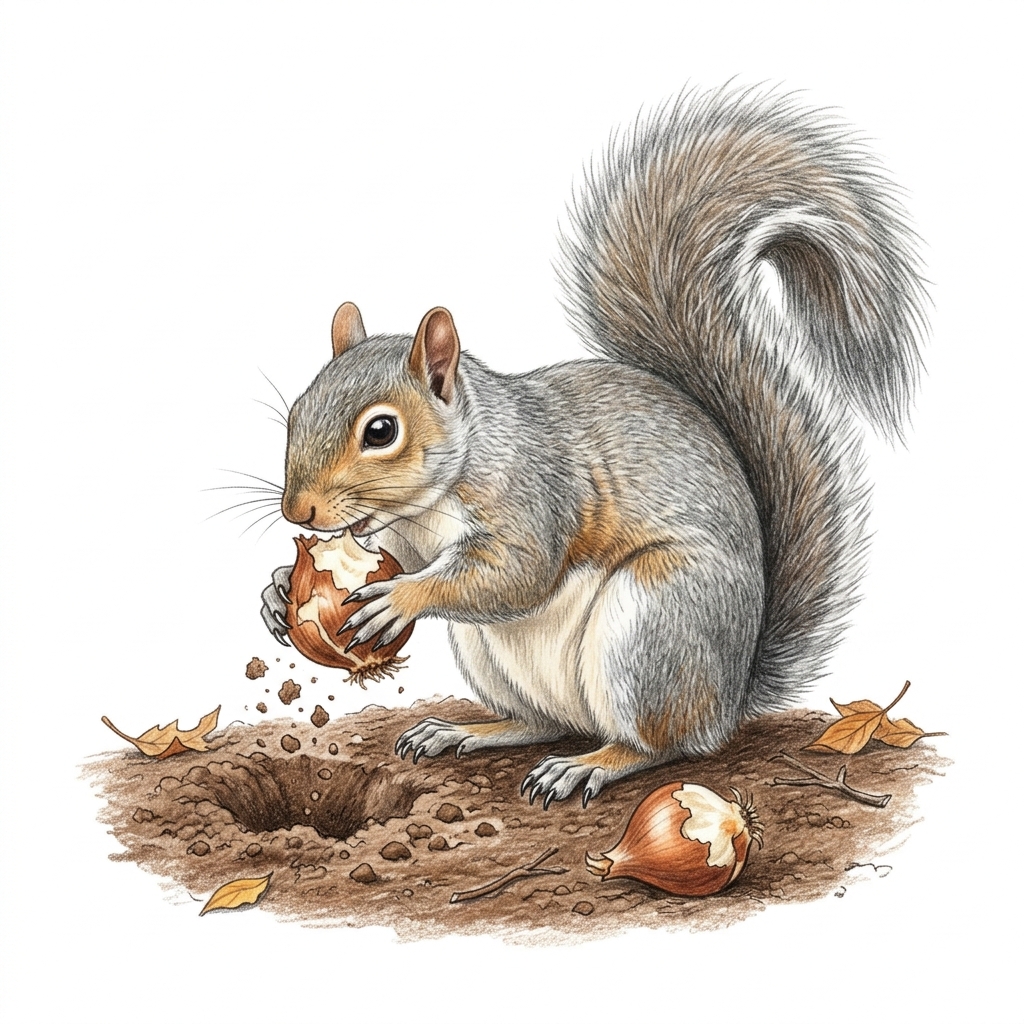
Illustration
Squirrels dig up and eat newly planted bulbs, take fruit and nuts, strip bark from trees and raid bird feeders, all in daylight. You can't keep them out of a garden, so protect what they want most: wire over bulbs at planting, netting over fruit, and baffles on feeders.
How to spot it
- Newly planted bulbs and corms dug up and eaten: tulips and crocuses are favourites, but daffodils, hyacinths, lilies, onions and garlic are taken too.
- Small holes dug in lawns, beds and pots, where squirrels bury food or dig up their stores, mostly in autumn.
- Fruit, nuts, sweetcorn and strawberries taken or half-eaten, and the flower buds of camellias and magnolias nipped off.
- Bark stripped from trunks and branches, leaving bare wood; sycamore, maples, ash and beech are often hit, and a badly stripped tree can die.
- Bird feeders raided, and plastic gnawed, including hosepipes, plant labels and plastic netting.
- Grey squirrel: silver-grey fur (sometimes black) with a white belly and a long bushy tail, about 40 to 60 cm (16 to 24 in) long from nose to tail tip; seen by day, climbing trees and running along fences.
- Ground squirrels (western USA): live in burrows about 10 cm (4 in) across and always run into them when frightened; tree squirrels climb instead.
Easily confused with
Rats
Mostly active at night, with burrows and runs at ground level among plants; roof rats also gnaw fruit on the tree, but squirrels feed by day.
Mice
Also eat crocus corms and tulip bulbs, leaving small holes in the soil, but mostly at night; squirrels dig by day and are often seen at it.
Birds
Peck holes in ripening fruit and tear seedlings into shreds; squirrels gnaw, carry food off and dig.
Possums
In Australia, a bushy-tailed climber in the fruit trees at night is a possum: there are no known wild squirrels there.
Where it's a problem
- United Kingdom: The grey squirrel came from North America in the 19th century and is a listed invasive non-native species. If you have caught one, it is an offence to release it back into the wild: government guidance says to kill it humanely or take it to a licensed facility, and anyone setting traps must be trained and equipped to do so. A squirrel caught by accident, for example tangled in wire netting, can be let go. Red squirrels are fully protected by law, and in Wales, for example, only live traps may be used for greys where reds live.
- United States: Eastern gray and fox squirrels do most garden damage, and are classed as game animals in most states, so the rules on trapping and moving them vary. In California, an owner may control fox squirrels damaging crops or property at any time, gray squirrels need a permit, and moving any tree squirrel elsewhere is illegal without one. In Washington, a squirrel may only be let go on the property where it was caught, unless you have a permit. Check with your state wildlife agency first.
- Western United States: Ground squirrels live in burrows and eat seedlings, vegetables, nuts and fruit, gnaw bark and chew sprinkler heads and irrigation lines. In California, ground squirrels damaging crops or property may be controlled by the owner without a licence, but a few kinds, such as the Mohave ground squirrel, are protected: identify the animal first.
- Australia: There are no known wild squirrels anywhere in Australia. The northern palm squirrel, released at Perth Zoo in 1898, is a declared pest in Western Australia and is now considered eradicated there; illegally kept pets are the main risk of its return. If you see a small grey-brown squirrel with five white stripes along its back, note the date, time and place, take a photo if you can, and report it to DPIRD through the MyPestGuide Reporter app or on (08) 9368 3080.
How to protect your plants
- Accept that you can't keep squirrels out of a garden, and protect the few things they go for: new bulbs, ripening fruit and nuts, young trees and bird feeders.
- At planting, cover a bed of bulbs or corms with chicken wire or wire netting, staked or weighed down with bricks, or plant groups of bulbs in an aquatic planting basket topped with chicken wire and sunk to the right depth. Take the wire off the bed in early spring, before the leaves come through: once bulbs are growing, squirrels lose interest.
- Plant bulbs at their full depth and firm the soil well afterwards: tulips, daffodils and hyacinths 15 to 20 cm (6 to 8 in) deep, crocuses 8 to 10 cm (3 to 4 in). Cover bulbs in pots with wire netting.
- Grow more of the bulbs squirrels rarely eat, such as daffodils, snowdrops, grape hyacinths and alliums, but protect them at planting too: squirrels may still dig them up, and the RHS lists daffodils among the bulbs they take.
- Net fruit bushes and small fruit trees as soon as squirrels show an interest. Squirrels bite through plastic, so use wire netting for a fruit cage. Keep any netting taut and check it often for holes and trapped animals.
- Cover seed rows and new plantings with freestanding cages of chicken wire, about 2.5 cm (1 in) mesh, until the plants are growing strongly.
- On a lone tree, fit a smooth metal band about 60 cm (2 ft) wide around the trunk, about 1.8 m (6 ft) off the ground, held with wire and springs so the tree can grow. It only works if no branch, fence or building lies within about 3 m (10 ft), because squirrels jump.
- Put bird feeders on a pole at least 3 m (10 ft) from branches and buildings, with a cone-shaped baffle at least 1.2 m (4 ft) up that sticks out at least 60 cm (2 ft). Catch spilled seed in a tray, and don't feed the squirrels.
- Expect little from repellents and scarers: noise and visual scarers stop working within days, and taste repellents give short-term protection at best and need putting on again after rain.
Never use poison on squirrels: no poison is registered for tree squirrels in the US, home gardeners in California can't legally use poison baits for ground squirrels, and in the UK red squirrels are fully protected. Protect your plants with wire and netting instead, and ask your local wildlife agency if you need more help.
Take care: Don't handle a squirrel: they bite and scratch. If one does, scrub the wound with soap and water and see a doctor. In the western US, ground squirrels' fleas can carry plague: don't touch dead squirrels, and report unusual numbers of them to your local health department.
Free account, no card needed. You sign up or sign in first, then the scanner opens.
Sources (16, from RHS, GOV.UK, Natural Resources Wales and others)
- RHS: Grey squirrels · Mice and voles
- GOV.UK: Invasive non-native (alien) animal species: rules in England and Wales · March 2019 update: invasive non-native species and grey squirrels
- Natural Resources Wales: Red and grey squirrel licensing
- University of California IPM: Tree squirrels · Ground squirrel · Rats
- Penn State Extension: Tree squirrels
- Washington Department of Fish and Wildlife: Tree squirrels
- Internet Center for Wildlife Damage Management: Tree squirrel damage prevention and control · Bird feeders
- Iowa State University Extension: Keeping squirrels from digging up newly planted tulip bulbs
- University of New Hampshire Extension: How can I keep wildlife from eating my new bulbs?
- University of Illinois Extension: Debunking spring flowering bulb myths
- DPIRD (Western Australia): Biosecurity alert: Northern palm squirrel
Facts checked Friday 13 November 2026. General guidance only: follow your local council, agency and product label.