Home › Garden pests › Possums
Garden pests
Possums
Common brushtail possum (Trichosurus vulpecula), common ringtail possum (Pseudocheirus peregrinus) and others · Mammal
Also called brushtail possum, ringtail possum (Australia), possum (an introduced pest) (New Zealand).
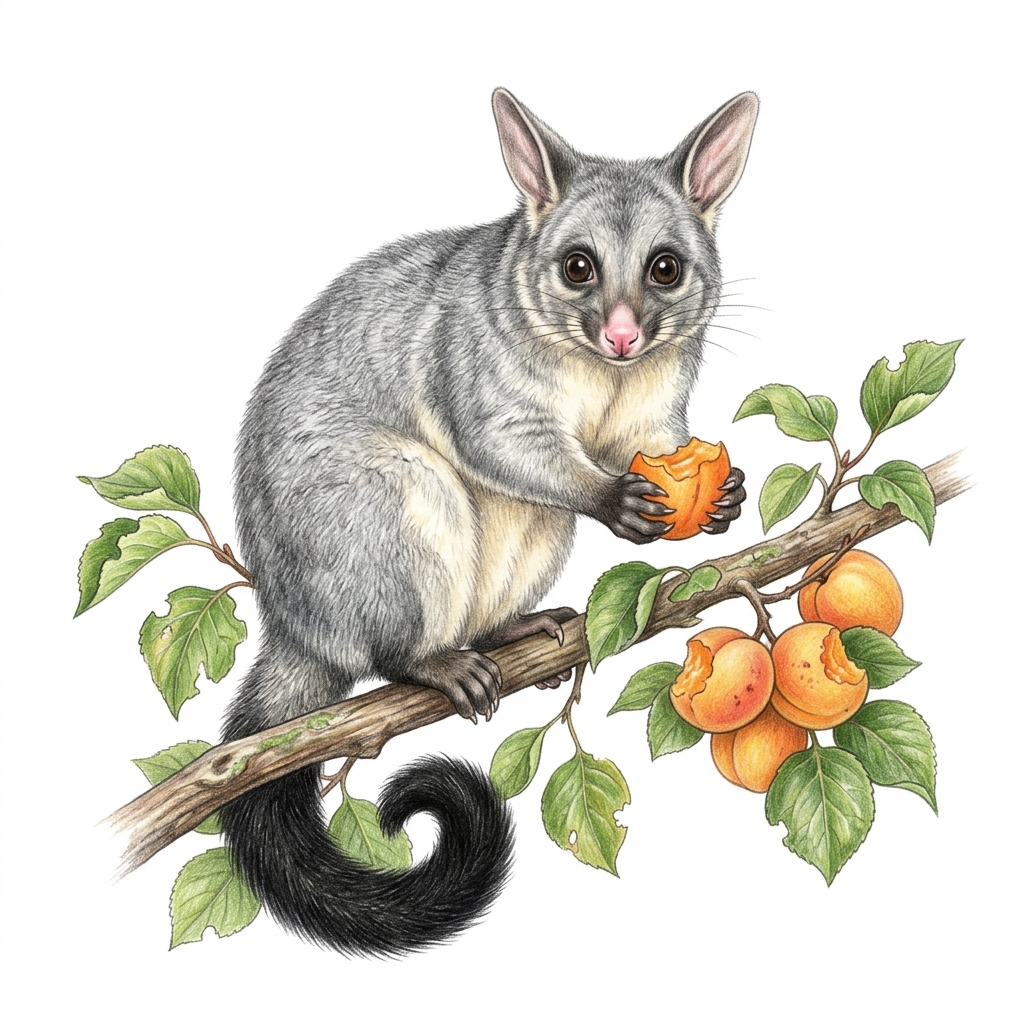
Illustration
Possums climb in at night and strip leaves, shoots, flowers and fruit, often a whole plant in one visit. In Australia they are protected and territorial, so removing one only makes room for the next: the answer is to keep them off the plants you care about, with collars, covers, netting and floppy-topped fences.
How to spot it
- Leaves, shoots, buds and flowers chewed or stripped overnight, sometimes a whole plant at once; roses, fruit trees and vegetable seedlings are favourites.
- Fruit half-eaten on the tree or knocked to the ground.
- Droppings under trees, along fence tops and on paths, and a strong smell where they mark their territory.
- Scratch marks on tree bark, and thumping or scampering on the roof after dark.
- Common brushtail possum: about the size of a house cat, grey or brown, with a bushy black tail and long ears.
- Common ringtail possum: smaller and grey, with round ears with a white patch behind them and a thin, white-tipped tail that is not bushy.
Easily confused with
Birds
Peck fruit and seedlings in daylight, mostly early in the day; possums feed only at night.
Flying foxes (fruit bats)
Fly in at night to ripe fruit high in the tree and leave no tracks on the trunk, so tree collars don't stop them; only netting does.
Mice
Much smaller droppings, and gnawed seeds and seedlings at ground level rather than leaves stripped high up.
Slugs and snails
Ragged holes low on the plant with silvery slime trails, rather than whole shoots and fruit taken.
Where it's a problem
- Australia: All possums are protected native animals. Trapping, moving or harming one without a licence or permit is illegal, and possums are territorial: a moved possum usually dies within days in another possum's patch, and a new one soon moves into the empty one. The trapping rules are mainly about possums living in roofs, and say how close to home they must be let go: within 25 m (80 ft) in Queensland, by licensed relocators; within 150 m (500 ft), at dusk, in New South Wales, by licence holders; and on the same property, within 50 m (165 ft), after sunset on the day of capture in Victoria, where ringtails need a permit. South Australia's advice is that possums should only be trapped if they live in buildings. In the garden, protect the plants instead.
- Western Australia: In the south-west the western ringtail possum is critically endangered, and in towns such as Albany it lives and breeds in private gardens. Protect your plants, and never try to catch one.
- Tasmania: Brushtail possums are protected. Trapping and moving them generally doesn't work, and a permit to trap is issued only as a last resort. A well-built fence about 1.5 m (5 ft) high, with a floppy top, keeps them out.
- New Zealand: Brushtail possums were brought in from Australia and are a declared pest of native forest, orchards and home gardens. Home gardeners may trap them, but the method must be humane under the Animal Welfare Act 1999: live-capture traps must be checked within 12 hours of sunrise, and kill traps are mounted on a tree about 1.5 m (5 ft) off the ground to keep pets and children safe. Your regional council and local Predator Free groups can advise.
- United States: There, "possum" usually means the Virginia opossum, a different animal that eats fallen fruit, berries, grapes and pet food. A poultry-wire fence about 4 ft (1.2 m) high, with the top 12 to 18 in (30 to 45 cm) bent outward and left unsupported, keeps it out of a vegetable garden. In California, moving a trapped opossum needs written permission from the state's Fish and Wildlife department.
How to protect your plants
- Work out what they are eating, and protect those plants first: it's usually a few favourites, not the whole garden.
- Cover small fruit trees and vegetable beds at night with wildlife-friendly netting or light shade cloth, held up on a frame and pegged down all round so possums can't push under it. Netting must be fine: in Victoria, by law, holes no bigger than 5 mm (3/16 in) for household fruit trees and vegetable gardens. If you can poke a finger through, it's too coarse.
- On a single tree, slip individual fruit into shade-cloth bags, or cover seedlings with upturned pots or mesh cloches at night.
- Fit a smooth metal collar about 60 cm (2 ft) wide around the trunk of a fruit tree, starting about 60 cm (2 ft) above the ground. It only works if no branch, fence, roof or other tree lets the possum jump in, so prune back any that do.
- Around a vegetable or flower bed, build a floppy fence: heavily galvanised chicken wire about 80 cm (32 in) wide, the bottom 20 cm (8 in) buried, the rest held up on flexible wire stakes and curved outward at the top. A climbing possum bends it over and falls off.
- Take away what draws them in: pick up fallen fruit every day, bring pet food in at night, use a closed compost bin, and never feed possums.
- Try a bitter or hot spray on the leaves, such as quassia chips, or chilli and garlic boiled in water and cooled. Expect mixed results: in one study, none of six taste-based repellents stopped hungry possums, so use sprays only alongside covers and collars.
- Plant what possums tend to leave alone, such as prickly grevilleas and hakeas, woody banksias and melaleucas, and strong-smelling mint and geraniums, and keep the plants they love under cover.
- Give a resident possum somewhere else to live: a possum box at least 4 m (13 ft) up a tree, away from the house, can keep it out of the roof without breaking the law.
In Australia, never use poison, glue or any trap on a possum unless your state's law allows it: possums are protected native animals, and harming one is an offence. In New Zealand, use only methods your regional council approves, and never put out a toxin that a pet, child or native bird could reach.
Take care: Don't try to handle a possum: they scratch and bite. If you find one sick, injured, orphaned or caught in netting, call a local wildlife rescue group.
Free account, no card needed. You sign up or sign in first, then the scanner opens.
Sources (12, from Queensland Government, NSW Environment, Bayside City Council (Victoria) and others)
- Queensland Government: About possums
- NSW Environment: How to stop possums eating your garden · How to remove a possum from your roof
- Bayside City Council (Victoria): Possums
- Agriculture Victoria: Use of fruit netting, harvest without harm
- South Australian Government: Possums and gardens
- Tasmania NRE: Living with brushtail possums
- University of Western Australia: Critically endangered possum calls local backyards home
- Predator Free NZ: Possum facts and control tips
- Department of Conservation (NZ): Animal welfare and trapping
- Taranaki Regional Council: Trapping possums at home
- University of California IPM: Opossums
Facts checked Thursday 12 November 2026. General guidance only: follow your local council, agency and product label.