Home › Garden pests › Rats
Garden pests
Rats
Brown rat (Rattus norvegicus) and black rat (Rattus rattus) · Mammal
Also called Norway rat, sewer rat (the brown rat, in the United States and New Zealand), roof rat (the black rat, in the United States), ship rat (the black rat, in New Zealand).
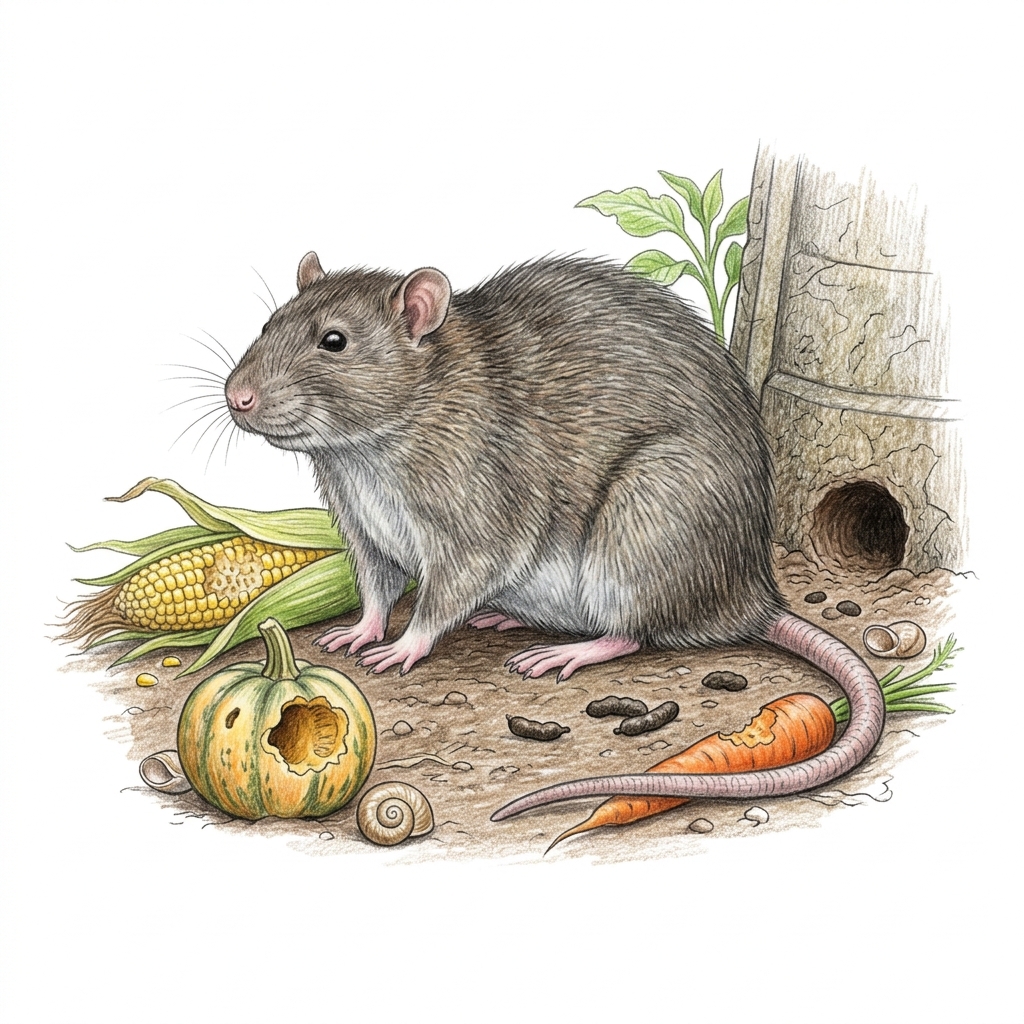
Illustration
Rats gnaw sweetcorn, squash, root crops and ripening fruit, raid compost, bird seed and chook feed, and burrow under sheds and compost bins. Take away their food and shelter first, store crops in rat-proof containers, and if you trap, keep traps where children, pets and wildlife can't reach them.
How to spot it
- Sweetcorn cobs, pumpkins, squash, carrots, parsnips, beetroot and potatoes gnawed in the ground or in store, with paired grooves from the front teeth.
- Fruit and nuts eaten on the tree: black (roof) rats hollow out oranges and leave the empty rind hanging.
- Burrows 30 to 40 mm (1¼ to 1½ in) across in the soil under compost bins, sheds, hedges and woodpiles, with worn runs between them.
- Droppings about 15 mm (⅝ in) long and 5 mm (3/16 in) wide, sausage-shaped with rounded ends: about twice the size of a mouse's. A pile of empty snail shells is another sign.
- Brown rat: stocky and grey-brown, about 21 cm (8 in) long plus a tail of about 18 cm (7 in), with a blunt nose, small furry ears and a thick, scaly tail shorter than its body.
- Black rat: slimmer and a good climber, with a pointed nose, large thin ears and a tail longer than its body.
Easily confused with
Mice
Droppings about half the size, and tooth marks about 2 mm wide against a rat's 4 mm (⅙ in). A young rat has a big head and big feet for its body.
Possums
Much bigger, about the size of a house cat, and they strip leaves, shoots and flowers, often a whole plant overnight, rather than gnawing cobs and roots.
Squirrels
Out by day, with a long, bushy tail; a rat's tail is scaly and almost hairless, and rats feed mostly at night.
Native bush rat (Australia)
Its tail is no longer than its body and it is shy, rarely seen near people; a black rat's tail is longer than its body. Native rats are protected.
Where it's a problem
- Worldwide: Rats breed all year round, and a female brown rat can raise 20 or more young a year. They are easiest to deal with early, while numbers are still low.
- Australia: Black and brown rats are introduced pests, but Australia has more than 60 native rodents, such as the bush rat, swamp rat and rakali (water rat), and native animals are protected by law. If there's a chance the animal is native, you may not be allowed to bait or trap it: ask your council or state wildlife agency. In South Australia, the government suggests keeping native swamp rats out of a vegetable patch with wire mesh or shade cloth buried 200 mm (8 in) deep, or with raised beds. In Victoria, glue traps are banned. Rats also spread rat lungworm through snails and slugs, so wash vegetables well before eating them raw and watch that small children don't eat snails.
- New Zealand: All three rats here were brought in: the ship rat, the commonest, which climbs to raid nests high in trees; the Norway rat, the biggest, found mostly near water; and the kiore. They eat native birds, eggs and chicks, wētā, lizards, fruit and seeds. Predator Free NZ suggests 2 to 3 animal-welfare-approved traps per backyard, each inside a tunnel to keep children and pets safe, and telling your neighbours, as rats cross fence lines.
- United Kingdom: The brown rat is the garden rat: the black rat is now very rare and does not live outdoors in towns. Under the Prevention of Damage by Pests Act 1949, dealing with rats is the landowner's responsibility. Your council can advise, and you may need a professional pest controller. In England, using a glue trap on a rodent without a licence is against the law, and only professional pest controllers can get one.
- United States: Neither the Norway rat nor the roof rat is native. Roof rats nest in trees, ivy and dense shrubs and eat citrus, avocados, nuts and berries, often on the tree; Norway rats burrow along foundations, under woodpiles and around gardens. Rat baits sold to households must come as blocks or paste in ready-to-use bait stations, and California restricts most anticoagulant baits further.
How to keep rats out of your garden
- Take away their food: pick up fallen fruit and nuts every day, and don't leave pet food or bird food out overnight.
- Feed wild birds from hanging feeders with a tray to catch spilt seed, put out only a day's worth, and clear up what falls. If rats move in, stop putting seed out until they have gone.
- Keep chook and pet food in metal or thick plastic bins with tight lids, and clean waste out of chook pens and aviaries regularly.
- Use a closed compost bin with a tight lid, standing on paving or on strong wire mesh so rats can't dig in from below. Add only garden waste and raw fruit and vegetable scraps: no meat, fish, dairy, cooked food or pet droppings.
- If rats have lived in the compost, don't use it on crops eaten raw whose edible parts touch the soil, such as radishes, celery, cucumbers and strawberries.
- Take away shelter: clear rubbish, garden waste and dense undergrowth near sheds and beds, stack firewood at least 30 cm (1 ft) off the ground, and thin out ivy and other climbers on fences and walls.
- Keep black rats off the roof: prune shrubs back at least 60 cm (2 ft) from the house, and cut back branches within 1 to 2 m (3 to 6 ft) of the roof.
- Store harvested crops, seed and bulbs in rat-proof containers, and keep sheds and greenhouses shut: a rat can squeeze under a door through a gap of about 12 mm (½ in).
- If you trap, snap traps are the safest choice. Set them inside a box or tunnel where children, pets and birds can't reach them, along walls and the rats' runs. Rats are wary of anything new, so leave a baited trap unset for a few days first. Never use glue traps outdoors.
- Make sure it isn't a protected native rat before trapping or baiting, and call a licensed pest controller for a large or lasting problem. Report rats on council land to your council.
No spray keeps rats off crops, and repellents and ultrasonic devices don't work for long. Rat poisons are toxic to children, pets and wildlife, and a poisoned rat can in turn poison the owl, hawk, dog or cat that eats it. Follow the label and your local rules, use a locked bait station out of reach of children and pets, and never bait for a rat that could be a protected native animal.
Take care: Rats can carry leptospirosis (Weil's disease), caught when their urine gets into a cut, the eyes or the mouth, often from wet soil or water. Cover cuts, wear gloves to handle traps, droppings or dead rats, never touch them with bare hands, and wash your hands with soap and water afterwards. Don't sweep or vacuum droppings: wet them with disinfectant first.
Free account, no card needed. You sign up or sign in first, then the scanner opens.
Sources (19, from RHS, University of California IPM, ACT Government and others)
- RHS: Rats
- University of California IPM: Rats · Tree squirrels
- ACT Government: Rats and mice
- Victorian Department of Health: Rodents and pest control
- Australian Museum: Is it a rat?
- Green Adelaide (SA Government): How to identify South Australia's native rodents
- NSW Health: Rat lung worm
- Predator Free NZ: Rat facts and control tips
- Department of Conservation (NZ): Rats
- Reading Borough Council: Rat prevention
- The Mammal Society: Black rat
- GOV.UK: Glue trap licences
- NHS: Leptospirosis (Weil's disease)
- US CDC: About leptospirosis · How to clean up after rodents · Preventing rat lungworm
- US EPA: Restrictions on rodenticide products
- California Department of Fish and Wildlife: Avian investigations
Facts checked Friday 13 November 2026. General guidance only: follow your local council, agency and product label.