Home › Garden pests › Squash vine borer
Garden pests
Squash vine borer
Melittia cucurbitae · Insect
Illustration
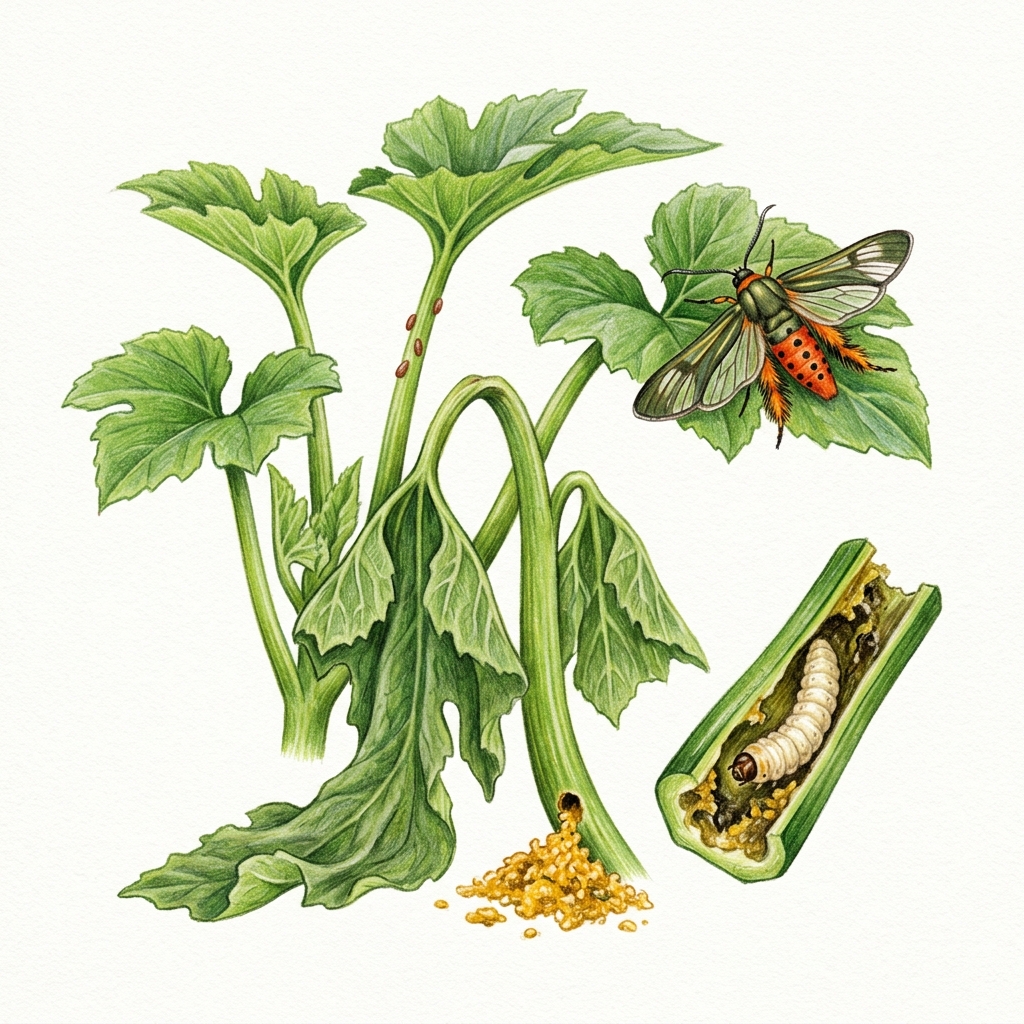
The caterpillar of a wasp-like moth that bores into the stems of zucchini, squash and pumpkins, so whole runners suddenly wilt. Cover young plants, check stem bases for eggs and sawdust-like droppings, and slit infested stems to take the grubs out.
How to spot it
- A runner or a whole plant that suddenly wilts, often in midsummer and at midday, while plants nearby look fine.
- A small hole near the base of the stem, with sawdust-like droppings (frass) pushed out of it.
- Inside the stem, a fat, cream-white grub with a brown head, up to about 25 mm (1 in) long.
- Tiny, flat, reddish-brown eggs, about 1 mm across, laid singly on the stem base and leaf stalks.
- The adult: a day-flying moth about 16 mm (⅔ in) long that looks like a wasp, with an orange-red body dotted with black and metallic dark green front wings.
Easily confused with
Bacterial wilt
Wilting with no hole or frass at the stem base, and no grub inside. Cut a wilted stem and squeeze it: sticky sap that strings out as you pull the cut ends apart points to bacterial wilt.
Squash bugs
Leaves wilt and blacken too, but you'll find flat grey-brown bugs and bronze egg clusters on the leaves, and no hole in the stem.
Cucumber beetles
Small yellow beetles with black stripes or spots chewing the leaves and flowers; the wilt they spread leaves no hole or frass in the stem.
Where it's a problem
- North America: Native to North America: common across the eastern United States and found in south-eastern Canada. There is one generation a year in the north, with moths flying from June to mid-August, and two in the south.
- Mexico: Also found south through Mexico to near Guatemala.
- Elsewhere: Our sources record it only in the Americas. If you find a grub inside a squash stem elsewhere, your local agriculture department can identify it.
What to do
- From early summer, check the base of the stems every few days, and crush or wipe off any eggs before they hatch.
- Cover young plants with row cover from planting until they flower, but only where squash didn't grow last year, as moths can hatch from the soil underneath. Then uncover them, or hand-pollinate the flowers.
- If you find frass, slit the stem lengthwise beside the hole with a sharp knife, take out the grub, and heap moist soil over the cut so the stem can root again.
- On vining kinds, bury a few leaf joints along the runners so they grow extra roots and keep going if the base is damaged.
- Where borers are bad, grow the kinds they like least, such as butternut. Hollow-stemmed zucchini, summer squash, pumpkins and Hubbard squash suffer most.
- Pull up and destroy the vines as soon as you've finished harvesting, and turn the soil in autumn and again in spring to expose the cocoons.
If you use an insecticide, choose one labelled for squash vine borer and follow the label and local rules. Sources say sprays only work before the grubs get inside the stems.
Vegetables it affects
Free account, no card needed. You sign up or sign in first, then the scanner opens.
Sources
- UConn Extension: Squash vine borer in home gardens
- Cornell University IPM: Squash vine borer
- University of Wisconsin–Madison Extension: Squash vine borer
- UF/IFAS Extension: Squash vine borer
- University of Kentucky Entomology: Cucumber beetles and bacterial wilt (ENTFACT-311)
Facts checked Wednesday 21 October 2026. General guidance only: follow your local council, agency and product label.