Home › Garden pests › Squash bugs
Garden pests
Squash bugs
Anasa tristis · Insect
Illustration
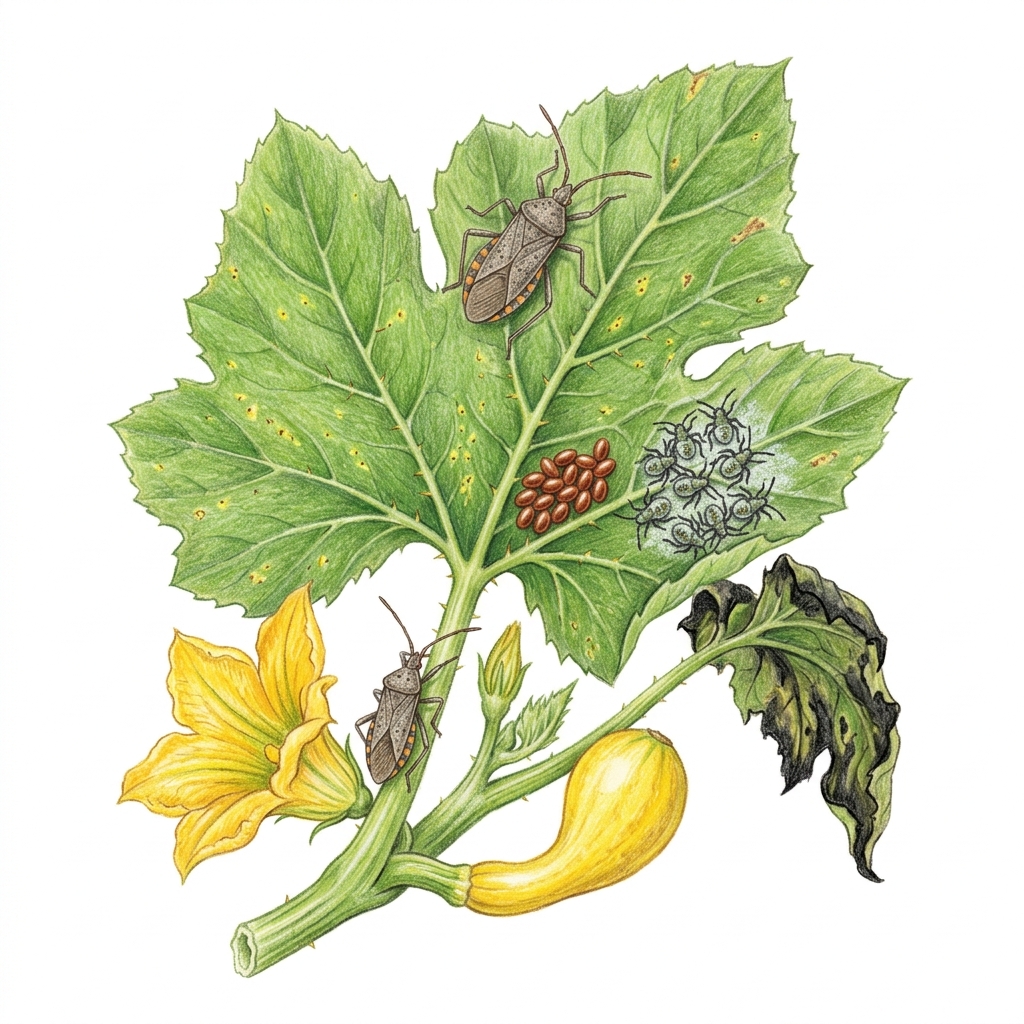
A flat, grey-brown North American bug that sucks sap from squash and pumpkins, leaving speckled leaves that yellow, wilt and blacken. Crush its bronze egg clusters early, trap adults under boards, and clear old vines after harvest.
How to spot it
- Flat-backed, grey-brown adults about 1.6 cm long, with orange and brown stripes along the edges of the abdomen.
- Groups of wingless, spider-like young, greenish-grey to light grey with dark legs, often dusted with white powder.
- Clusters of shiny bronze to brick-red oval eggs on the undersides of leaves, between the veins.
- Leaves speckled with yellow that turns brown; badly hit plants wilt, and the leaves blacken and go crisp.
- Bugs gathering at night under boards, dead leaves and debris near the plants.
Easily confused with
Stink bugs
Wider and rounder, and more often on tomatoes than on squash.
Leaf-footed bugs
Close relatives with flattened, leaf-like flaps on the hind legs, which squash bugs lack.
Where it's a problem
- North America: Common throughout the United States, and found from southern Canada to Central America.
- Elsewhere: Our sources record it only in the Americas. If you find a bug on squash elsewhere, your local agriculture department can identify it.
What to do
- From spring, check the undersides of leaves every 2 to 3 days and crush the bronze egg clusters.
- Hand-pick adults and nymphs; starting early in the season makes the biggest difference.
- Lay boards or heavy cardboard on the ground near plants; the bugs gather underneath at night, so check and destroy them each morning.
- Cover young plants with row cover, and take it off when they start to flower so they can be pollinated. Growing vines up a trellis also helps.
- Plant early to give the crop a head start, and try more resistant varieties such as butternut.
- Clear away old vines, fruit and debris after harvest, where adults spend the winter.
If you use an insecticide, choose one labelled for squash bugs and follow the label and local rules. Sources say sprays only work on the small young nymphs, not on the larger bugs.
Free account, no card needed. You sign up or sign in first, then the scanner opens.
Sources
- University of California IPM: Squash bugs
- University of Florida IFAS: Squash bug
- Utah State University Extension: Squash bugs
- University of Kentucky: Squash bug on cucurbit crops
- Ohio State University: Leaf-footed bugs
Facts checked Sunday 27 September 2026. General guidance only: follow your local council, agency and product label.