Home › Garden pests › Spotted-wing drosophila
Garden pests
Spotted-wing drosophila
Drosophila suzukii · Insect
Also called SWD (growers and agencies).
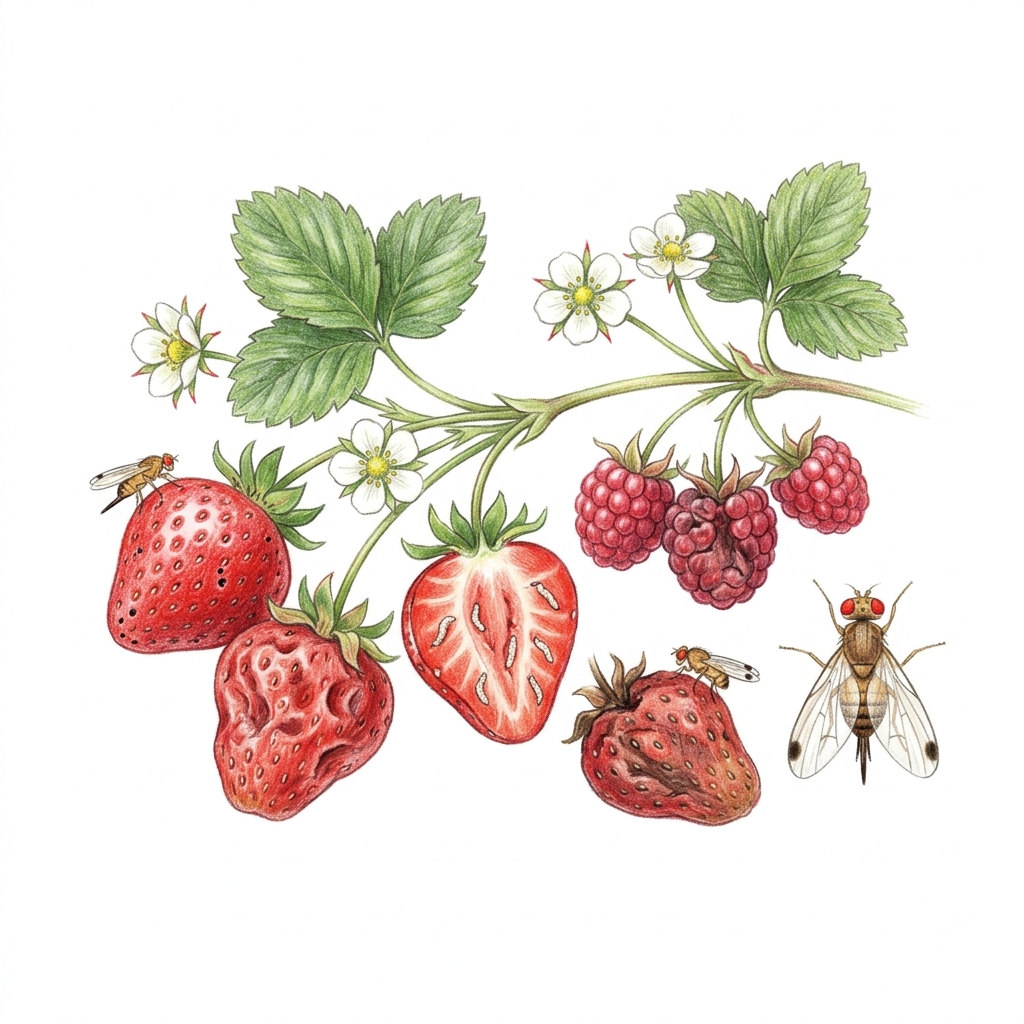
Illustration
A tiny vinegar fly that, unlike its relatives, lays its eggs in sound, ripening fruit, so strawberries and other berries go soft and collapse with small white maggots inside. Pick fruit as it ripens, clear away damaged and fallen fruit, and cover plants with very fine mesh; in Australia and New Zealand, where it isn't found, report it.
How to spot it
- Tiny pinprick holes or scars in the skin of ripening, otherwise sound fruit.
- Fruit that turns soft and brown, wrinkles, sinks into craters and collapses, often then rotting.
- Small white maggots up to about 4–6 mm (¼ in) long inside the fruit, sometimes several in one berry.
- Pale brown flies 2–3 mm (⅛ in) long with red eyes: males have a dark spot near the tip of each wing, and females have a saw-like egg-laying tube.
- Damage is worst in warm, humid weather, in summer and autumn.
Easily confused with
Vinegar flies (kitchen fruit flies)
Similar tiny flies, with no wing spots, that breed in overripe, damaged and rotting fruit rather than sound ripening berries.
Grey mould
Berries rot under a fluffy grey fur, with no pinprick holes and no maggots inside.
Slugs and snails
Holes eaten into the berries, often hollowed out, with silvery slime trails.
Fruit fly
Larger, wasp-like flies, such as Queensland fruit fly at about 8 mm (⅓ in), that sting a wider range of fruit.
Where it's a problem
- Worldwide: Native to south-east Asia. It has spread rapidly through Europe and North America, and is established in Chile.
- Australia: Not present in Australia, and a national priority plant pest. If you suspect it, call the Exotic Plant Pest Hotline on 1800 084 881 (in Queensland, also Biosecurity Queensland on 13 25 23).
- New Zealand: Not known in New Zealand, though the climate suits it. If you think you've seen it, phone MPI on 0800 80 99 66.
- United Kingdom and Europe: First reported in Britain in 2012, and widespread in much of Europe, including Germany, Italy, Spain, Austria and Switzerland.
- North America: Widespread across the United States and in parts of Canada. In California, strawberries are most at risk in moist coastal areas, and raspberries are the most susceptible berry.
What to do
- In Australia and New Zealand, report a suspected find to the hotline before doing anything else.
- Pick strawberries as soon as they ripen, and pick often, so ripe fruit isn't left on the plants.
- Clear away overripe, damaged and fallen fruit. Don't compost it: seal it in a strong plastic bag and bin it, or leave the sealed bag in full sun for several days first.
- Cover plants with very fine insect mesh, with holes no bigger than about 0.98 mm (1/25 in), once the fruit has set and before it ripens, sealed at the edges so flies can't get in.
- Hang traps to see whether the flies are about. Traps show when they arrive, but don't catch enough to protect the crop.
In Australia and New Zealand, report a suspected find rather than treating it. Elsewhere, if you use an insecticide, choose one labelled for spotted-wing drosophila and follow the label and local rules.
Vegetables it affects
Free account, no card needed. You sign up or sign in first, then the scanner opens.
Sources (5, from RHS, University of California IPM, Business Queensland and others)
- RHS: Spotted wing drosophila
- University of California IPM: Spotted wing drosophila
- Business Queensland: Spotted wing drosophila
- Kiwifruit Vine Health (NZ): Spotted wing drosophila fact sheet
- EPPO Global Database: Drosophila suzukii, distribution
Facts checked Wednesday 28 October 2026. General guidance only: follow your local council, agency and product label.