Home › Garden pests › Fruit fly
Garden pests
Fruit fly
Bactrocera tryoni, Ceratitis capitata and related species · Insect
Also called Qfly (Queensland fruit fly) (Australia), Medfly (Mediterranean fruit fly) (Western Australia and worldwide).
Illustration
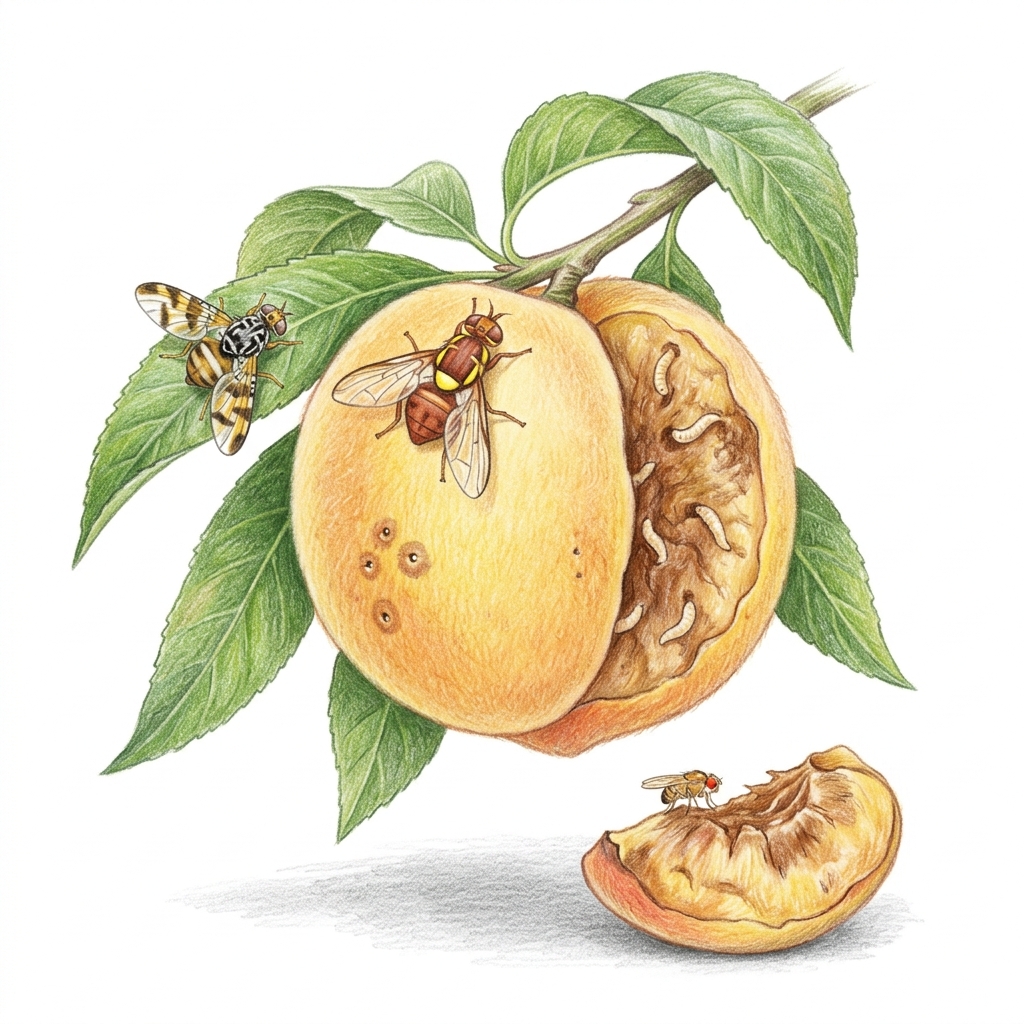
Maggots in ripening fruit are usually fruit fly: Queensland fruit fly in eastern Australia and Medfly in Western Australia sting the skin to lay eggs, and the fruit rots. Tiny flies around the fruit bowl are vinegar flies, which breed in overripe fruit.
How to spot it
- Small wasp-like flies on ripening fruit: Queensland fruit fly is red-brown with yellow marks and about 8 mm long; Medfly is smaller (3–5 mm), with a mottled black-and-silver back and banded wings.
- Tiny sting marks on the skin, with discoloured or bruised skin around them.
- Fruit that rots quickly.
- White, carrot-shaped maggots up to about 7 mm long tunnelling in the flesh.
Easily confused with
Vinegar flies (kitchen fruit flies)
Tiny, about 3 mm, often with bright red eyes; they breed in overripe and fallen fruit and fermenting food, not sound fruit on the tree.
Spotted-wing drosophila
A 2–3 mm vinegar fly whose males have a dark spot on each wing; it attacks healthy ripening soft fruit such as berries and cherries.
Codling moth
A caterpillar with a dark brown head, up to about 19 mm long, that tunnels to the core of apples and pears and leaves reddish-brown droppings at the hole.
Where it's a problem
- Eastern Australia: Queensland fruit fly is a native pest throughout eastern Australia. Central and eastern Australia are kept free of Medfly.
- Western Australia: Medfly is found through much of WA, from Carnarvon to Esperance. Queensland fruit fly is a declared pest that has been eradicated from Perth ten times since 1989: anyone who finds or suspects it must report it to DPIRD (MyPestGuide Reporter, or PaDIS on (08) 9368 3080). Outbreak areas have rules on moving fruit.
- Tasmania and South Australia: Tasmania and South Australia's Riverland are recognised fruit fly free areas. In Tasmania, if you find maggots in fruit, don't throw it out: seal it in a plastic bag or container, put it in the fridge and call Biosecurity Tasmania on (03) 6165 3777.
- Worldwide: Spotted-wing drosophila damages soft and stone fruit in Asia, Europe and the Americas. It isn't present in Australia and must be reported (Exotic Plant Pest Hotline 1800 084 881).
What to do
- Pick up fallen fruit and remove infested fruit from the tree regularly; don't let it build up under trees.
- Kill the maggots before binning the fruit: seal it in black plastic bags in the sun, or freeze it for at least 24 hours.
- Protect whole trees or single fruit with mosquito netting, shade-cloth or fine-mesh bags.
- Hang male lure traps in the shade of the canopy to see when flies are about.
- Remove unwanted fruit trees.
- For flies in the kitchen, remove overripe fruit and keep fruit in the fridge; a jar of cider vinegar with a drop of washing-up liquid will catch them.
If you use a bait or insecticide, choose one labelled for fruit fly and follow the label and local rules. Where fruit flies aren't established, such as Tasmania, report maggots in fruit and keep the fruit, rather than treating it or throwing it out.
Free account, no card needed. You sign up or sign in first, then the scanner opens.
Sources
- Business Queensland: Queensland fruit fly
- WA DPIRD: Queensland fruit fly, declared pest
- WA DPIRD: Mediterranean fruit fly
- NRE Tasmania: Fruit fly
- International Plant Protection Convention: Australia's fruit fly pest free areas
- Business Queensland: Spotted wing drosophila
- University of Maryland Extension: Fruit flies
Facts checked Sunday 27 September 2026. General guidance only: follow your local council, agency and product label.